
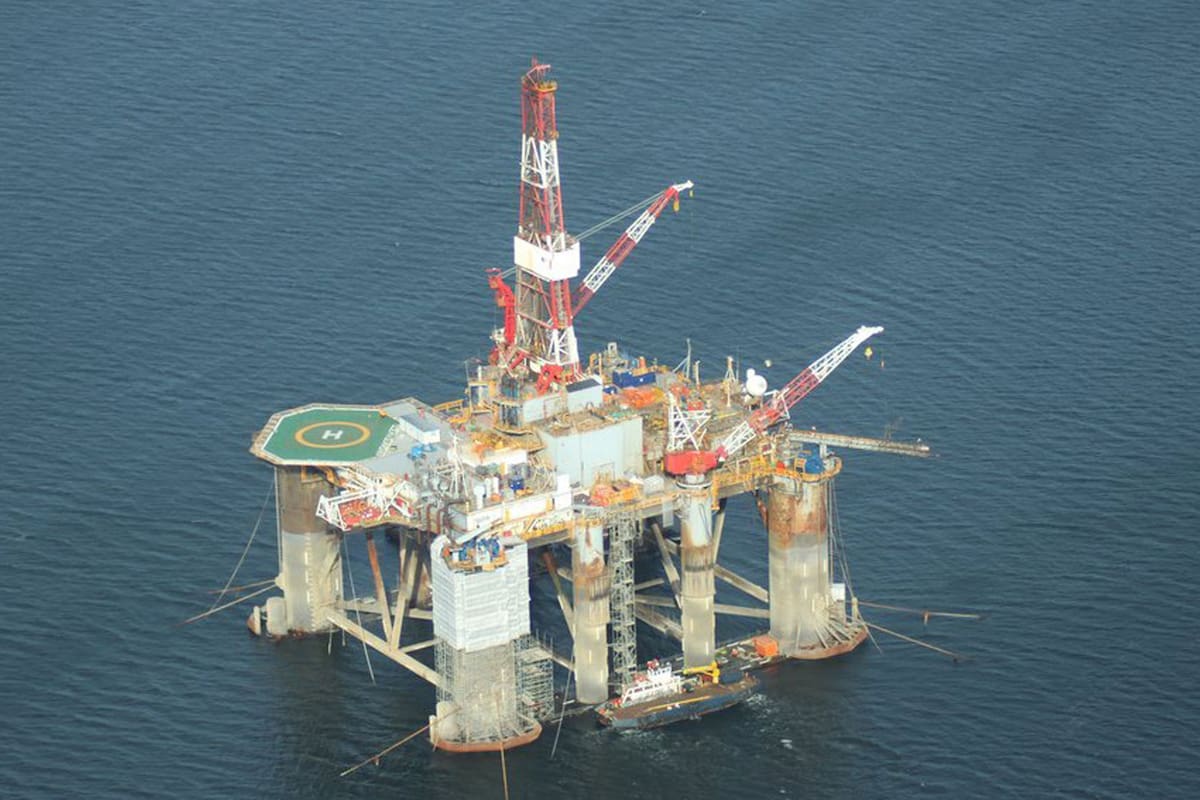
Oil exploitation in the Argentine Sea, 220 kilometers north of the Falkland Islands, is advancing with concrete steps. The Israeli company Navitas Petroleum acquired a floating production, storage, and offloading (FPSO) vessel, OSX-1, which will join the already acquired Aoka Mizu, with the aim of increasing production from 55,000 to 180,000 barrels per day by the end of the decade. The initial investment for this new platform was 125 million dollars, according to La Nación.
Meanwhile, the Argentine government, through the Foreign Ministry, filed a formal protest note on July 13 with the UK Embassy over the unnotified transit of the HMS Medway, illegally stationed in the islands, through Argentine territorial waters. This action was described as a violation of bilateral confidence-building commitments.
What does the purchase of the second platform mean for the Sea Lion project?
The acquisition of the FPSO OSX-1 by Navitas Petroleum, along with the agreement signed with Rockhopper Exploration to formally incorporate it, confirms that the Sea Lion project is a reality, not just a plan. The Aoka Mizu platform, according to the island legislature, is undergoing maintenance in Singapore, having been moved from the Middle East due to insecurity arising from the conflict with Iran. This detail, reported by La Nación, has not been confirmed by official sources, but it indicates the scale of the operation.
The total business plan, including port expansion and onshore works, amounts to 2.1 billion dollars. Navitas Petroleum holds 65% of the investment package, and Rockhopper Exploration the remaining 35%. Both companies were sanctioned in Argentina for operating illegally in its maritime territory in 2012 and 2022, and are therefore barred from commercial operations in the country.
What measures is the island government taking to manage the oil boom?
The island government suspended Permanent Residence Permits (PRP) for one year to review the population scheme, given the potential impact of the oil industry. Additionally, it will conduct a Population Census on October 18. The last census recorded 3,660 permanent residents, 331 with provisional residence permits, and 770 with work permits. The measure aims to count permanent residents and grant only work permits to those arriving attracted by the exploitation.
Infrastructure works include expanding the port complex and an operations plan to accommodate about 260 people, including technicians and workers. A hotel complex and a heliport will also be built. According to local legislator Dean Dent, barges for the new port structure will arrive from China in mid-2027.
What is the official Argentine position and what diplomatic actions has it taken?
The Argentine Foreign Ministry, on the instructions of Chancellor Quirno, filed a formal protest note on July 13 with the UK over the movements of HMS Medway. The protest is based on the violation of the Joint Declaration of September 25, 1991, which establishes confidence-building measures, and UN General Assembly Resolution 31/49, which urges the parties to refrain from modifying the situation while the sovereignty dispute is pending.
The Argentine government rejects these unilateral actions and reaffirms its sovereignty rights over the islands and surrounding maritime areas. The protest adds to a series of previous diplomatic actions, such as the December statement denouncing oil exploitation, although Javier Milei’s government has not included this issue on the official agendas of its meetings with Israeli authorities.
What differences and coincidences exist between the sources?
La Nación, as a secondary source, relies on information from the island legislature, the Merco Press portal, and statements by Navitas CEO Amit Kornhauser. It does not cite official Argentine documents. On the other hand, the Argentine Foreign Ministry, as a primary source, presents the text of the diplomatic protest, without mentioning oil exploitation. Both sources agree that there are unilateral actions by the UK, but they differ in focus: one centers on oil activity, the other on the military incursion.
La Nación mentions that the Argentine government issued a statement in December denouncing the exploitation, but does not detail its content. The Foreign Ministry makes no reference to that statement. Furthermore, the island source (via La Nación) projects royalty revenues of 90,000 pounds sterling per inhabitant and 350 million euros as a counterpart, but these figures are not confirmed by official Argentine sources.
What verifiable data and calculations can we derive?
- Initial investment for the FPSO OSX-1: 125 million dollars (La Nación).
- Projected production: 55,000 to 180,000 barrels per day by the end of the decade (La Nación).
- Total project investment: 2.1 billion dollars (La Nación).
- Shareholding: Navitas 65%, Rockhopper 35% (La Nación).
- Island population according to last census: 3,660 permanent residents (La Nación).
- Date of Argentine protest: July 13 (Foreign Ministry).
- Vessel involved: HMS Medway (Foreign Ministry).
Value module: Difference in projected production.
- Document: La Nación, August 28, 2026.
- Organization and date: Navitas Petroleum, 2026.
- Unit: Barrels per day.
- Values used: 55,000 (current production) and 180,000 (projection).
- Operation: 180,000 – 55,000 = 125,000 additional barrels per day.
This calculation shows the projected increase in production, evidencing the magnitude of the project. However, the exact date to reach that figure is not specified, only «by the end of the decade.»
What data or decision should be monitored?
It is advisable to monitor the evolution of the Argentine protest and whether the UK responds formally. It is also relevant to monitor the October 18 census in the islands, as it could alter the population composition and affect local dynamics. Additionally, it will be key to observe whether the Argentine government takes concrete measures beyond protest notes, such as activating sanctions or international legal actions, given that the companies involved are already sanctioned in the country.
Fuentes consultadas
- LA NACION
- Cancillería Argentina Fuente primaria
El Sereno contrastó las fuentes enlazadas y añadió contexto, comparación o análisis documental. Las fuentes primarias están identificadas. La nota no se presenta como investigación de campo ni como entrevista propia, salvo indicación expresa.



Comentarios