
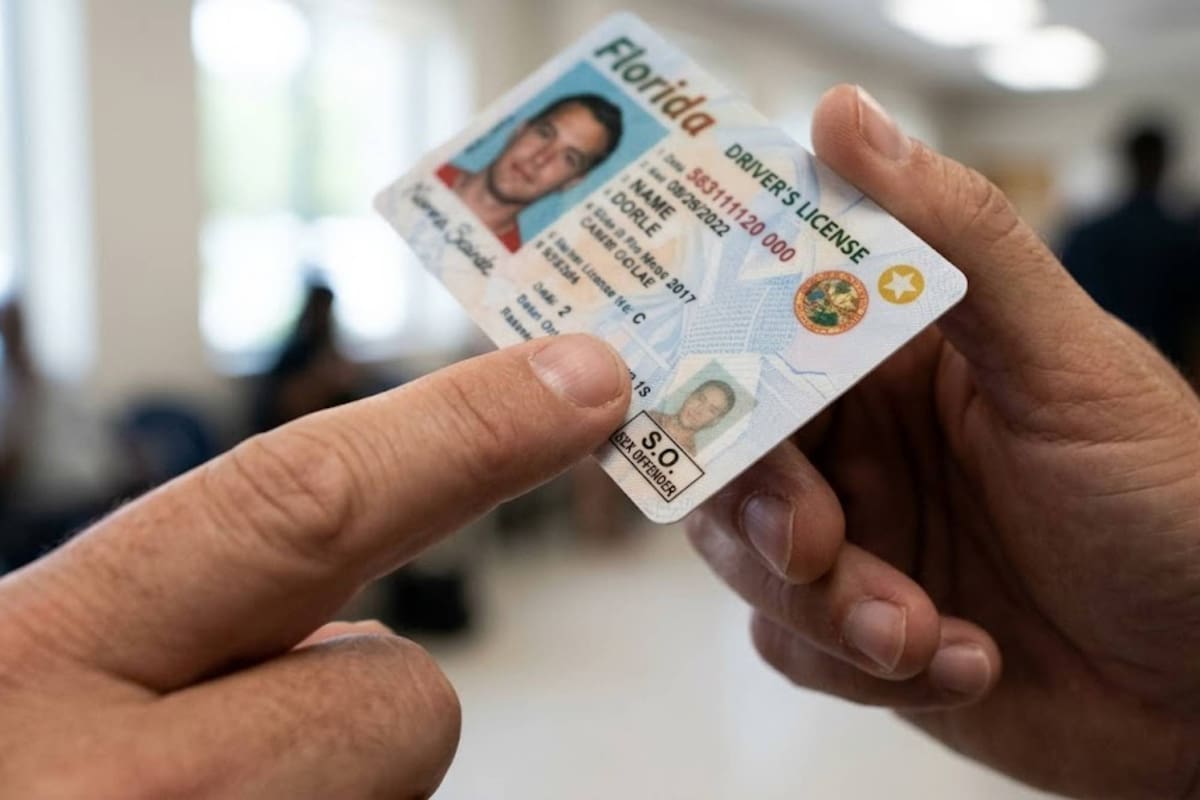
Florida’s legislature is advancing with bill SB 1332, which introduces changes in the supervision of people considered «career offenders.» The norm, which still must be enacted, establishes that driver’s licenses and identification cards of those registered in the state registry must bear on the front the reference «775.261, F.S.,» linked to the section of the code that regulates that registry.
Who is affected and what the mark implies
According to the legislative text, the measure affects more than 20,000 people in Florida. Among the groups included are those who have been convicted of certain serious crimes and have been released from prison on or after July 1, 2002. The provision covers both those who were in the custody of state penitentiary institutions and people released from federal prisons who meet the established criteria.
The mark on the document will allow authorities to quickly identify, during official checks, whether a person is subject to the registry’s obligations. SB 1332 also reinforces the obligation to keep data updated: the person must appear in person at an office of the Department of Highway Safety and Motor Vehicles (FLHSMV) within 48 hours after the start of their birth month to manage the documentation. In addition, they must report any permanent or temporary change of address within 48 hours, as well as notify of certain movements or temporary stays.
What changes in deadlines and reporting obligations
The law reduces the available deadlines to report movements and establishes requirements aimed at keeping the information of people included in the registry up to date. In this way, authorities would have data on residence, employment, and other aspects contemplated by the regulations. Governor Ron DeSantis, in a statement, noted that «this will improve coordination between local law enforcement and our state agencies, including our Department of Corrections, to ensure that this information about offenders is accurate.» He also added that «it increases accountability for offenders who do not comply with these requirements.»
Penalties for non-compliance and for collaboration
Failing to comply with the registry, omitting required information, or not obtaining the credential with the corresponding mark can constitute a third-degree felony. Each non-compliance will be considered an independent criminal offense, so the same person could face separate charges for different omissions. A third-degree felony in Florida can carry a penalty of up to five years in prison and a fine of up to $5,000.
There is also a provision with a higher penalty for certain cases related to changes of address. If a person reports that they plan to move, within or outside Florida, but ultimately does not make the reported move nor later provides a clarification, they could face a second-degree felony, which carries up to 15 years in prison and a fine of up to $10,000.
The proposal also establishes consequences for those who collaborate with a career offender with the aim of avoiding the planned controls. Hiding a person covered by the norm or providing false information to facilitate non-compliance can constitute a crime under the new rules.
Implementation timeline
- July 1, 2002: Deadline for the release of people who become covered by the registry, according to the text of SB 1332.
- Presentation of SB 1332: The bill is introduced in the Florida legislature, although the exact date is not specified in the sources.
- Legislative approval: The law is approved by both chambers, according to Governor DeSantis’s statement, who highlights it as an improvement in coordination.
- Enactment and entry into force: Once the governor signs the law, security agencies must prepare their databases to meet the technological requirements, and affected individuals must obtain the new credential.
Between each milestone, the main change is the transition from a registry without a visible mark on documents to the implementation of the mandatory reference, and the reduction of deadlines to update information.
What data to follow
It is advisable to follow the exact date of enactment of SB 1332 and the FLHSMV instructions on the process to obtain the new credential. It is also relevant to observe how security agencies adjust their databases and whether official guides are published for those affected.
Value module: Scope of the measure
| Concept | Data |
|---|---|
| People affected | More than 20,000 |
| Deadline to update personal data | 48 hours from the start of the birth month |
| Deadline to report changes of address | 48 hours from the change |
| Maximum penalty for third-degree felony | 5 years in prison and fine of up to US$5,000 |
| Maximum penalty for second-degree felony | 15 years in prison and fine of up to US$10,000 |
Document: Text of SB 1332 (primary source, cited by La Nación). Organization and date: Florida Legislature, no specific date in the source. Unit: People, US dollars, years, hours. Values used: Textual figures from the bill. Operation: No additional calculations are performed; data are transcribed as they appear in the source.
Fuentes consultadas
- LA NACION
- Argentina.gob.ar Fuente primaria
El Sereno contrastó las fuentes enlazadas y añadió contexto, comparación o análisis documental. Las fuentes primarias están identificadas. La nota no se presenta como investigación de campo ni como entrevista propia, salvo indicación expresa.



Comentarios