
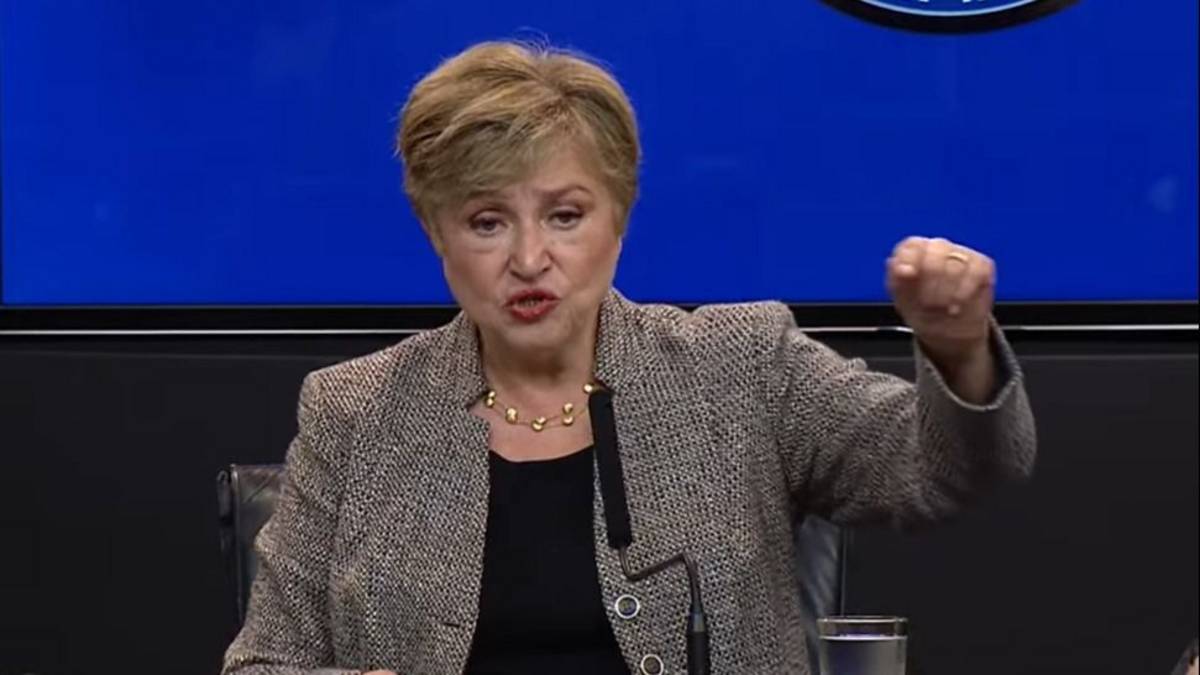
Kristalina Georgieva, Managing Director of the International Monetary Fund (IMF), backed the economic program of Javier Milei’s government during a press conference at the Ministry of Economy, but warned about the need to generate formal employment and strengthen small and medium-sized enterprises (SMEs). In parallel, the official IMF payment schedule, updated to June 30, 2026, shows that Argentina faces maturities of 2,082,529,842 SDRs in 2026, with a sharp increase starting in 2027.
Georgieva’s support and warnings
According to El Destape, Georgieva stated that the Argentine economy is in a more favorable macroeconomic position than in 2018, highlighting fiscal consolidation (moving from deficit to primary surplus), the slowdown of inflation (from 210% annually to around 30%), and the accumulation of international reserves (the BCRA bought more than USD 30 billion). However, the official warned that construction shows signs of stagnation and that informal employment is high. «We know that jobs need to be created so that there is consumption and more companies become prosperous,» she said. She also noted that growth is concentrated in sectors such as oil & gas, mining, and agriculture, and that the main challenge is to expand that dynamism to the rest of the economy.
IMF payment schedule
The IMF’s projected payment table, published on its official website, details Argentina’s maturities in SDRs (Special Drawing Rights). For 2026, total payments amount to 2,082,529,842 SDRs, including basic charges, surcharges, and capital repayments under the EFF agreement. The first maturities of the year are on August 1, 2026, with a total of 622,615,704 SDRs in charges and surcharges, followed by a capital repayment of 583,333,333 SDRs on September 25. In 2027, payments jump to 5,650,460,371 SDRs, with quarterly capital repayments. The heaviest burden is concentrated in 2028 (7,004,829,747 SDRs) and 2029 (7,792,755,072 SDRs).
What each source says and open questions
| Document / Source | What it states | What it does not state | Open questions |
|---|---|---|---|
| Georgieva’s statements (El Destape) | Backed the official program; highlighted fiscal improvement, inflation, and reserves; warned about informal employment and stagnation in construction; called for expanding growth to SMEs. | Does not quantify informal employment; does not detail timelines for job creation; does not mention new IMF disbursements or renegotiation of the agreement. | What concrete policies does the IMF propose for employment? When is growth expected to diversify? Will there be a new review of the agreement? |
| IMF payment schedule (as of 06/30/2026) | Argentina must pay 2,082,529,842 SDRs in 2026; maturities increase sharply from 2027; includes charges, surcharges, and capital repayments. | Does not indicate whether Argentina will be able to meet payments; does not include possible new loans or rescheduling; does not convert SDRs to dollars or pesos. | How will Argentina finance the growing maturities? Will the terms be renegotiated? What impact will it have on reserves? |
Value module: comparison of maturities 2026-2027
Document: IMF payment schedule (IMF Financial Data).
Organization and date: IMF, updated to June 30, 2026.
Unit: SDRs (Special Drawing Rights).
Values used: Total 2026: 2,082,529,842 SDRs; Total 2027: 5,650,460,371 SDRs.
Operation: Difference = 5,650,460,371 – 2,082,529,842 = 3,567,930,529 SDRs. The year-on-year increase is 171% (3,567,930,529 / 2,082,529,842 * 100).
Denominator: Total payments in 2026.
What to watch
It is key to monitor the evolution of the BCRA’s international reserves and monthly fiscal results, as they will determine Argentina’s ability to face the 2027 maturities, which more than double those of 2026. It is also relevant to follow discussions on a possible new agreement or rescheduling, as well as specific measures the government announces to promote formal employment and SME growth, as Georgieva pointed out.
Fuentes consultadas
- El Destape
- Fondo Monetario Internacional Fuente primaria
El Sereno contrastó las fuentes enlazadas y añadió contexto, comparación o análisis documental. Las fuentes primarias están identificadas. La nota no se presenta como investigación de campo ni como entrevista propia, salvo indicación expresa.



Comentarios