
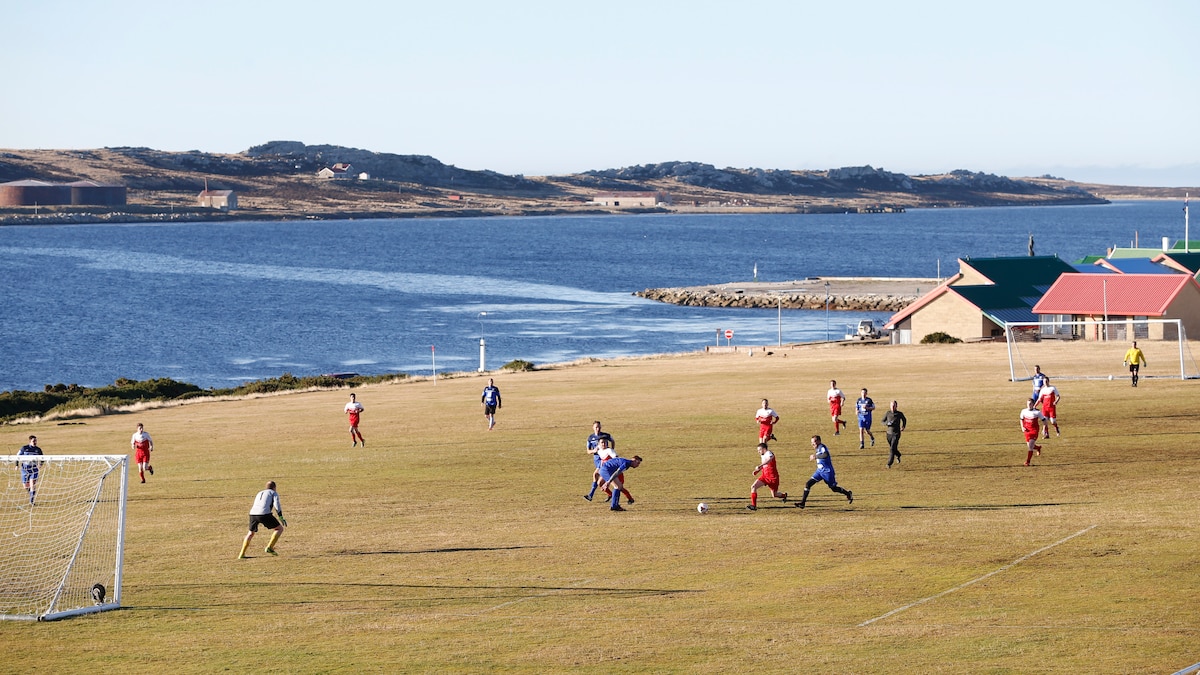
Argentina’s relationship with the Falkland Islands combines a long-standing sovereignty dispute with a cultural and emotional bond that has changed over time. Two recent documents allow us to trace that history: the column by the La Nación journalist who traveled to the archipelago three times, and the formal protest that the Foreign Ministry filed on July 13 over the transit of the British ship HMS Medway. Both materials, of different natures, coincide on one point: the Malvinas issue remains relevant, although with nuances worth clarifying.
La Nación column: a personal and critical view
The text published in La Nación, signed by a reporter who visited the islands on three occasions, offers an unusual perspective: that of an Argentine who knew the territory and its inhabitants up close. The author recounts that in 2000 he covered the visit of former Foreign Minister Guido Di Tella to Sea Lion Island and the Darwin cemetery, where Argentine soldiers rest. At that time, he says, Malvinas was «an open and even shameful wound.» Five years later, the film Illuminated by Fire (2005) presented the recruits as victims of the dictatorship, a critical view that contrasts with the current fervor.
The reporter also recalls that on his trips he was able to verify the existence of a shared history between the islands and Patagonia: the first sheep in Santa Cruz came from the archipelago, and the founders of Ushuaia in 1869 were Anglican missionaries who came from Malvinas. Until the 1982 war, the islands depended on Argentina for fuel, air connections, and medical services, according to his account.
The official protest: HMS Medway and the sovereignty dispute
For its part, the Argentine Foreign Ministry reported that on July 13 it filed a protest note with the United Kingdom Embassy over the movements of the ship HMS Medway, which it called «illegally stationed» in the islands. According to the official statement, those movements were not notified in accordance with current bilateral agreements, particularly the Joint Declaration of September 25, 1991, which establishes confidence-building measures. The protest argues that the British action violates UN General Assembly Resolution 31/49, which urges both parties to refrain from introducing unilateral modifications to the situation of the islands.
The official text reaffirms Argentina’s «legitimate and imprescriptible sovereignty rights» over Malvinas, South Georgia, and the South Sandwich Islands, and concludes with the phrase: «By history, by right, and by conviction, the Malvinas are Argentine.»
Coincidences and differences between the sources
Both sources address the Malvinas issue from different angles: one is a personal and journalistic reflection; the other, an official state position. They coincide in that the sovereignty dispute remains open and that the United Kingdom carries out unilateral actions that Argentina rejects. However, they differ in tone and content: the La Nación column does not mention the diplomatic protest or the HMS Medway, while the Foreign Ministry does not refer to the reporter’s trips or the shared cultural history.
It is important to note that the La Nación column is a secondary source, since it is an opinion article that does not cite official documents. The Foreign Ministry, on the other hand, is a primary source, as it disseminates the text of the protest. The column neither confirms nor denies the facts of the protest, and vice versa. They are independent materials that, read together, offer a broader panorama.
Chronology of a changing relationship
The documents allow us to reconstruct a sequence of milestones that show how the Argentine link with the islands evolved:
- April 2, 1982: the military dictatorship lands on Malvinas. The reporter recalls that the inhabitants of Stanley woke up with an army deployed. The war lasted until June 14 and left 649 Argentines dead.
- October 2000: former Foreign Minister Guido Di Tella visits the islands. The reporter covers it and describes the Darwin cemetery as a desolate place, with headstones that read «Argentine soldier known only to God.»
- 2005: Illuminated by Fire is released, a film that presents the soldiers as victims of the dictatorship. According to the reporter, that critical view contrasts with the current fervor.
- July 13, 2025: the Foreign Ministry files a formal protest over the passage of HMS Medway. The event shows that the dispute remains in force and that the Argentine government maintains a stance of rejection of unilateral British actions.
Between 1982 and 2025, the meaning of Malvinas for Argentina went from being a shameful wound to a symbol of national pride, as demonstrated by the fans’ chant at the 2022 Qatar World Cup: «For Malvinas, for Diego, for Leo’s last one.» The reporter notes that this fervor contrasts with the scant knowledge Argentines have of the islands and their history.
The name of Stanley: an example of complexity
The La Nación column devotes a passage to explaining why it used the British name «Stanley» in his novel. According to his account, the town was founded in 1845, when the British already controlled the islands, and it never had a previous Argentine name. The military dictatorship, which landed in 1982, only three weeks later made the name «Puerto Argentino» official through a decree. Before that, it had tried «Puerto Rivero» and «Puerto de la Isla Soledad.» This historical detail, which the reporter claims to have verified in chronicles of the time, shows that the naming of places is part of the symbolic dispute.
What to watch closely
The most relevant fact for the immediate future is the United Kingdom’s reaction to the Argentine protest. If London responds formally, a new diplomatic instance could open. It is also worth watching whether the Argentine government publishes more details about the movements of HMS Medway, such as maps or exact dates, and whether the international community, particularly the UN, issues any statement. On the cultural front, it will be interesting to see if the debate over the name of the islands, which the La Nación column reignited, generates new public discussions.
Value module: comparison of dates and contexts
| Document | Organization and date | Unit | Values used | Operation |
|---|---|---|---|---|
| La Nación column | La Nación, August 17, 2026 | Years elapsed | 1982, 2000, 2005, 2026 | Difference between 1982 and 2026: 44 years |
| Foreign Ministry protest | Argentine Foreign Ministry, July 13, 2025 | Days since protest | July 13, 2025 and August 17, 2026 | Difference: 400 days (approx.) |
Note: the dates correspond to the original publications. No currency or unit conversions were performed.
Fuentes consultadas
- LA NACION
- Cancillería Argentina Fuente primaria
El Sereno contrastó las fuentes enlazadas y añadió contexto, comparación o análisis documental. Las fuentes primarias están identificadas. La nota no se presenta como investigación de campo ni como entrevista propia, salvo indicación expresa.



Comentarios