
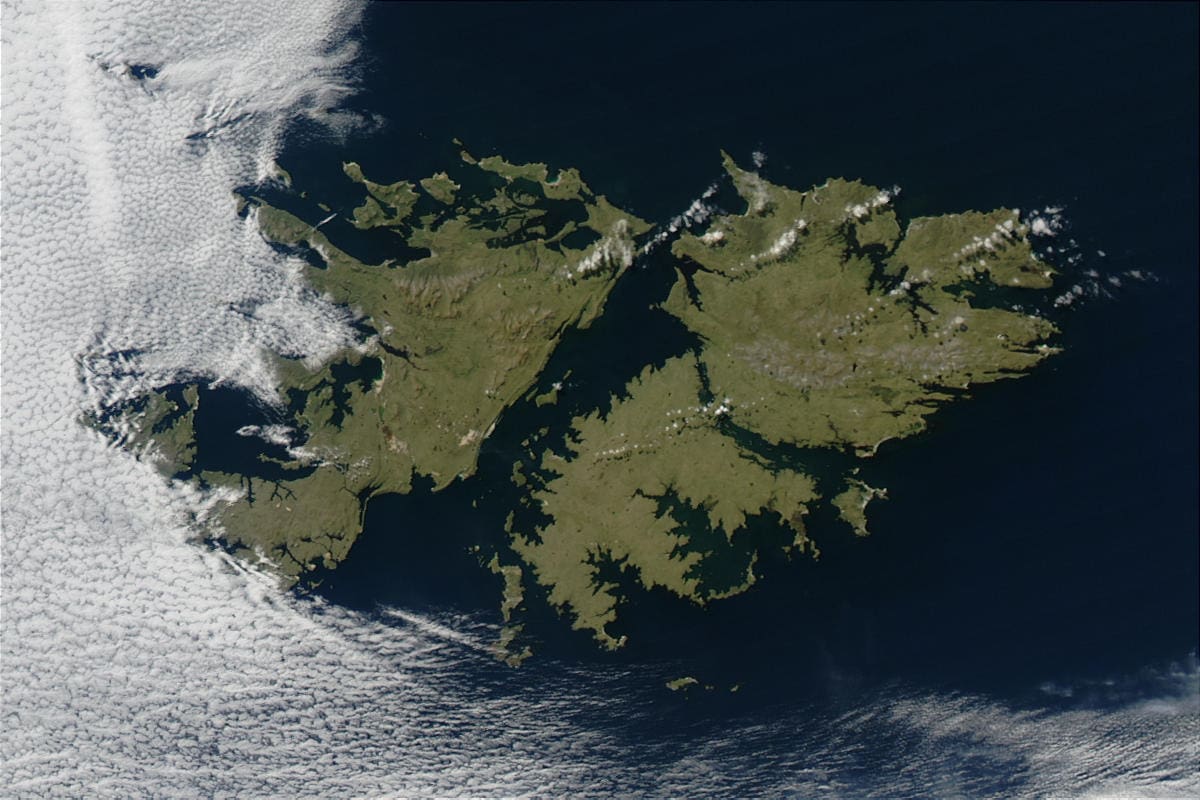
The dispute over the Falkland Islands adds a new diplomatic chapter while the advancement of large-scale economic activities in the South Atlantic is being debated. A formal Argentine protest over movements of a British military vessel and a journalistic analysis of aquaculture, fishing, and hydrocarbon projects shape a scenario where sovereignty and economic development appear intertwined.
The protest over HMS Medway and bilateral agreements
On July 13, on the instructions of Foreign Minister Quirno, Argentina submitted a formal note of protest to the Embassy of the United Kingdom. According to the official statement, the movements of the vessel HMS Medway, deployed in the Falkland Islands, were rejected because they were not notified in accordance with current agreements and involved transit through Argentine territorial waters.
The Foreign Ministry maintained that this unilateral action violates the Joint Declaration of September 25, 1991, which replaces annexes of the Madrid Declaration of February 15, 1990, in its section on confidence-building measures. The Argentine government described the incursion as incompatible with United Nations resolutions and with the duty of both parties to refrain from altering the situation while the sovereignty dispute remains pending.
The fishing legal framework and resolution 31/49
The journalistic source reviews that fishing constitutes the backbone of the Falklands economy, with 58.3% nominal of its income. In response to the exploitation of fishing resources, Argentina built a legal framework that does not merely disregard licenses granted under British administration: it also establishes consequences within the national fishing system.
In 2008, Law 26.386 amended the Federal Fishing Regime. Those who access Argentine quotas or authorizations must lack certain legal, economic, or profit relationships with owners or shipowners of vessels that fish in waters under Argentine jurisdiction without national permission. Once incompatibility is verified, permits, quotas, or authorizations automatically expire.
Both sources agree in invoking resolution 31/49 of the UN General Assembly, which calls on the parties to refrain from introducing unilateral modifications while the process related to the sovereignty dispute continues. The Foreign Ministry mentions it as the framework for the claim regarding the vessel; the article links it to the exploitation of natural resources.
Hydrocarbons and aquaculture: two projects under discussion
The journalistic text describes that in addition to the Sea Lion oil project, located north of the Islands on the maritime shelf, a third large-scale activity is added: the Unity Marine project to produce up to 50,000 tons per year of Atlantic salmon, valued at US$600 million annually, through a partnership between a fishing company based in the Islands and Danish capital.
For fishing and hydrocarbons, the source notes, instruments were built aimed at companies operating without national authorization. Aquaculture, on the other hand, introduces a different variable: it does not capture existing biomass nor extract from natural deposits, but rather is produced with an agro-industrial logic and requires controlled planning, infrastructure, and permanence in the territory.
The article cites that Chile generated more than US$7.8 billion from aquaculture in the last year, as a dimension of the activity. This is not a direct comparison with the Falklands, but a reference of scale.
Timeline of milestones and changing scenarios
- February 15, 1990: Madrid Joint Declaration, whose annexes are later replaced by the 1991 Declaration. It establishes confidence-building measures in the military sphere.
- September 25, 1991: Joint Declaration that replaces annexes I, II, III, and IV of the Madrid Declaration. The Foreign Ministry invokes it as the framework violated by the movements of HMS Medway.
- July 12, 1993: Buenos Aires and London Joint Declaration that updates the text of section I.2 on confidence measures, as cited by the Foreign Ministry.
- 2008: Law 26.386 amends the Federal Fishing Regime and incorporates consequences for those who maintain economic relations with vessels that fish without Argentine permission.
- July 13 (year not specified in the source): Argentine formal protest to the Embassy of the United Kingdom over the movements of HMS Medway.
Between the first milestone and the last, the central change is that the sovereignty dispute is intertwined with specific legal and economic instruments: first fishing, then hydrocarbons, and now aquaculture as a possible third large-scale activity.
What data or decision should be followed
Monitoring should focus on whether Argentina extends to aquaculture the same legal criteria applied to fishing and hydrocarbons, and on how the United Kingdom responds to the protest over HMS Medway. It is also important to verify whether the Unity Marine project moves forward with authorizations under British administration and whether this generates a new formal controversy.
Value module: cited economic dimension
| Document | Body and date | Unit | Values used | Operation |
|---|---|---|---|---|
| Journalistic article | La Nación, October 5, 2026 | Nominal percentage | 58.3% of fishing income | Cited data, not calculated |
| Journalistic article | La Nación, October 5, 2026 | Millions of dollars | US$600 million annually | Estimated value of the Unity Marine project |
| Journalistic article | La Nación, October 5, 2026 | Tons per year | 50,000 tons | Maximum planned salmon production |
| Journalistic article | La Nación, October 5, 2026 | Millions of dollars | US$7.8 billion | Value generated by aquaculture in Chile, cited data |
No currencies or units are converted because the material does not include exchange rates or conversion factors with exact dates. Original units are preserved.
Fuentes consultadas
- LA NACION
- Cancillería Argentina Fuente primaria
El Sereno contrastó las fuentes enlazadas y añadió contexto, comparación o análisis documental. Las fuentes primarias están identificadas. La nota no se presenta como investigación de campo ni como entrevista propia, salvo indicación expresa.


Comentarios