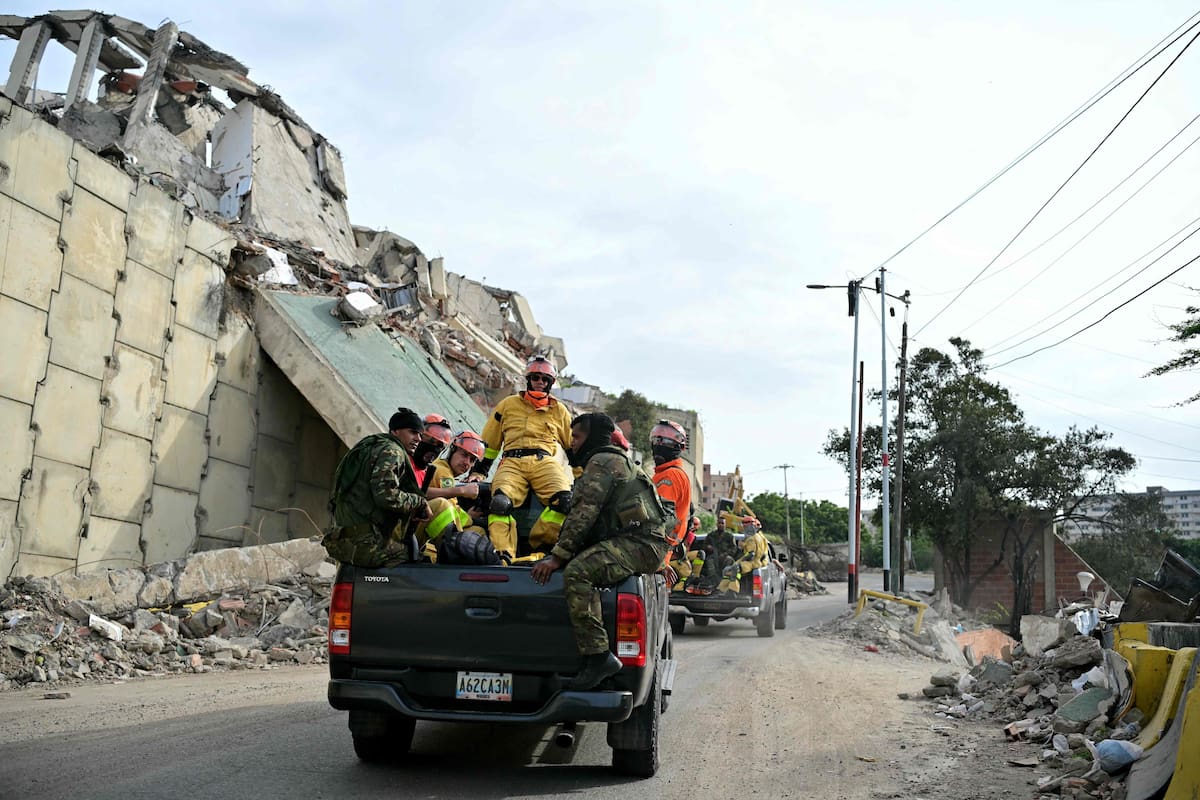
CARACAS.– In Playa Grande, a few meters from what was once the Marriott Hotel in La Guaira, what strikes you most is seen, and also smelled. The mask is not enough. It barely helps filter a thick air, the smell of decomposing bodies, which seeps in through the sides anyway. After a few minutes, the smell ceases to be a surprise and becomes something constant. It comes and goes, but never fully leaves. It accompanies every step through the streets of the city hardest hit by the earthquake.
On Saturday, a team from El Sereno toured the disaster zone with a group of Venezuelan volunteers who supply food and essential items to the churches that remain «down below,» as they call the area of La Guaira near the sea. The trip from Caracas down takes about 50 minutes and crosses different landscapes. As you approach the coast, you see entire neighborhoods where the landscape seems suspended in the exact moment the earth decided to move.
There are buildings still standing, but few. Others are left open as if someone had ripped a wall off in one pull, leaving bedrooms, kitchens, and dining rooms exposed to the street. From outside, you can see beds still made, open closets, children’s toys, family photos, and paintings still hanging on a wall that no longer belongs to any house. The earthquake turned the private lives of thousands of families into an open-air stage.
In some areas, buildings did not collapse downward but sideways. Walls are piled on top of each other like a deck of cards someone dropped on the floor. Among concrete blocks, pipes, twisted rebar, and fragments of stairs protrude. Facing the sea, a multi-story building remains mutilated on the edge of the cliff. «It’s half a building,» says one of the volunteers. Next to it, what seemed to be a hotel had a pool that collapsed into the void.
In the midst of this tragic geography, signs appear that speak of those who are no longer there. On a huge black wall, someone wrote in white paint: «Samara we love you.» A message addressed to a person who will never read it again. In different parts of the city, relatives leave phrases written directly on the remains of the buildings where they believe their loved ones are trapped.
The walls also tell another story. Many have been marked with paint by the teams that tour the area. A «D» indicates that there are still bodies inside the structure. A «C» indicates that those bodies have already been recovered. They are simple letters, painted by hand, but they are enough to completely change the meaning of a house and serve as a guide for international volunteers working tirelessly to find survivors.
However, not all inscriptions speak of death. Some express the urgency of those who are still alive and have no one to turn to. On cracked facades, requests appear written in spray paint: «We need food,» «We need medicine.» In many neighborhoods, the walls function as a bulletin board for those arriving with humanitarian aid.
The volunteers know these marks by heart. With trucks loaded with food, drinking water, diapers, and medicine, they travel through streets where it is still difficult to distinguish which buildings can be saved and which will end up demolished. Each stop involves unloading boxes and continuing on to the next neighborhood. The demand seems endless.
There are scenes that are hard to forget. A brick house was split exactly in half. From the street, you can still see the unmade bed, the piled-up clothes, the washing machine, the stove, and a crack running through the floor. It looks like a set made on purpose to explain the damage an earthquake can do. But it is someone’s home.
At 6:30 in the evening, the sun begins to set, but darkness cannot hide the destruction. Rescuers continue working. Relatives stay near the safety tape, waiting and praying. And the smell, that which greets anyone arriving for the first time, remains stagnant over the city as a permanent reminder that, beneath many of those mountains of concrete, the tragedy is not over yet.



Para mí esto huele a la derecha de siempre, dejando escombros y muerte mientras se llenan los bolsillos. Mensajes desesperados en las paredes y ellos ni ahí. Basta de hipocresía, los únicos responsables son estos cómplices del hambre. ¡Qué bronca!
Para mí esto huele a teatro montado por los zurdos. El doble terremoto fue un castigo divino por tener un gobierno comunista de mierda. Yo creo que los que votaron a Maduro se tienen que joder. ¡Basta de lloriqueos! Venezuela necesita orden y patria, no llantos de estos comunistas.