
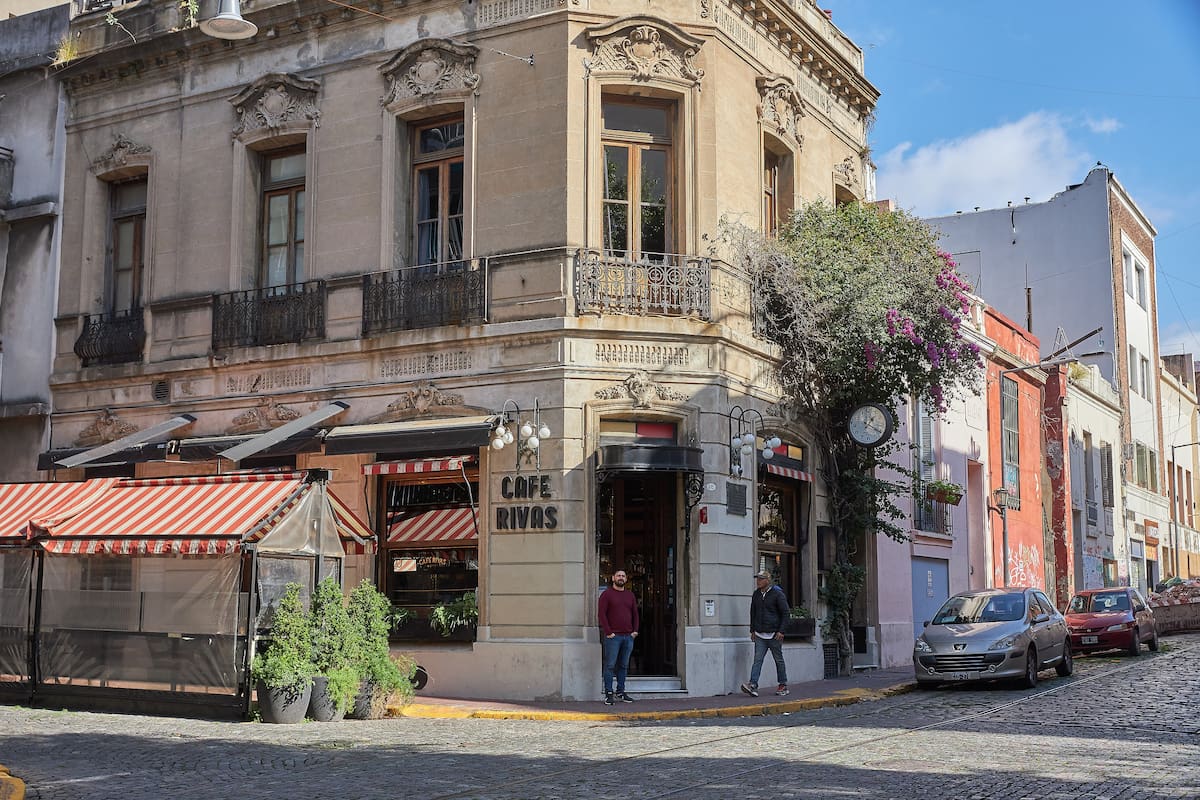
In San Telmo, a historic house breathed again after a meticulous restoration process that restored layers, gestures, and atmospheres of one of the city’s notable bars. The recovery of Café Rivas looked to nostalgia as an architectural method, with the idea of restoring so that time could flow again.
Buenos Aires built much of its urban identity around bars. Long before gastronomy became a spectacle, cafés were an extension of public space, civic architecture on a domestic scale, a climatic and social refuge, a stage for political, literary, and everyday discussions. Buenos Aires learned to narrate itself among wood paneling, marble counters, stained glass, beveled mirrors, and warm light lamps. This tradition did not respond to fashions but to a way of inhabiting the city, a typology that consolidated as living heritage.
San Telmo preserves some of the most eloquent pieces of that architecture of encounter. Corners that still maintain original proportions, generous heights, sash windows, wrought iron marquees. In this historic fabric, the corner of Estados Unidos and Balcarce holds a singular place. There, the original layout of Buenos Aires stopped in 1580, at the edge of the ravine overlooking the river. That liminal, almost symbolic point has housed Café Rivas since 1967, one of the notable bars that best condensed the cultural life of the neighborhood.
The building, an old house on a chamfered corner, dialogues with its surroundings through architecture. Metal marquee, large windows, hanging clock, Santa Rita climbing over the facade, signs of an urban continuity that survived transformations and closures.
The interior offers a double-height hall, wooden floors, perimeter wood paneling, a longitudinal bar that structures the space, and a mezzanine with lattice railings that overlooks the main scene. Each element built, over decades, a recognizable atmosphere.
The passage of time, however, was not always kind. Partial interventions, changes in criteria, urgent repairs, and isolated decisions gradually blurred the original identity. The challenge assumed by the new recovery process was not to reinvent the place, but to read it with surgical attention. “The space was always beautiful,” summarizes Lupe Unamuno, partner of the project and responsible for the restoration, “but the accumulated layers had fragmented its coherence; the decision was to return it to its essence and bring it back to 1967.”
The restoration involved a patient and deeply artisanal task. The original wood paneling was fully recovered, unified in tone and texture after years of disparate treatments. This work required partial disassembly, manual cleaning, surface consolidation, and a chromatic choice that respected the patina without falsifying it. “Each section of wood had a different history; it was necessary to read them one by one so they could speak the same language again,” explains Unamuno.
The selection of textiles demanded a similar level of dedication. Upholstery and armchairs had to match the era without falling into literal reproduction. “Getting the fabrics was a long and complex process; we wanted materials that would dialogue with the architecture, not simple replacements,” says Unamuno, alluding to a search that prioritized quality, texture, and durability over explicit origins.
Lighting functioned as a central chapter of the recovery. Vintage pieces from the 60s and 70s were incorporated with curatorial criteria: space-age aesthetic lamps, table lamps, and period fixtures that now coexist with the original chandeliers in the hall. “Lighting had to tell a continuous story, not compete with what existed,” Unamuno adds. Beveled mirrors on the sides amplify the warm light and multiply reflections, reinforcing an intimate atmosphere that invites lingering.
The process included a spatial reinterpretation of the link between kitchen and bar. An area previously saturated with elements was freed to make way for an open kitchen, visible, visually integrated into the hall. This decision responds not to a gastronomic trend but to an architectural operation of perceptual expansion. “Opening the kitchen allowed the space to breathe better and the hall to regain depth,” explains Unamuno.
The tableware also participates in the architectural narrative. Vintage pieces, butter dishes, plates, cocktail glasses, objects that reinforce the material continuity of the whole. “It wasn’t about decorating but about completing a coherent system,” Unamuno maintains, emphasizing that “the restoration was conceived as a whole, from the walls to the smallest objects.”
The visual identity accompanied that criterion. Logos, typographies, and colors were unified to sustain the original spirit without affectation. The result sought to reactivate a built memory. Café Rivas began to function again as what it always was: a fragment of the city where architecture sustains collective experience.
The recovery of this notable bar demonstrates that “heritage conservation is not an exercise in nostalgia but an act of urban responsibility,” concludes Unamuno. “Restoring implies understanding, choosing, renouncing, and above all, respecting.” In a city that changes its skin quickly, operations like this restore more than a building; they return a way of being, of looking, and of meeting. At the corner where Buenos Aires began, architecture tells its story again in the present tense.


q lindo q resucite el cafe rivas pero para mi estos zurdos de mierda lo van a cerrar de vuelta con sus paros los 60 eran otros tiempos con patria y orden viva la libertad carajo firmado el gaucho
Para mí esto es un verso de la clase alta. Restauran un café para chetos mientras la gente se muere de hambre. Lindos vitrales burgueses para tapar la mugre del sistema. Devuelvan los comedores populares, no esta nostalgia de mierda. ¡Viva la lucha! ✊