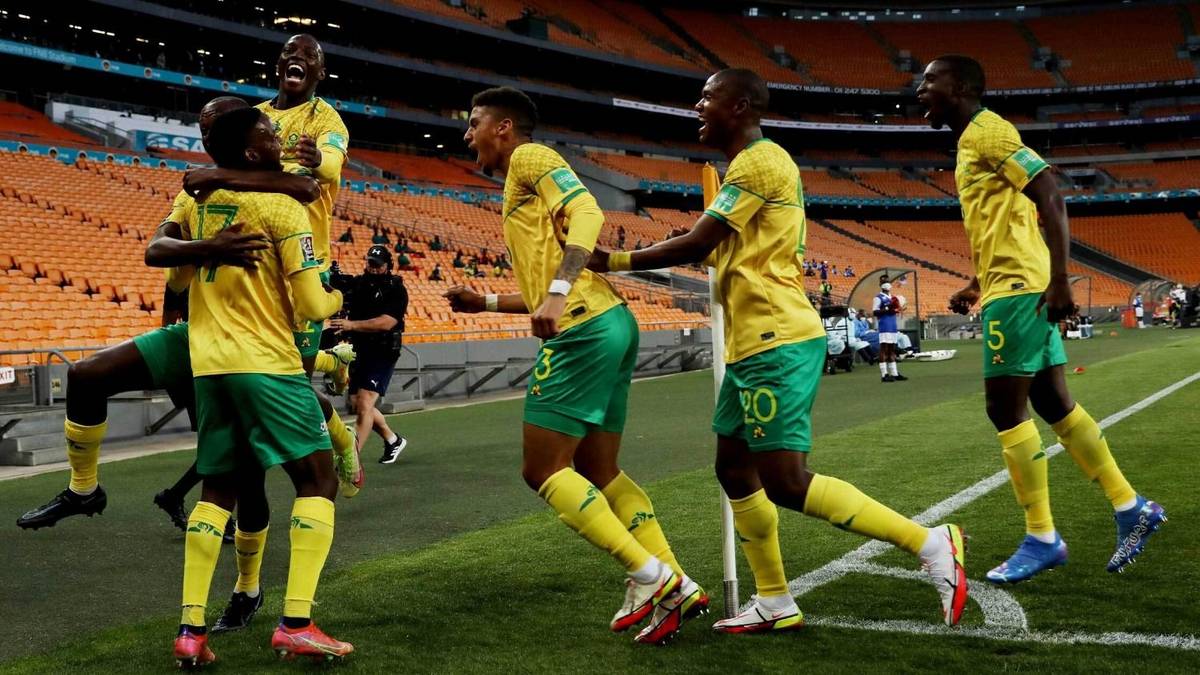
A twist of fate wanted this World Cup to open with a match we already know. Back then, South Africa and Mexico inaugurated the first World Cup played in Africa on June 11, 2010, at Soccer City Stadium in Johannesburg. From that 1-1 draw and what followed, we all remember the same images: Siphiwe Tshabalala’s great goal, who blasted the Mexican goal with a left-footed cross shot that remains the most remembered goal in Bafana Bafana history. It also marked the start of a chaotic tournament, with the constant buzz of vuvuzelas as a soundtrack, the «Jabulani» that only Forlán seemed to master, and a tournament that ended with an unprecedented champion.
Sixteen years later, in its return to a World Cup after that edition, the scenario repeats itself although now South Africa arrives as a visitor, where Mexico will return the favor at the iconic Estadio Azteca. But it is not the same South Africa that faced Mexico in that Cup and the one that will do so now. The country returning to a World Cup no longer relies on the epic of being the host, but on a concrete structure that explains a good part of what this national team is today and much of what happens beyond its borders. That structure has a name: Mamelodi Sundowns.
Of the twenty-six players called up by Broos, eight belong to the Pretoria club, most of them starters, and another two players were formed at the club and played until last season. In 2010, this same team contributed four players. The curve is not coincidental. It is impossible to understand, not only South African football, but current African football, without talking about the Masandawana.
The club is no newcomer by any means. It was born in the townships of Pretoria, the segregated neighborhoods created by the apartheid regime, in the early 1960s. At that time, «black» football competed in parallel leagues that the regime tolerated because it kept them separate from official and, obviously, white football. They played on dirt fields, without stands, without cash prizes, before crowds crowded along the sidelines. Its footballers were much more talented than the league’s professionals. To the point that the ban could not last long because white teams played «secret» friendlies against those teams, or forced the federation to allow them to hire these players.
From those fields scattered across South Africa emerged «kasi flava,» the football of individual creativity and tricks that prioritized spectacle over results, a form of cultural resistance in a country that denied most of its population almost everything else. From those neighborhoods, some teams began to stand out. From the Soweto Township, Orlando Pirates first emerged, and in the 1970s, after a split within the club itself, Kaizer Chiefs. In Pretoria, it was Mamelodi that elevated that football to the category of art with its own stamp, «shoe shine and piano»: brilliant touches like polished shoes and delicate passes like playing a piano.
The identity leap came in the mid-1980s, under the leadership of the extravagant businessman Zola Mahobe, who began paying real professional salaries to black players and adopted the yellow, green, and blue of the Brazilian national team. Sundowns renamed itself «the Brazilians,» and the nickname was a declaration of principles, as they found in the traditional Brazilian «jogo bonito» a mirror to reflect themselves. Playing beautifully as a way of existing. Titles came quickly, although Mahobe’s adventure ended in scandal when it was discovered that he financed the project with stolen money. The seed, however, was planted.
During the following decades, the club was important without being hegemonic, always one step behind the two giants of Soweto, which concentrated the masses of Johannesburg and monopolized the conversation of South African football. That hierarchy was completely overturned in a two-stage movement. In 2004, Patrice Motsepe bought 51% of the share package and began a transformation that took almost a decade to crystallize. Born in 1962 in Soweto, he was the son of merchants who, despite apartheid restrictions, managed to send him to a private Catholic school and later to study law. With just a few years of life, his family moved to Pretoria, and from that moment he became a fan of Mamelodi Sundowns.
He became the first black partner of a South African law firm and, in the late 1990s, took advantage of the fall in the price of gold to buy mines at low cost and found African Rainbow Minerals, the germ of an empire that would encompass gold, platinum, iron, and coal. In 2008, he became the first black African to enter Forbes’ billionaire list, with a fortune that today hovers around three billion dollars. His weight far exceeds sports: brother-in-law of South African President Cyril Ramaphosa, he embodies the new black elite that emerged from the end of apartheid. When he bought Mamelodi, he did not come to play at being a club president, but with the resources and mindset to turn a Pretoria team into a winning enterprise.
Motsepe’s start as club president was promising but uneven: a title in 2006 with a technical duo that included Argentine Miguel Ángel Gamondi, another in the following season under Gordon Igesund, and a close approach to the championship in 2009 with Hristo Stoichkov on the bench, which ended second. Then came opaque years, without performances that rounded out. The club had money and ambition, but had not yet found the formula.
Everything changed at the end of 2012, when Motsepe hired Pitso Mosimane and, ahead of the 2013 season, made a strong investment in the best players of the local league. Mosimane, nicknamed «Jingles,» is the most important proper name in the recent history of South African football. Born in 1964 in Kagiso, a township west of Johannesburg, he was a footballer before a coach: a national team midfielder, he wore the shirts of Jomo Cosmos, Sundowns itself, and Orlando Pirates, and emigrated to Greek, Belgian, and Qatari football in the years when a South African rarely crossed the ocean. As a coach, he forged himself at SuperSport United, where he won three consecutive leagues, and coached Bafana Bafana between 2010 and 2012, just before landing in Pretoria. At Mamelodi, he built the team that broke the mold: eight years in charge, five local titles, countless cups, and above all, the club’s first CAF Champions League in 2016, won in Alexandria against Zamalek.
Mosimane showed that a homegrown African coach could conquer the continent without going through Europe, and his stamp was not only tactical: he combined high pressing and modern circulation with the creativity inherited from the townships, a sophisticated version of the kasi flava that the club never abandoned. His prestige transcended South Africa. In 2020, he was hired by Egyptian Al-Ahly, the most decorated club in Africa, and there he won two more African Champions Leagues in just over a year, a mark that placed him among the most respected coaches on the continent.
Today, South Africa returns to a World Cup wearing the Bafana Bafana jersey, but with the soul of Mamelodi Sundowns. The sensation team that was born in the townships, grew up amid discrimination and poverty, and became an empire thanks to the vision of a millionaire and the genius of a local coach. The story of a country that, like its national team, never stopped fighting.
Watch the 2026 World Cup in the best quality
These are the most sought-after TVs to watch the National Team. All with 12 interest-free installments:
- Smart TV Kanji 32″ LED HD – From $120,000 in 12 interest-free installments (VAFTS9-89J3)
- Smart TV LG 43″ 4K UHD WebOS – From $450,000 in 12 interest-free installments (VAFTS9-WXW9)
- Smart TV Samsung 50″ 4K UHD – From $600,000 in 12 interest-free installments (VAFTS9-VVE0)
Approximate prices. 12 interest-free installments subject to each seller. Look for the codes on Mercado Libre.
Para mí esto es puro verso, vuelven los sudafricanos pero con la guita de los Sundowns, los mismos negros que antes pedían limosna. Me parece un marketing berreta, nos venden el cuento de los townships cuando es un equipo de millonarios. Encima les dan bola a estos y después lloran que no hay patria. Yo creo que dejen de joder y vuelvan a laburar.
para mi sudafrica vuelve al mundial pero ojo este equipo es de los townships de los negros q el apartheid quiso borrar mamelodi sundowns del pueblo y pa el pueblo mientras los fifas se llenan los bolsillos estos pibes juegan con hambre de justicia vamos bafana bafana q la copa sea de los de abajo los ricos lloran ja