
Uruguay’s premature elimination in this World Cup led analysts in the neighboring country to conclude that tradition and history do not win matches or titles. Just 72 hours later, Brazil responded that they cannot be achieved without character, persistence, and at least a few drops of good football.
The team coached by Carlo Ancelotti is far from being a marvel. It is hard to find in their game similarities with those teams that dazzled with pure touch and creativity, but they retain in some players enough technique to get through difficult moments; and in the jersey, the strength that instills pride in those who wear it and fear in those who face it. In a world where footballing distances have narrowed to almost disappearing, these arguments still allow them to come back from adverse results, like the one the Canarinha took to the dressing room at halftime, beating a tough rival like Japan 2-1 and continuing their quest for that sixth star denied since 2002.
Carletto’s Verdeamarela has a predictable structure. A holding midfielder – Casemiro -, a box-to-box – Bruno Guimarães -, one with more freedom – Lucas Paquetá -, two wingers – Rayan and Vinicius Jr -, a striker – Matheus Cunha -, whose mobility and dropping deep is the only variable compared to what they were doing in the South American qualifiers, Danilo’s contribution on the right when he joins the attack, and crosses for the heads of the center-backs or Casemiro. Plus, of course, whatever those most skilled with the ball can invent on their own.
It sounds like little in a mechanized, dynamic football that favors remote-controlled movements to disrupt opposing defenses and avoid problems at the back. But for now it works, even though for 45 minutes Japan reduced their attacking efficiency to a minimum and exposed their defensive fragility in a couple of actions, with the goal being the most evident indicator.
At 29 minutes, Kaishu Sano intercepted a horizontal pass from Danilo in midfield, accelerated to leave Casemiro behind, and found no more obstacles until the edge of the D. The center-backs retreated, inviting him to shoot from distance, Alisson Becker did not advance enough to cut off the possible trajectory of the cross-shot, Sano struck low, the ball curled towards the right post, the goalkeeper’s save fell short, and it was 1-0.
They had to wait until the second half for those differences that still exist between countries with football tradition and those without to come to light, with personality and well-understood anger.
Back in 2005, the Japan Football Association made a decision: to host a World Cup to win it. The immediate one? The next one? Not at all. In the Far East, planning is always very long-term. They set their sights on 2050 and studied all the steps necessary to achieve that goal.
The Japan’s Way, as they named it, proposes, among other things, the creation of a football culture of their own, adapted to local idiosyncrasies, and a style of play that takes advantage of the natural physical conditions of the Japanese ethnicity and compensates for the disadvantages in height, weight, or build of Africans, Europeans, and South Americans.
In this last aspect, the table legs are aggressiveness, speed, agility, endurance, and muscle development. The Japanese have been on this path for the first quarter-century, but this new defeat in a World Cup playoff match showed they still have tasks ahead for the second quarter. Not so much in refining tactics or individual technique, but in the psychological aspect, where they continue to accumulate their biggest deficit, and which in Houston cost them another frustration (they lost on penalties in 2010 and 2022, and with a goal in stoppage time in 2018).
Brazil came out determined from the dressing room in the second half, began to fill Suzuki’s area with crosses, and won headers. They came close to scoring in the first two, and did not miss on the third: Gabriel Magalhães, with no one bothering him, sent in a cross and Casemiro equalized in the 9th minute.
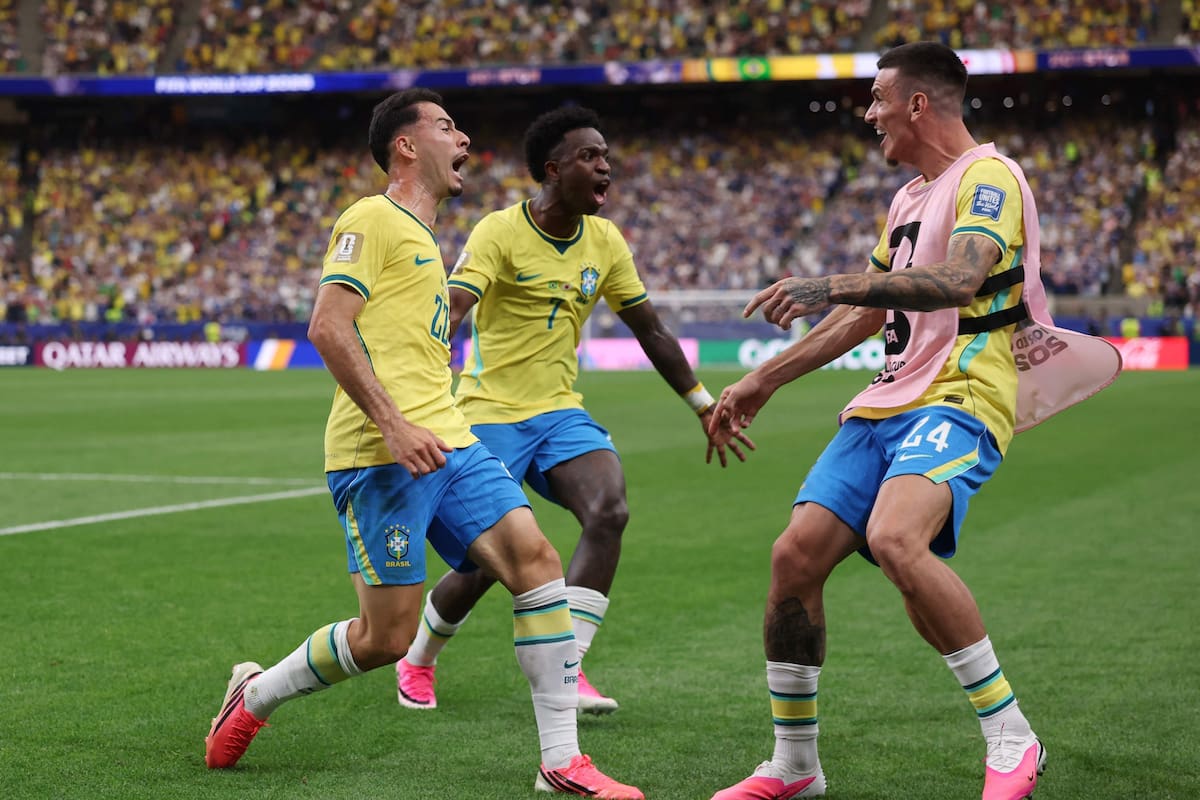
What happened from that moment on made it clear that, beneath the game plans, ancestral reasons can underlie a match’s outcome. Brazil felt victory was theirs and went forward. With few ideas and limited danger, but asserting the weight of their history. For Japan, excessive respect tied their legs and removed any hint of rebellion. They dedicated themselves to holding on and waiting for extra time. In stoppage time, Ao Tanaka lost the ball at the right corner of the area, Rayan stole it and passed to Guimarães, who laid it off to Gabriel Martinelli. A specialist in last-gasp celebrations at his club, the Arsenal player controlled it with his left and finished across goal with his right: post, goal, and the round of 16 in sight.
The Uruguayan analysts have a point. Tradition and the jersey alone do not win matches or titles. But against rivals whose growth is still halfway, they can provide moments of joy. It’s a matter of adding some doses, even moderate ones, of football. Just look at this modern-day Brazil.



para mi brasil gano? si pero con un juego reaccionario q da asco. japon tuvo mas planificacion q un gerente de banco pero les falta calle huevo. martinelli? un burgues mas festejando el gol mientras el pueblo sufre. esto es lo q el sistema quiere futbol sin conciencia de clase. la fifa y la derecha festejan. #TodoPorLaPlata
para mi japon por mas que planifiquen 100 años les falta huevo brasil gano con personalidad como siempre la garra criolla vence a la tecnocracia nipona vamos canarinha aguanten los nuestros carajo 🇧🇷