
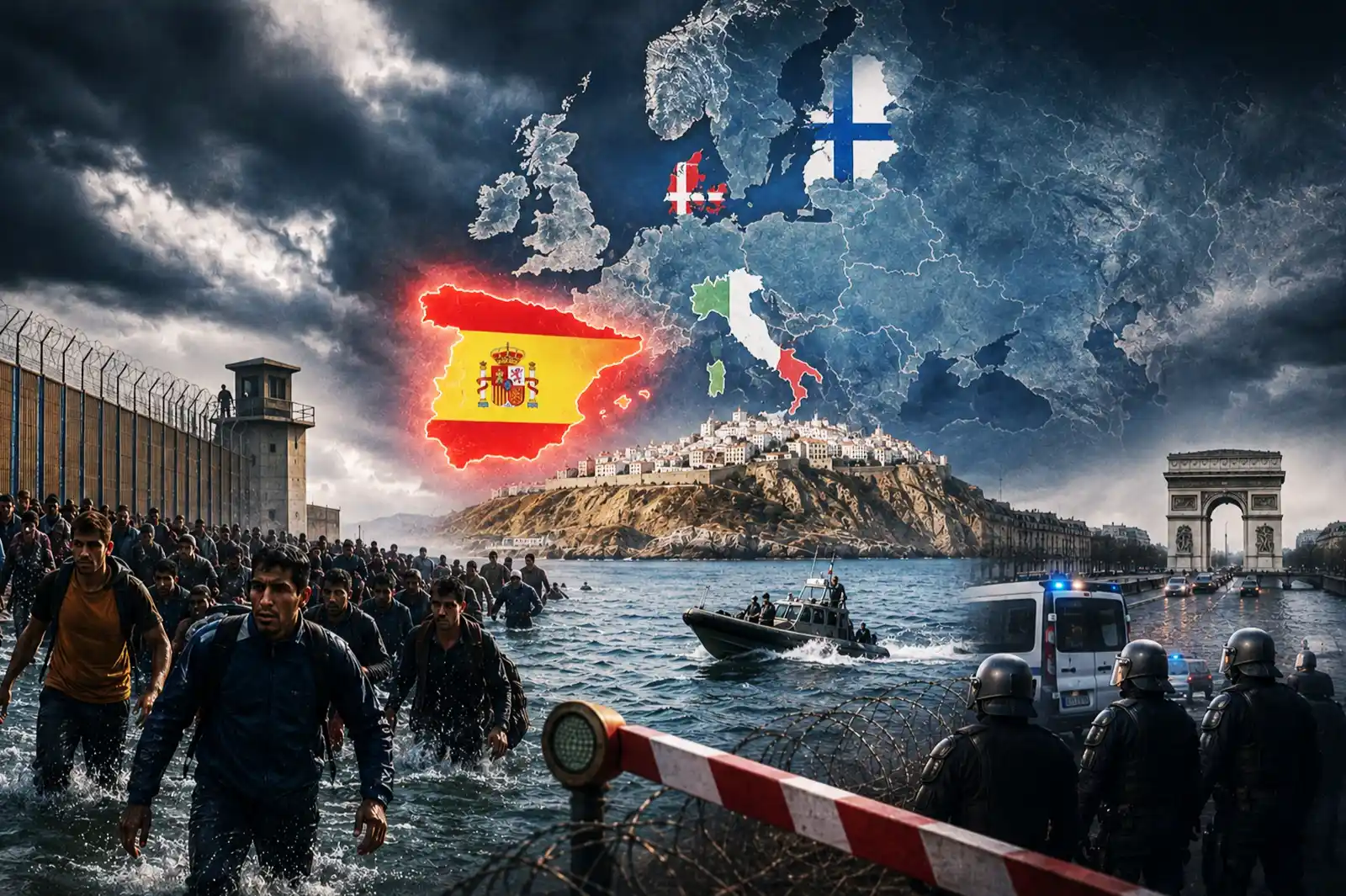
The migratory crisis in Ceuta, a Spanish enclave in North Africa, triggered a chain reaction in the European Union. Italy and Denmark announced the temporary suspension of the Schengen Agreement with Spain, while France reinforced border controls. The measures, based on intelligence assessments, generated a diplomatic short-circuit with Madrid and criticism from the Italian opposition.
Measures adopted by European countries
The government of Giorgia Meloni decided on Friday to suspend the free movement agreement with Spain, a measure that will last for one month. The decision was based on assessments by the Committee for the Analysis of Immigration and Border Security, chaired by Interior Minister Matteo Piantedosi, according to ANSA. Denmark, for its part, joined the stance of Italy and Finland, calling for Spain’s suspension from the Schengen area, although details of its measure were not specified.
France, meanwhile, agreed with Italy to reinforce controls on the land border between the two countries, in accordance with existing police cooperation agreements. Border police will carry out specific and selective checks on nationals of third countries to verify that they possess the necessary documentation to travel within the Schengen area.
Figures on irregular arrivals: Italy vs. Spain
The president of the Spanish government, Pedro Sánchez, responded to Italian criticism by citing Frontex data: between 2021 and 2026, 478,600 irregular immigrants arrived in Italy, while 234,760 arrived in Spain. These figures contrast with Italy’s decision to suspend Schengen with a country that has no direct border with Italy.
| Country | Irregular arrivals (2021-2026) | Source |
|---|---|---|
| Italy | 478,600 | Frontex, cited by Sánchez |
| Spain | 234,760 | Frontex, cited by Sánchez |
Methodological note: The figures correspond to irregular entries recorded by Frontex between 2021 and 2026, as published by Pedro Sánchez on his X account. It is not specified whether they include all types of crossings (maritime, land) nor the exact counting methodology.
Controversy over the regularization of migrants in Spain
Italian Deputy Prime Minister and Foreign Minister Antonio Tajani criticized «the deeply mistaken decision of the Madrid government to grant Spanish citizenship, and therefore European citizenship, to more than 500,000 irregular immigrants.» However, this claim was denied by the Spanish government: what Sánchez did was regularize the legal status of thousands of people who already lived and worked in Spain, without granting them citizenship. Spanish Foreign Minister José Manuel Albares called Tajani’s message «improper» and summoned the Italian ambassador.
The crisis in Ceuta was triggered by a ruling from the Spanish Supreme Court that determined it is not possible to repatriate people who enter by swimming. According to the Spanish government, this ruling was exploited by mafias and criminal organizations, which would have driven the increase in crossings.
Political reactions and internal criticism in Italy
Italy’s center-left opposition accused Meloni of using the issue to campaign, in a context where the far-right party of Roberto Vannacci is growing. Senator Francesco Boccia, of the Democratic Party, called the proposal to suspend Schengen «lacking any political or legal foundation» and a «maneuver that carries no more risk than provoking a sterile diplomatic crisis.»
For its part, the Spanish government defended its management and called for European unity. Sánchez wrote on X: «This is not a time to divide. It is a time to continue building a strong and united EU.»
What data to follow
The key data to follow is the evolution of irregular arrivals to Ceuta and Melilla in the coming weeks, as well as the effective implementation of the Schengen suspensions by Italy and Denmark. It will also be relevant to observe whether other countries, such as France, adopt similar measures and how the European Commission responds to these unilateral actions.
Fuentes consultadas
- La Derecha Diario
- Argentina.gob.ar Fuente primaria
- LA NACION
- La Izquierda Diario
El Sereno contrastó las fuentes enlazadas y añadió contexto, comparación o análisis documental. Las fuentes primarias están identificadas. La nota no se presenta como investigación de campo ni como entrevista propia, salvo indicación expresa.


Comentarios