
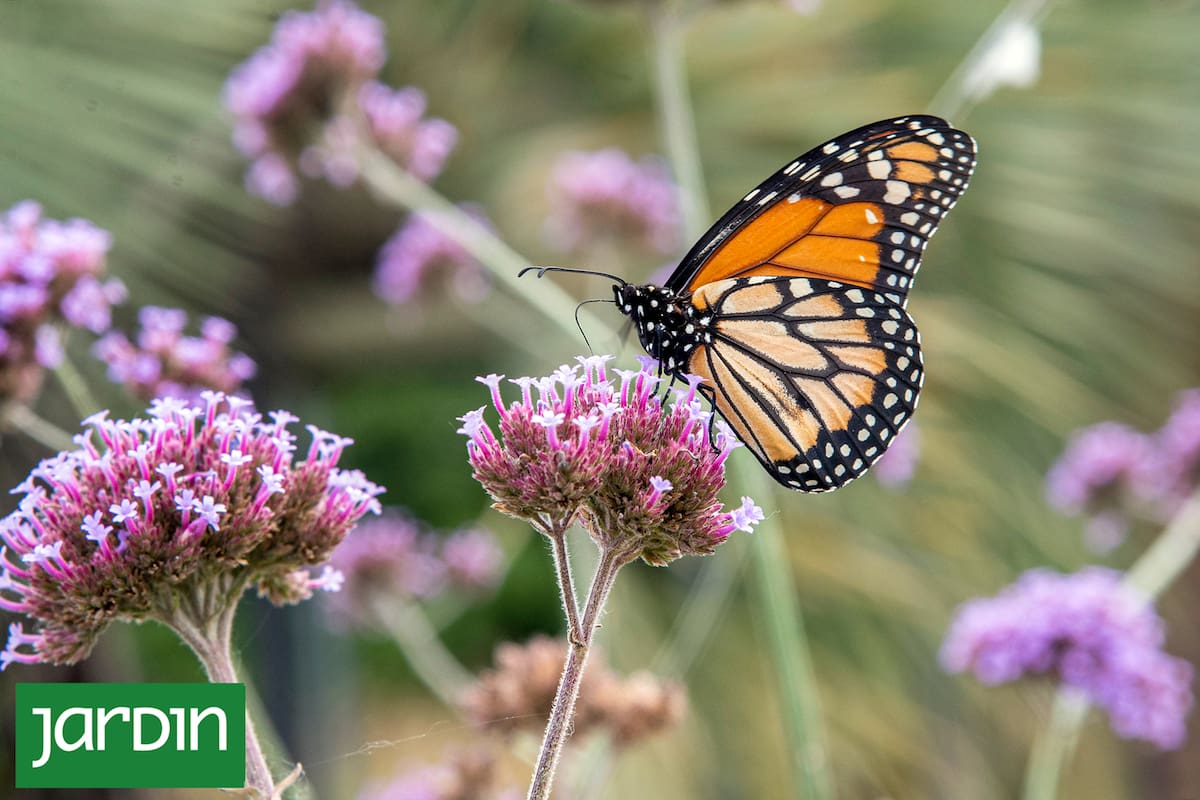
A butterfly alighting on a flower is often interpreted as a casual visit. However, when butterflies appear frequently in a garden, it is rarely a coincidence. Behind each specimen lies a much more complex story: a plant where the female laid her eggs, a caterpillar that found food to grow, a chrysalis protected among the leaves, and finally a butterfly seeking nectar to feed. That is why a true butterfly garden is not simply a space with attractive flowers. It is an ecosystem designed to accompany all stages of these insects’ lives.
In times when cities lose biodiversity and pollinators face multiple threats, creating one of these gardens has become one of the most effective ways to bring life back to the domestic landscape. The fundamental difference from a conventional garden is that it is not designed solely for the flowers that adult butterflies visit. It also incorporates so-called host plants, those on which butterflies lay their eggs and which will serve as food for future caterpillars. Without them, butterflies may visit the garden occasionally, but they will hardly establish themselves there.
A successful butterfly garden combines two types of vegetation: host plants and nectar plants. The former feed and sustain the life of caterpillars, while the latter feed adult butterflies. Each butterfly species has very specific preferences. The popular southern monarch (Danaus erippus), for example, depends on species such as honey milkweed (Asclepias mellodora) and tasi or doca (Oxypetalum solanoides). Without these plants, females will simply look for another place to reproduce. Something similar occurs with the little mirrors (Dione spp.), whose caterpillars develop on various passionflowers such as Passiflora caerulea and Passiflora misera. Aristolochia (Aristolochia triangularis) is another key species because it hosts the striking gold-rimmed swallowtail (Battus polydamas), one of the most showy in Argentina. These relationships are the result of millions of years of co-evolution and explain why native plants are often much more valuable for biodiversity than many exotic ornamental species.
Once transformed into butterflies, needs change: now the goal is to find nectar sources. For this, it is advisable to incorporate a good diversity of species with staggered blooms throughout the year. Among the most visited are Salvia guaranitica, Salvia pallida, Verbena bonariensis, Verbena montevidensis, Lantana megapotamica, Lantana montevidensis, Buddleja stachyoides, Baccharis articulata, Oenothera affinis, and Zinnia peruviana. Diversity is key. The more varied the floral offering, the greater the number of butterfly species that can find food.
This is perhaps the most difficult aspect for many gardeners: caterpillars eat, and sometimes they eat a lot. A successful butterfly garden involves accepting perforated leaves, partially consumed shoots, and some less-than-perfect plants. What at first glance might seem like a problem is, in reality, proof that the system works. Each bitten leaf represents food for a future butterfly.
There are some frequent mistakes that can ruin the project. The main one is the use of insecticides. Even products considered mild can affect eggs, caterpillars, and adults. It is also advisable to avoid excessive garden cleaning. Butterflies need sheltered corners, dry leaves, and a certain plant complexity to complete their cycle. Another common mistake is planting only showy flowers without incorporating host species. In that case, you get a garden attractive for occasional visits, but not a true refuge for reproduction.
Butterfly gardens work best when they mimic the structure of a natural ecosystem. The combination of herbaceous plants, shrubs, and climbers creates different vegetation layers and multiplies the available microhabitats. Passionflowers can climb over fences or pergolas. Salvias and verbenas provide prolonged blooming. Native shrubs offer shelter and protection from the wind. As the system matures, not only butterflies begin to appear, but also native bees, pollinating beetles, insectivorous birds, and other organisms that enrich the garden. A butterfly garden is, in reality, a small biodiversity reserve where each plant fulfills a specific function. Each flower feeds and each leaf can become the beginning of a metamorphosis.



para mi que estos nabos progre no entienden nada de la vida, deja de usar pesticidas como un zurdo cagón y planta ortigas aunque te duela, bancate las orugas y listo, después agradecé, los pelotudos estos creen que con tirar semillitas ya está y después lloran que no hay bichos, aprendé a laburar la tierra sin veneno salame, firmado el gaucho furioso
Para mí esto es un verso de mierda, un cuento del Primer Mundo para que nos olvidemos de los agrotóxicos que matan todo. Mientras los ricos hacen jardincitos de mariposas, ellos envenenan los campos. ¡Es una cortina de humo! Yo creo que hay que luchar por agroecología, no por flores de cuento. ¡Viva la lucha, carajo!