
Kintsugi is a Japanese technique for restoring ceramics, where a crack represents an opportunity. Restoration not only changes the object’s appearance but adds value. “Now the object also has a story. Urban kintsugi extrapolates this concept to exalt a crack in the urban landscape through mural intervention, object repair, and the symbolic act of transforming this crack into a new place,” explains architect Carolina Huffmann, who leads Urbanismo Vivo alongside Cecilia Ciancio, a team seeking connection between citizens and the place they inhabit.
The French artist known as Ememem is considered the leading figure of urban kintsugi, a discipline he himself dubbed flacking, a term derived from the French word flaque (puddle). Since he first repaired a pothole on the streets of Lyon in 2016, this sidewalk surgeon has dedicated himself to filling cracks, holes, and asphalt fractures using colorful ceramic, wood, and bitumen mosaics.
Unlike traditional municipal repairs that seek to homogenize and hide deterioration, Ememem’s work rescues the heritage of kintsugi by illuminating the urban wound and seeks to turn an accident or public neglect into a piece of art. His work has become a symbol of Lyon’s cobblestone streets and cracked sidewalks, but his playful mosaic art can also be found in other cities such as Paris, Madrid, Barcelona, and Milan.
While the concept of urban kintsugi is quite specific, the average Buenos Aires resident has surely already encountered some urban interventions that, differences aside, share that spirit of “repair” and “healing” of public space. Like the Enlace Defensa project in the San Telmo neighborhood, an intervention located in the degraded area under the 25 de Mayo highway that crosses Defensa Street.
“In 2020 we carried out this participatory project that sought the revitalization of the under-highway area to bring better safety, recreation, and connectivity conditions to the neighborhood,” explains Huffmann. Thus, the goal was to create a more pleasant pedestrian experience by incorporating new public space, improving the continuity and vitality of the walking route from Plaza Dorrego to Parque Lezama.
Another Urbanismo Vivo project carried out in 2023, called Nature at a Step, aimed to change the connection between people, nature, and infrastructure in Villa Luro. “The proposal was to intervene in the street and promote cultural diversity and educational activities, whose main theme was native vegetation. It was a participatory and educational proposal that addressed the theme of biodivercity and was crossed by a gender perspective,” recalls Huffmann.
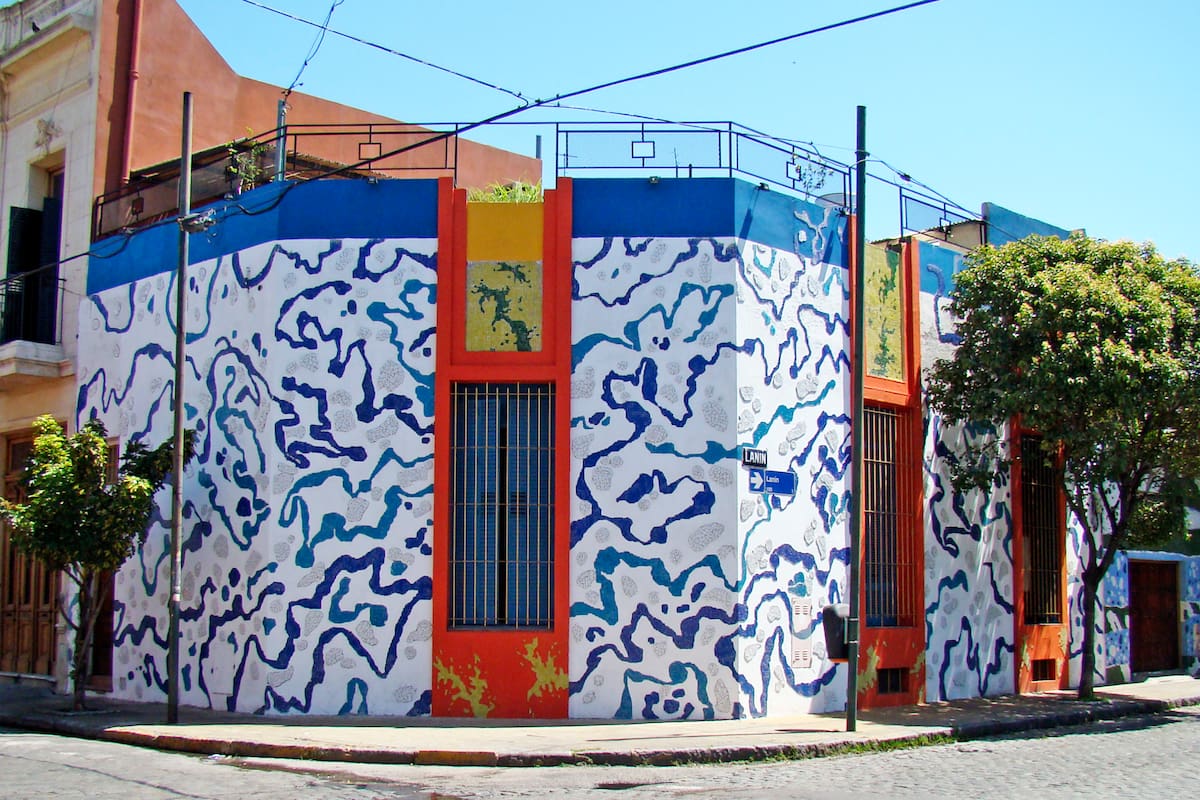
The work of visual artist Marino Santa María has shared for years the philosophy of “healing” and revaluing public space. In this sense, Pasaje Lanín is undoubtedly one of the most emblematic public art interventions in Buenos Aires. Located in the heart of Barracas, between Brandsen and Suárez streets, it was transformed by the artist, who has his studio in the same passage. The project began to take shape in 1999, when Santa María decided to take his easel works to the facades of his own block. After receiving approval from his neighbors, the work was inaugurated in April 2001.
Originally, the fronts were intervened with exterior latex paint and primary colors, using abstract, wavy, and geometric forms. However, due to wear, the artist began a second stage years later, replacing the paint with Venetian mosaic and tiles, which today define the passage.
Located between Jean Jaurès and Agüero streets in Abasto, Pasaje Zelaya constitutes Marino Santa María’s second major urban intervention. Inaugurated in 2002, the project sought to revitalize the tango identity of the neighborhood, using art as a “social glue” to rebuild collective memory. If on Lanín Street the focus was color and abstraction, in Zelaya the axis is the figure of Carlos Gardel. The intervention unfolds over two blocks and functions as an open-air museum that integrates portraits of the Morocho del Abasto on monumental scales; the lyrics and sheet music of iconic tangos like Mi Buenos Aires querido and Volver are integrated into the architecture of the houses. The chronology of tango links the past of the Abasto Market with the cultural centers and independent theaters of the area.
This project was fundamental to repairing a sector of Abasto that, after the market closed in the 1980s, had suffered marked deterioration. As in the kintsugi technique, where scars are highlighted in gold, Santa María used art to highlight the neighborhood’s history, turning a once-forgotten passage into a tourist and heritage landmark.



Para mí esto es un choreo de zurdos que ensucian la ciudad y lo llaman arte. Kintsugi porteño? Me parece puro maquillaje para esconder la decadencia. Limpien y barran, vagos de mierda. Firmado: Pocho_El_Derecho
Para mí esto es maquillaje de chetos que quieren disimular la podredumbre del sistema. Kintsugi es para samuráis, no para giles que buchonean casas chorros mientras los pobres se pudren en el conurbano. Me parece un verso de fachos que no dan laburo digno. Dejense de joder con la estética y denle de comer al pueblo, manga de vendidos.