
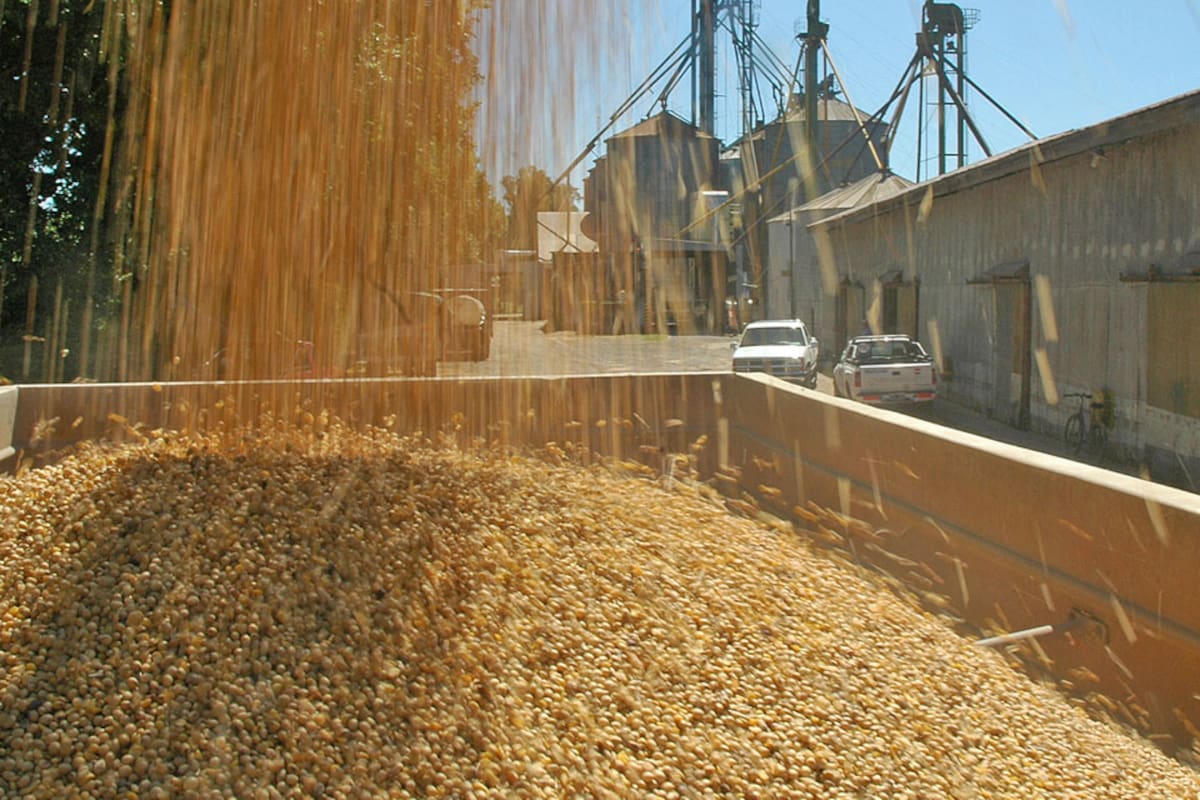
At the center of the agricultural debate in recent weeks, export duties (DEX) – known as retentions – have once again been questioned by producers and specialists, while the Government defends them as a fiscal tool. A column published in La Nación suggests that soybean export taxes imply a subsidy to competitors Brazil and the United States, by reducing the price received by local producers. In parallel, the Minister of Economy, Luis Caputo, confirmed at the Palermo Rural Exhibition that the goal is to eliminate them before 2031, although without specifying intermediate deadlines.
The deduction on the soybean price: comparable figures
According to the La Nación article, Argentine soybean producers receive around US$300 per ton at the farm gate, while in Brazil they receive US$380 and in the United States they exceed US$400. This difference, attributed to export taxes, implies a deduction that has ranged between 5% and 35% annually for over 40 years, and between 15% and 40% in the last 20. These figures, however, come from a single source (La Nación) and have not been cross-checked with official data from the Ministry of Economy or industry chambers.
The official position: gradualism and 2031 goal
The Ministry of Economy reported that Caputo, during his visit to the Rural Exhibition, emphasized that the Government has already “lowered export taxes” and that the goal is to “end the martyrdom of export taxes” before 2031. No reduction percentages or a timeline were specified. This statement contrasts with the position of producers, who demand immediate elimination or at least a significant reduction in the short term.
Comparison of data and positions
| Aspect | La Nación (column) | Ministry of Economy |
|---|---|---|
| Soybean price at farm gate (Argentina) | US$300 per ton | Not reported |
| Soybean price at farm gate (Brazil) | US$380 per ton | Not reported |
| Soybean price at farm gate (USA) | More than US$400 per ton | Not reported |
| Deduction due to export taxes (historical range) | 5% to 35% annually (40 years); 15% to 40% (last 20) | Not reported |
| Position on export taxes | Critical: subsidy to competitors | Fiscal defense, but goal of elimination by 2031 |
| Recent actions | Mentions temporary reduction to zero in September 2024 | Announces reduction of taxes and tariffs, and reduction of export taxes |
Methodological note: The table compares data published in the La Nación column (secondary source) with official information from the Ministry of Economy (primary source). Price and deduction figures come solely from La Nación and have not been verified with official data. The Ministry did not provide specific figures on prices or deductions.
Value module: the difference in income per ton
To gauge the impact, the difference between the price received by an Argentine producer and that received by a Brazilian producer is calculated, according to La Nación data.
- Document: La Nación column (secondary source).
- Organization and date: La Nación, August 1, 2026.
- Unit: Dollars per ton.
- Values used: Argentina price: US$300; Brazil price: US$380.
- Operation: 380 – 300 = 80 dollars per ton.
This difference of US$80 per ton represents 26.7% more for the Brazilian producer compared to the Argentine one (80/300). However, it is important to note that this comparison does not consider freight costs or other factors that may affect competitiveness. Furthermore, the data comes from a single source and has not been cross-checked with official statistics.
What to watch
The key data point to follow is the timeline for reducing export taxes that the Government may announce in the coming months. Caputo’s statement about 2031 is a distant horizon, but there are no details on intermediate steps. It is also relevant to monitor whether the Ministry of Economy publishes official data on international prices and deductions, which would allow verifying the column’s claims. The evolution of soybean production and exports in Argentina, Brazil, and the United States will be an indicator of the real impact of export taxes on competitiveness.
Fuentes consultadas
- LA NACION
- Argentina.gob.ar Fuente primaria
El Sereno contrastó las fuentes enlazadas y añadió contexto, comparación o análisis documental. Las fuentes primarias están identificadas. La nota no se presenta como investigación de campo ni como entrevista propia, salvo indicación expresa.



Comentarios