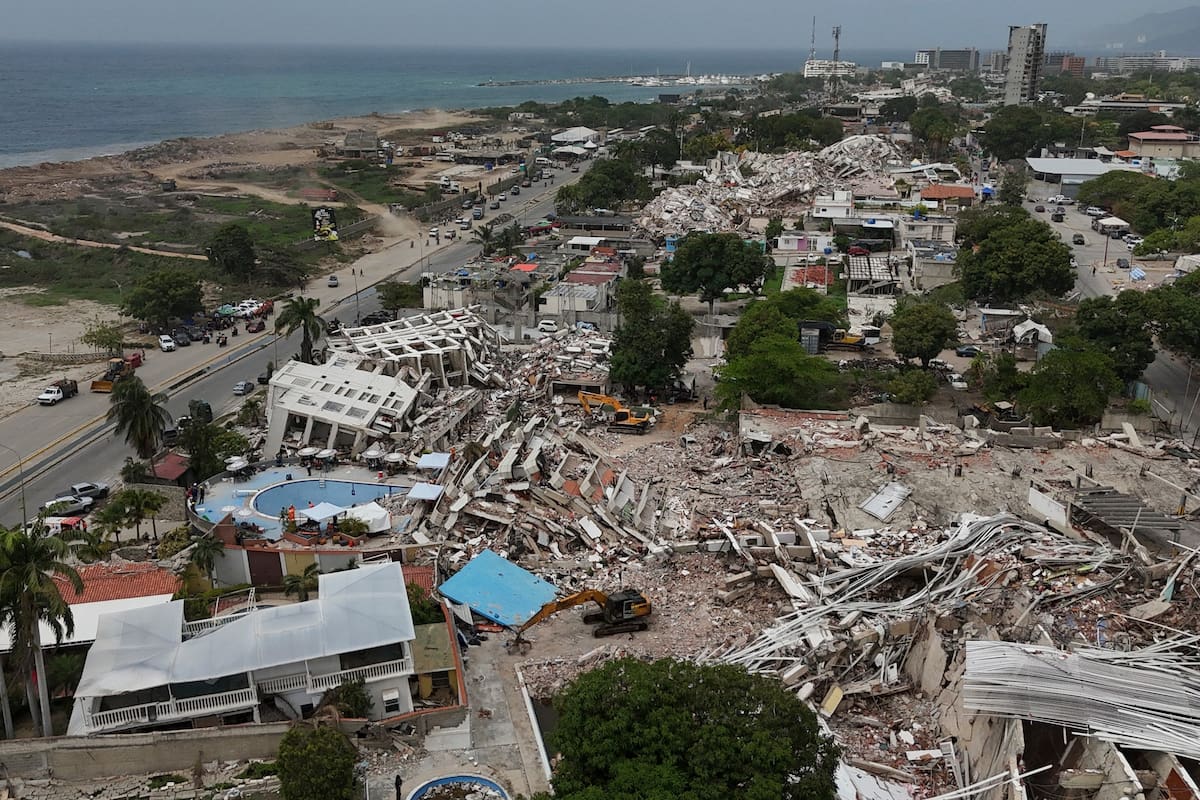
LA GUAIRA, Venezuela.– “The dream is shattered forever. Forever! My God!” The poem by Federico García Lorca emerges from the rubble of the Club Caribe building, ground zero of the San Juan Day tragedy. The book lies wide open, as crumpled as the massive walls of the two 14- and 7-story buildings that collapsed.
The verse from the Complete Works of the Spanish author has barely survived, as if to bear witness that La Guaira was a dream for its inhabitants and for Caracas residents—after all, it was their favorite beach. It was there that Hugo Chávez promised the new Cancún, where every time people drove down and saw the sparkling sea from the highway, they thought their little paradise was near. Until the fury of nature pulverized it.
“We are nine in the family; we came the first day from Caracas. Carla (47) and her daughters Bianca (10) and Verónica (14) are under there; one of the international rescuers saw one of their bodies. We have what you see—picks and shovels—and we know they are not alive. We have seen their photos, their shoes, and we know. But we are clear: we are going to recover their bodies,” explains Abraham Rojas among the remains of Club Caribe.
There are photos and books, like Lorca’s, that are part of the tide of rubble brought by the earthquake. The boy, his siblings, and the whole family have a mission and they will fulfill it. They have fought with strength, but they also feel despair—two of the many emotions flooding Venezuelans these days, a people who for a long time felt blessed by the gods, with wealth springing from their soil, whether oil, gold, or any other mineral.
“They are miracles, but they happen,” testified Daniel Acevedo, a Colombian from Boyacá, who participated in the rescue of the boy Moisés, which has deeply moved his country. The little boy had only a scratch, but beside him lay the bodies of his mother and little sisters. Daniel belongs to USAR Col1, the Colombian rescuers who, despite knowing that the 100-hour mark—the threshold between life and death in such tragedies—has long passed, refuse to yield to reality. That is why they refuse to follow the “orders” of a Venezuelan authority who wants to direct them to a collapse zone without hope. The Colombians are equipped with the latest technology. And the Venezuelans? the reporter asks. “Picks and shovels, nothing more,” Acevedo replies.
One of the latest miracles also has a name: Hernán Gil. Rescuers from the Costa Rican Red Cross pulled him from a mountain of rubble after 114 hours of relentless struggle. He was trapped in the Galería Shopping Center in Playa Grande.
The makeshift morgue at the entrance to the port of La Guaira also has an armed deployment, as if the dead might rebel. Relatives wait in chairs for their turn to identify their loved ones—one of the final stops on this journey through miracle and death. Here is José Fuente, who lived in Maiquetía but has seen how the savage earthquakes swallowed the lives of his relatives, including Carlos Eduardo, who is already a hero to them all after saving his wife and daughters. The man was trapped and died, but his family would not allow him to remain buried that way.
“We dug him out with our hands; no one helped. We pulled him from under the rubble and handed him over here. We have identified him and now we wait for them to give us the body to bury him, but the government does not help at all. They are many, but they are bad,” he testifies, lowering his voice. They all lived in one of the Misiones Vivienda, the famous subsidized housing plan that Hugo Chávez launched and wanted to turn into one of the great emblems of the Bolivarian revolution.
If the legacy of the “supreme commander” is to be measured in the future by this initiative, it has been shattered as much as his favorite populist Mission. The Fuente family is looking for a “hole” to bury him, “but with the situation, no one sells or lends. We want to bury him in the La Guaira cemetery or in Carayapa. Despite everything, we will give him the burial he deserves,” states José Fuente, who has saved on his mobile phone images of the makeshift morgue, while authorities have preferred to preserve them by covering the fences with semi-dark tarps.
Coffins and bodies covered with blankets, by the hundreds, make up another scene of the tragedy. There, forensic experts work tirelessly, also with their fingernails, like the Venezuelan volunteers. The great tragedy of La Guaira will go down in history as the catastrophe in which Venezuelans worked as best they could to rescue their own, much like what happened in Haiti in 2010, when 320,000 people lost their lives in Port-au-Prince, a city without large buildings like here.
One of the great controversies revolves around these buildings erected by Chavismo for its people. We are in Mare Abajo 2, in Catia La Mar, another housing development built by the Bolivarian government for disaster victims and people with homes in poor condition. “It moved forward and backward until it finally sank. Horrible, terrifying. A neighbor’s wall fell on her; another neighbor burned. I will not sleep in my house again; every day I feel the walls opening more,” describes Laura Cedeño, who camps with her back to the beach and facing the housing development, which looks like a huge cracked ghost.
Cedeño’s first confession leaves no doubt: “I don’t want to stay in La Guaira; I want to leave. Three tragedies in a row now.” The woman lived with her newborn children in Las Tunitas, a few kilometers away, when the formidable Ávila mountain, which separates the coast from Caracas, collapsed in 1999, turning into a tsunami of rocks and mud. “A rock then destroyed my entire house, but we were no longer inside. They rescued us. Then they gave us housing in another sector of Catia La Mar, in Surle, but months later, in 2000, the storm also left us homeless. And then they moved us here. Enough is enough,” the woman concludes.
Para mí esto huele a justicia divina. Se les derrumbó el sueño chavista junto con los edificios, un castillo de naipes que nunca fue real. El gobierno ausente mientras la gente entierra a sus muertos con las manos, una vergüenza. Argentina y Venezuela, mismo destino con estos populistas de mierda. Vayan a llorar a Miraflores, inútiles.
Para mí estos fachos de siempre aprovechan una tragedia para atacar a la Revolución. La Guaira no se derrumba, se transforma. El imperio y sus lacayos mediáticos inventan escombros donde hay lucha obrera. ¡Chavismo carajo, la solidaridad popular está más viva que nunca!