
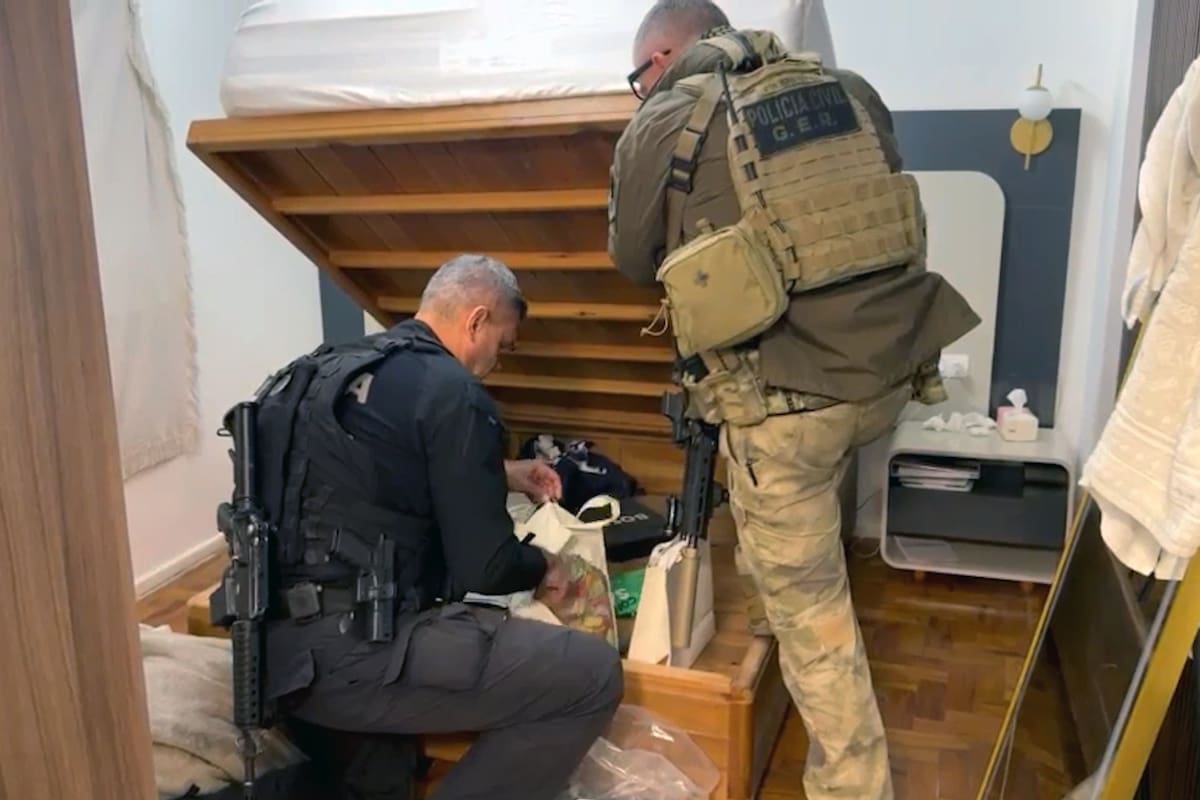
An investigation that began with raids on a humble cell phone case store in Complexo do São Carlos, a favela in Rio de Janeiro, ended up unraveling a web connecting Brazilian drug trafficking to the financing of international terrorist organizations. Operation Hawala, presented last Wednesday by the Public Prosecutor’s Office and the Civil Police of Rio, revealed a structure that allegedly laundered about 19 million dollars between 2021 and 2024 for Brazil’s three most powerful criminal factions: the First Capital Command (PCC), the Red Command (CV), and the Pure Third Command (TCP).
But the detail that placed the case at the center of the international stage was a lateral finding: investigators detected a commercial relationship between a company linked to the defendants and a man sanctioned by OFAC, the U.S. Treasury office that administers economic sanctions, identified as part of a financing structure for Al Qaeda and Hezbollah. That man was arrested in Rio during the operation, and in the raids, mentions of Hezbollah appeared, the Lebanese Shia organization whose fundraising network in the Triple Frontier has been investigated for three decades.
The complaint filed by the anti-mafia group of the Rio Public Prosecutor’s Office against 22 people, fully accepted by Judge Alexandre Abrahão Dias Teixeira, is for money laundering for the factions. The word terrorism does not appear in the official statement from the prosecutors: the hypothesis of a link with Al Qaeda and Hezbollah is, for now, a police investigation line that will begin to be deepened.
The case began far from any terrorism hypothesis. The police were investigating a «multi-brand» store in Complexo do São Carlos, controlled by the Pure Third Command. The store sold counterfeit products and received stolen cell phones. Its formal owner, Bárbara Luzia Souza de Carvalho, married to the store’s owner, is described by prosecutors as one of the main financial operators of the organization: she managed companies with revenue incompatible with her declared economic capacity, through which she moved tens of millions of reais.
The tracking of that store uncovered a much larger architecture. Dozens of shell companies registered in several states, successive transfers between linked firms, front men, accountants who omitted reports of suspicious transactions to the Brazilian anti-money laundering body, and the method known as «smurfing»: fractional cash deposits in small amounts designed not to trigger financial system alerts. The structure functioned as a «service provider» for organized crime: it was born to launder money for the TCP, but the same engineering processed funds from the Red Command and the PCC, three factions that fight each other in the favelas and share, without apparent conflict, the same laundering structure.
The operation’s name, Hawala, refers to the informal value transfer system, of ancient origin in the Middle East and South Asia, which allows moving money between countries through a network of intermediaries who offset credits and debts among themselves, without funds physically crossing any border or passing through a bank. It is, by design, invisible to regulators. And it is the mechanism that, according to international investigations, historically connects the Triple Frontier trade with financing networks in Lebanon.
At the center of the border chapter of the case is a core of businessmen of Lebanese origin. The brothers Reda, Yasser, and Kassem Zayoun —Reda was arrested in Foz do Iguaçu, where five raids were carried out— are identified as responsible for expanding the international circulation of money: companies registered in São Paulo and Minas Gerais moved values between financial operators, shell companies, and faction members in Rio. Among the 22 defendants, there are at least four other surnames from the Lebanese community —Alfakih, Awad, Dib, and Diab— and in São Paulo, the state police collaborated in the capture of Lebanese allegedly linked to Hezbollah, according to Brazilian press reports.
The suspicion of a possible relationship with international terrorism relates to the Triple Frontier, monitored since the 1990s as a logistical and financial hub for terrorist organizations: through it passed the Hezbollah fundraisers investigated after the attacks on the Israeli embassy and AMIA in Buenos Aires, and the Barakat clan, whose leader was arrested in Foz in 2018 at the request of Argentine Federal Justice. In December 2021, the U.S. Treasury sanctioned an Al Qaeda network based in Brazil —three men and two companies— the first such designation in the country. One of those names, or those added later to the list, would be the man whose transaction with the Zayoun companies triggered the new phase of the investigation.
For Argentina, Operation Hawala is not a foreign matter, as it describes the financial circuit of an area always watched closely by local investigators. On June 17, the Brazilian Federal Highway Police intercepted in Santa Terezinha do Iguaçu, 30 kilometers from Puerto Iguazú, a truck transporting animal feed and, hidden among the cargo, 27 rifles, 16 pistols, and more than 5,000 rounds of ammunition. Five of the long guns were FALs; one bore the Argentine Army shield and its serial number. The official suspicion is that it is part of the remainder of the 43 rifles stolen from Battalion 603 in Fray Luis Beltrán, near Rosario, a shortage that the Argentine armed forces never fully explained and whose final destination was, precisely, the PCC and the Red Command.
Weapons that emerge from Argentina and Paraguay to the factions; cocaine that goes down the Waterway and crosses to Atlantic ports; money that is compensated through the hawala system between Foz do Iguaçu, Ciudad del Este, and Lebanon without touching a bank. The three flows use the same geography and, as the case file opened in Rio de Janeiro suggests, sometimes the same operators.
para mí esto huele a cuento de la CIA para justificar la intervención yanqui en la Triple Frontera. el PCC es un chivo expiatorio mientras los mismos de siempre llenan sus bolsillos. ¡basta de hipocresía! territorio en disputa, no nido de terroristas. firmado: el Che Guevara de internet.
che y estos zurdos de mierda defienden inmigracion el pcc lava plata pa hezbollah y al qaeda en la triple frontera y los progres aplauden para mi hay que cerrar todo ya o nos estalla argentina viva la patria carajo 🐱👤💪 #PCC #Hezbollah