Argentina’s Foreign Ministry filed a formal protest note with the United Kingdom Embassy on July 13 over the movements of the HMS Medway, which according to the official statement involved transit through Argentina’s territorial sea without the notification required under bilateral agreements. Meanwhile, an opinion analysis published by La Nación argues that Donald Trump’s statement on British overseas possessions opened a window of opportunity for Javier Milei’s government, but did not change the fundamental positions of either London or Washington.
The two sources describe different episodes and do not confirm each other: one is an official Foreign Ministry statement about a specific diplomatic protest; the other is an opinion column assessing the political and economic context of the dispute. Neither allows asserting that there has been a change in the British position or a shift in U.S. policy on the sovereignty of the islands.
What the formal protest says and what it does not say
The Foreign Ministry statement, signed on the instructions of Foreign Minister Quirno, rejects «the movements of the HMS Medway, illegally deployed in the Malvinas Islands.» According to the text, those movements were not notified in accordance with current bilateral agreements and declarations and involved transit through Argentina’s territorial sea. The primary source invokes the Joint Declaration of September 25, 1991, which replaces annexes of the Madrid Declaration of February 15, 1990, in its section I.2 on confidence-building measures, point «b,» according to the text of the Buenos Aires and London Joint Declaration of July 12, 1993.
The document describes the action as a «British military incursion into spaces under Argentine jurisdiction» and places it within «a sustained policy of unilateral acts incompatible with United Nations resolutions.» It specifically mentions General Assembly Resolution 31/49, which calls on both parties to refrain from adopting decisions that introduce unilateral modifications to the situation of the islands while the sovereignty dispute remains pending. The Foreign Ministry reaffirms the «legitimate and imprescriptible sovereignty rights over the Malvinas, South Georgia and South Sandwich Islands and the surrounding maritime spaces.»
The statement does not mention Trump, Milei, sanctions on companies, or a National Sovereignty bill. Nor does it quantify bilateral trade or assess the economic impact of the protest. It is a document limited to a military incident and the invocation of bilateral commitments and international resolutions.
The Trump window according to the journalistic analysis
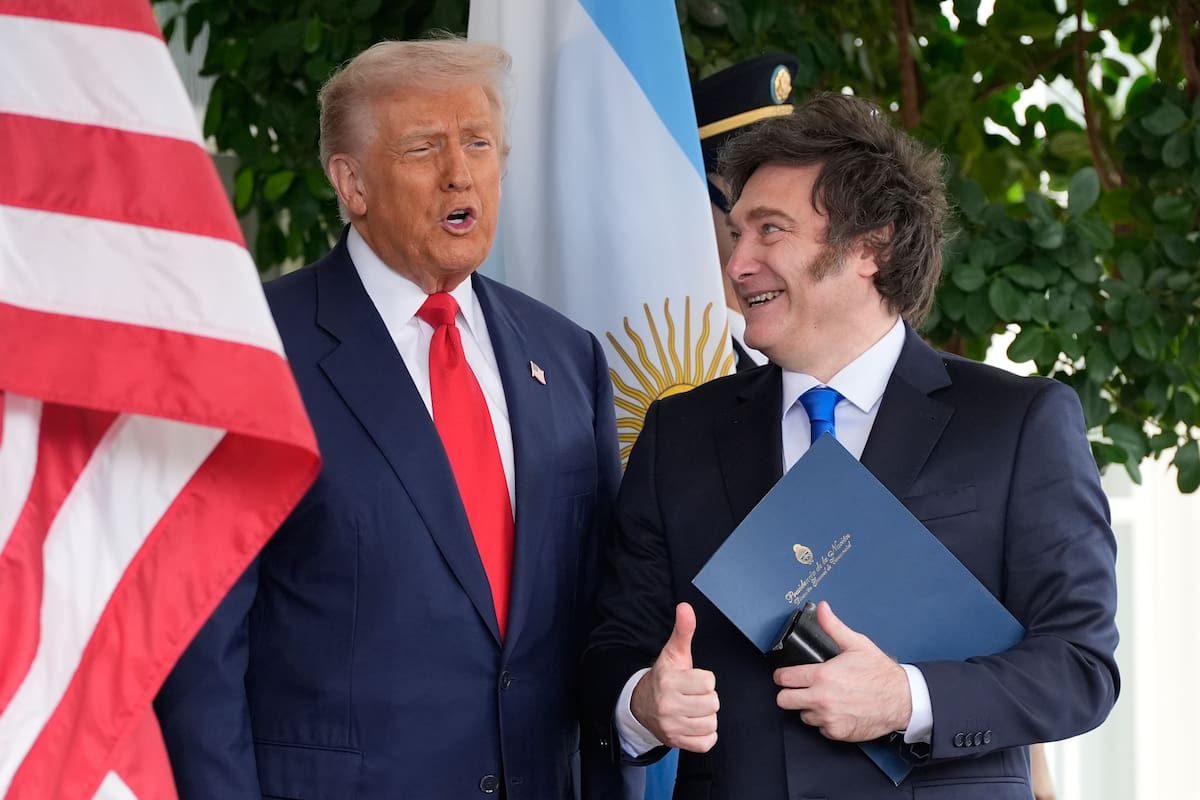
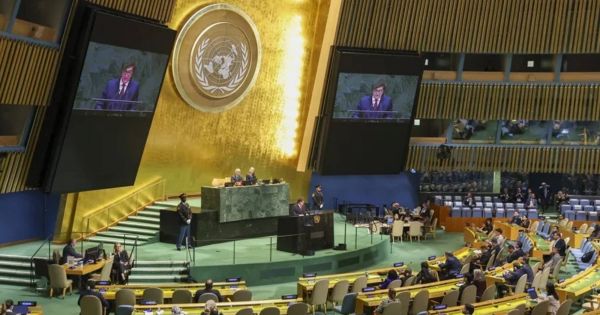
The La Nación column states that an isolated statement by Trump on British overseas possessions, in which he focused on the Malvinas as one of the most controversial, opened an opportunity for the Argentine government that it did not let pass. According to that secondary source, Milei revived the claim with a diplomatic and legal offensive that included the announcement of sanctions on companies linked to the exploitation of the Sea Lion field and a National Sovereignty bill sent to Congress. It also mentions his speech before the 81st UN General Assembly, where he called the body «useless» for having looked the other way in the face of Argentina’s claim.
The text downplays the U.S. signal: it argues that for Washington, the mention of the Malvinas does not imply a change of position or a conviction on the substance of the claim, but rather a comment reflecting bilateral tensions with the United Kingdom on other fronts, particularly the Middle East. It adds that there is no taking of a position on colonial policies or a definition on the Malvinas in particular, and that some analyses raised the possibility of U.S. intervention or a change of stance, but that is a distant scenario.
Regarding the United Kingdom, the column states that sovereignty over the islands is not a topic for discussion or negotiation, and that London bases it on the islanders’ right to self-determination. Argentina, on the other hand, maintains that there is a sovereignty conflict that must be resolved by bringing both parties to the negotiating table, a stance that according to the text has been consistently held by all Argentine governments, including Milei’s, which on this point hardens its 2024 position. Nothing indicates, it adds, that London will deviate from a course it has maintained without changes since 1982: under the so-called «sovereignty umbrella» it can negotiate trade, investment, or connectivity with the islands, but not sovereignty.
Where there could be economic consequences
The column argues that the area where there could be concrete consequences is the economy, though not in bilateral trade. Argentina and the United Kingdom are, mutually, secondary and peripheral partners: neither represents even 2% of the other’s trade, and the commercial relationship between the two countries is declining. The real risk lies, in any case, in investments. Argentina needs foreign currency and is advancing a policy of opening to British and international capital, including the natural resources sector under the RIGI. That is where Foreign Minister Quirno’s warning—that companies will have to choose between investing in Argentina or in the Malvinas—could have a real impact if it were to be enforced. For the United Kingdom, by contrast, the economic weight of the islands is smaller: their value is geopolitical and geostrategic rather than commercial, which makes this dispute, for London, more a matter of principles than of economics.
The secondary source does not provide specific trade or investment figures, only the percentage reference of less than 2%. It does not indicate amounts, dates for that data, or statistical sources. Nor does it specify the scope of the announced sanctions or the content of the bill. The official protest, for its part, does not mention the Sea Lion field, the RIGI, or the UN speech.
Comparison of data and limits between the sources
The following table contrasts the verifiable elements that each source mentions. No currencies or units are converted because the material does not include exchange rates or conversion factors. The magnitudes are those each text presents, without additional calculation.
| Element | Source 1: Foreign Ministry (official statement) | Source 2: La Nación (opinion column) |
|---|---|---|
| Type of source | Primary: official statement | Secondary: journalistic analysis |
| Central fact | Formal protest over HMS Medway movements | Trump’s statement and Argentina’s diplomatic offensive |
| Date of the event | July 13 (protest note) | Does not specify date of Trump’s statement |
| Legal instruments invoked | Joint Declaration 09/25/1991; Madrid Declaration 02/15/1990; Joint Declaration 07/12/1993; UN Resolution 31/49 | Does not mention specific legal instruments |
| Mentions of Trump | No | Yes, as the origin of the window of opportunity |
| Mentions of Milei | No | Yes, speech before the 81st UN General Assembly |
| Sanctions on companies | No | Yes, linked to the Sea Lion field |
| Bill | No | Yes, National Sovereignty sent to Congress |
| Bilateral trade | No | Neither represents even 2% of the other’s trade |
| British position | Does not describe it | Will not negotiate sovereignty; invokes self-determination |
Methodological note: the table was built exclusively with statements present in the two sources provided. No differences, percentages, or averages were calculated because the texts do not offer comparable numerical series. The only explicit numerical magnitude is the «2%» of bilateral trade mentioned by La Nación, which is not accompanied by a year, statistical source, or precise denominator. No currencies or units were converted because there are no exchange rates or conversion factors in the material. The official protest does not quantify the incident or the economic impact. The column does not provide exact dates for Trump’s statement or the announced sanctions.
What data or decision should be followed
The most verifiable follow-up involves the British response to the July 13 protest note and the eventual enforcement of Foreign Minister Quirno’s warning about companies investing in the Malvinas. It is also worth watching whether the National Sovereignty bill advances in Congress and whether the announced sanctions are formalized in official instruments. Trump’s statement, by itself, is not enough to confirm a change in the U.S. position: the secondary source itself describes it as an isolated comment with no definition on the substance. The formal protest, by contrast, is an official act with a date, recipient, and cited legal grounds, and its evolution can be contrasted with subsequent statements from the Foreign Ministry or the British Embassy.
Fuentes consultadas
- LA NACION
- Cancillería Argentina Fuente primaria
El Sereno contrastó las fuentes enlazadas y añadió contexto, comparación o análisis documental. Las fuentes primarias están identificadas. La nota no se presenta como investigación de campo ni como entrevista propia, salvo indicación expresa.


Comentarios