
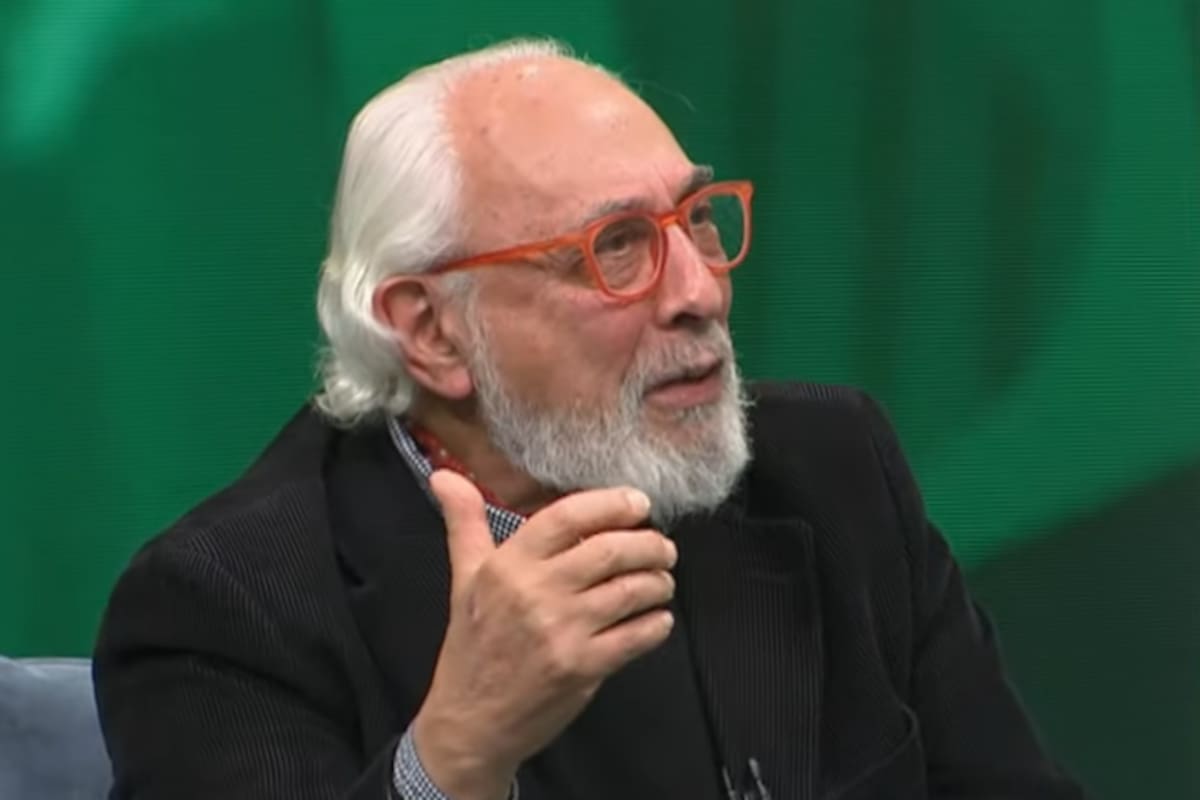
The Malvinas issue has once again taken center stage in Argentine public life. In recent days, three distinct positions have emerged: that of philosopher Santiago Kovadloff, who linked the official strategy to the pursuit of electoral unity; that of the Foreign Ministry, which filed a diplomatic protest over the movements of the British vessel HMS Medway; and that of former President Alberto Fernández, who called the sovereignty claim a «show» and asserted that Argentina is «completely disarmed.» These three sources allow for a comparison of approaches and data, although they come from very different formats: a journalistic interview, an official statement, and an opinion piece with strong language.
Kovadloff’s Reading: Malvinas in an Electoral Key
In an interview with José Del Rio on LN+, philosopher Santiago Kovadloff argued that the Government «is fighting for its prominence in the country» and that the stance on Malvinas seeks to prevent «its hegemony from being compromised by an unforeseen outcome in the elections.» According to Kovadloff, the administration «is doing everything it can to generate unity.»
The philosopher highlighted the emphasis on natural resources: «I believe that the way the issue is now framed, stressing the need for oil and resources derived from there to serve Argentina’s presence, strikes me as an interesting stance.» But he warned that «the Malvinas issue resurfaces at an electoral moment.»
Kovadloff also referred to the need for «state priorities» and «state policies that demonstrate the capacity to generate shared consensus,» and noted that the challenge is for interdependence among sectors, including governors, to transcend the discussion over the islands.
The Official Protest: A Vessel and a Diplomatic Note
The Argentine Foreign Ministry reported that on July 13 it submitted a protest note to the United Kingdom’s Embassy over the movements of the HMS Medway, «illegally stationed in the Malvinas Islands,» which were not notified in accordance with bilateral agreements. The official statement indicates that those movements involved «transit through Argentine territorial waters» and constitute a «violation» of the Joint Declaration of September 25, 1991, in its section I.2 on confidence-building measures.
The official text «firmly rejects this British military incursion» and frames it within a «sustained policy of unilateral acts» that contravenes UN General Assembly Resolution 31/49. That resolution urges both parties to refrain from introducing unilateral modifications while the sovereignty dispute is pending.
The Foreign Ministry reaffirms «the legitimate and imprescriptible sovereignty rights» over the islands and surrounding maritime areas. The statement does not mention natural resources or electoral strategy; it is limited to the diplomatic and legal dimension.
Alberto Fernández’s Criticism: «Show» and Disarmament
In radio statements reproduced by La Derecha Diario, former President Alberto Fernández called the Government’s sovereignty claim a «show» and referred to President Javier Milei as a «clown» and «delusional.» According to the article, Fernández stated that «Argentina is completely disarmed» and sent a message to the British: «the English need not worry.»
The former president also questioned the purchase of the 24 F-16 aircraft, which he described as «a rip-off» and «a relic that is useless,» and compared Milei’s firmness to that of Leopoldo Galtieri during the dictatorship. He also defended his own administration: he asserted that «one of those companies was sanctioned during my tenure with a 20-year ban» and that «the military base in Tierra del Fuego was ordered built by me.»
The La Derecha Diario article, strongly critical of Fernández, includes a response from presidential advisor Santiago Caputo, who wrote on social media: «I can’t think of anything more cipayo than siding with the United Kingdom just to oppose President Javier G. Milei.»
Comparison of Data and Approaches
The three sources differ in nature and purpose. The interview with Kovadloff is a secondary source analyzing official strategy; the Foreign Ministry is a primary source documenting a diplomatic protest; and the La Derecha Diario article is a secondary source reproducing Alberto Fernández’s statements with a strong editorial slant. There are no factual overlaps among them: Kovadloff does not mention the HMS Medway, the Foreign Ministry does not discuss elections, and Fernández does not refer to the diplomatic protest.
As for figures, there is only one notable numerical data point: the purchase of 24 F-16 aircraft, mentioned by Fernández and not confirmed in the other sources. The Foreign Ministry provides no figures. Kovadloff mentions no numbers. Therefore, the comparison focuses on positions and arguments rather than quantitative data.
| Aspect | Kovadloff (LN+) | Foreign Ministry | Alberto Fernández (La Derecha Diario) |
|---|---|---|---|
| Source nature | Secondary (interview) | Primary (official statement) | Secondary (opinion piece) |
| Reference date | Not specified | July 13 (protest note) | Not specified |
| Position on Malvinas | Supports the claim but warns of electoral use | Rejects British actions and reaffirms sovereignty | Calls the claim a «show» and defends British position |
| Mention of natural resources | Yes, as part of the strategy | No | No |
| Mention of elections | Yes, explicit | No | No |
| Mention of F-16 | No | No | Yes, critical |
Methodological note: The table compares qualitative and quantitative aspects present in each source. The dates of Kovadloff’s and Fernández’s statements are not specified in the material, so they are not recorded. The Foreign Ministry is the only primary source.
Value Module: Difference in Tone and Attribution
A notable aspect is the difference in the treatment of President Milei. While Kovadloff mentions him in the context of a possible reelection and says that «the Government loses much more than an election if it loses an election,» Fernández calls him a «clown» and «delusional.» The Foreign Ministry does not mention Milei directly, but its protest is framed within official policy.
Document: Interview with Kovadloff (La Nación, September 6, 2026), Foreign Ministry statement (date not specified), La Derecha Diario article (date not specified). Organization and date: Not applicable; they are journalistic and official sources. Unit: Not applicable; there are no comparable numerical magnitudes. Values used: No numerical values. Operation: No calculation is performed.
What to Follow
The most relevant data point to follow is the evolution of the diplomatic protest filed by the Foreign Ministry on July 13. It would be useful to monitor whether the United Kingdom responds formally and whether Argentina elevates the matter to multilateral forums, such as the UN General Assembly. It is also worth observing whether the official strategy on Malvinas intensifies in the pre-election period, as Kovadloff suggests, and whether Alberto Fernández’s statements generate reactions across the political spectrum. The purchase of the F-16s and the construction of the base in Tierra del Fuego are topics that may resurface on the public agenda.
Fuentes consultadas
- LA NACION
- Cancillería Argentina Fuente primaria
- La Derecha Diario
El Sereno contrastó las fuentes enlazadas y añadió contexto, comparación o análisis documental. Las fuentes primarias están identificadas. La nota no se presenta como investigación de campo ni como entrevista propia, salvo indicación expresa.

Comentarios