
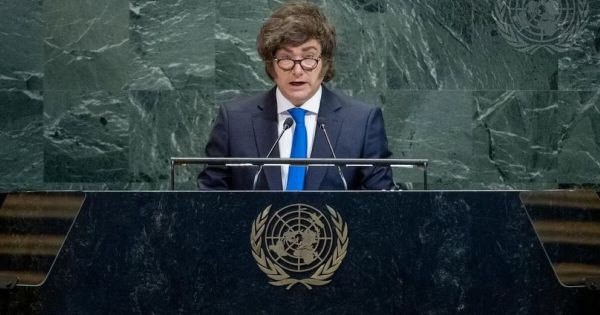
President Javier Milei will speak this Wednesday for the third time before the United Nations General Assembly, according to the newspaper Crónica. The speech is scheduled for 12:00 (Argentine time). The outlet reports that the speech will have three main themes: Malvinas, criticism of the UN’s role, and a defense of artificial intelligence development.
The main themes of the speech according to the journalistic source
Crónica indicates that the highest expectations are placed on the proposal regarding Malvinas sovereignty. According to that source, the claim is reinforced by a package of measures announced by the Government that includes tougher sanctions on companies operating in the islands without Argentine authorization and funds for an integrated naval base in Tierra del Fuego.
The second point, according to the same article, will be the questioning of the UN for its interference in the internal politics of countries, a line that Milei has maintained since his debut at the forum in 2024. The third theme will be the defense of technological progress without restrictions, in contrast to the debate that divides much of the industry over the risks of artificial intelligence.
The journalistic source adds that, after speaking at the 81st General Assembly, Milei will participate in the conference “Western Values, Economic Freedom & Strategic Security”, organized by the Federalism and Freedom Foundation with the support of the International Republican Institute, at 16:00. Then, at 18:00, he will meet with business leaders associated with Americas Society/Council of the Americas, and at 19:30 with Rabbi Simón Jacobson.
For Thursday, Crónica anticipates that at 13:00 the president will give a presentation at The Economic Club of New York and afterwards will have a bilateral meeting with Israeli Prime Minister Benjamin Netanyahu. The return to Argentina is scheduled for Thursday at 21:00, with landing at Aeroparque on Friday at 8:30.
The diplomatic protest over Malvinas: official source
The Argentine Foreign Ministry issued a statement about a formal protest presented on July 13 to the Embassy of the United Kingdom. According to that text, on the instructions of Foreign Minister Quirno, the “most energetic rejection” was expressed of movements of the HMS Medway, “illegally deployed in the Malvinas Islands”, which were not notified in accordance with existing bilateral agreements and involved transit through the Argentine Territorial Sea.
The official statement maintains that this unilateral action violates commitments assumed in the Joint Declaration of September 25, 1991, which replaces annexes of the Joint Declaration of Madrid of February 15, 1990, in its section I.2 “Confidence-building measures”, point “b”, according to the text of the Joint Declaration of Buenos Aires and London of July 12, 1993.
The Foreign Ministry states that the Government rejects “this British military incursion into spaces under Argentine jurisdiction”, which adds to a sustained policy of unilateral acts incompatible with UN resolutions. It mentions General Assembly Resolution 31/49, which calls on both parties to refrain from adopting decisions that introduce unilateral modifications in the situation of the Malvinas Islands while the sovereignty dispute remains pending.
The official text reaffirms “the legitimate and imprescriptible rights of sovereignty over the Malvinas, South Georgia and South Sandwich Islands and the surrounding maritime spaces”.
Agreements, differences and limits between the sources
Both sources address the Malvinas issue, but from different angles. Crónica focuses on the presidential speech and mentions a package of measures announced by the Government, without detailing dates or regulatory scope. The Foreign Ministry, by contrast, documents a concrete diplomatic protest over a specific episode: the movements of the HMS Medway and its transit through the Argentine Territorial Sea.
The journalistic source does not confirm the diplomatic protest of July 13 or the HMS Medway episode. The official source does not mention the UN speech or the themes of artificial intelligence or criticism of the organization. There is no direct overlap between both materials beyond the general reference to Malvinas.
Crónica attributes expectations and reports about the content of the speech (“according to what transpired”), so those themes are not officially confirmed. The Foreign Ministry, meanwhile, is a primary source for the official position on the protest, but does not report on the presidential agenda in the United States.
Practical impact: who is affected and from when
The presidential speech is scheduled for this Wednesday at 12:00 (Argentine time), according to Crónica. The diplomatic protest was presented on July 13, according to the Foreign Ministry. Both events have international scope and affect bilateral relations with the United Kingdom and Argentina’s position in multilateral forums.
- Immediate effect: Milei’s speech before the UN General Assembly, with the themes reported by Crónica, and the continuation of the formal protest already presented by the Foreign Ministry.
- Conditioned effect: the package of measures on sanctions for companies operating in the islands and funds for a naval base in Tierra del Fuego, mentioned by Crónica, requires regulatory and budgetary details that the source does not specify.
- Uncertain effect: the impact of the speech on the artificial intelligence debate and on relations with the United Kingdom. Neither source allows projecting concrete consequences.
What data or decision should be followed
It is advisable to follow the official publication of the presidential speech before the UN to verify whether the three themes mentioned by Crónica are confirmed and to what extent. It is also appropriate to monitor whether the Government formalizes the package of measures on Malvinas announced according to the journalistic source, and whether the Foreign Ministry expands the information on the July 13 protest and its bilateral effects.
Fuentes consultadas
- Crónica
- Cancillería Argentina Fuente primaria
El Sereno contrastó las fuentes enlazadas y añadió contexto, comparación o análisis documental. Las fuentes primarias están identificadas. La nota no se presenta como investigación de campo ni como entrevista propia, salvo indicación expresa.


Comentarios