
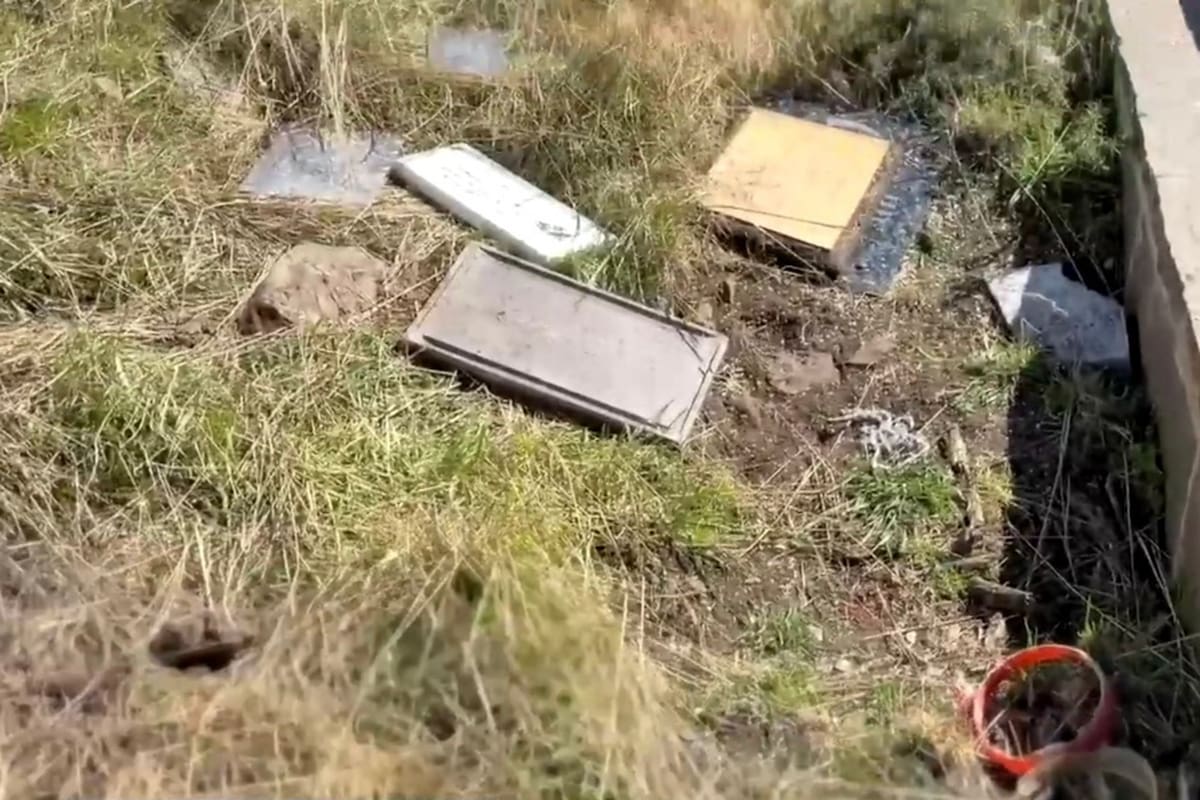
A report by Chilean channel Teletrece, circulated by La Nación, shows commemorative plaques and personal objects left by Argentine visitors that appear to have been thrown behind the white fence of the Darwin cemetery in the Malvinas Islands. The journalistic material attributes those actions to local residents and links them to the rejection of slogans considered a provocation. Argentina’s Foreign Ministry, meanwhile, did not comment on that episode in the available statement: its formal protest to the United Kingdom refers to the movement of the vessel HMS Medway.
What the report shows about the Darwin cemetery
According to La Nación’s account, journalist Samuel Rojas, a Teletrece correspondent, toured the cemetery where 249 fallen from the 1982 war rest. The television report shows plaques placed as tributes that appear thrown behind the Main Cross of the cenotaph, and objects such as broken ribbons, bracelets, figurines and shattered ceramics piled up outside the perimeter, in a sort of improvised dump.
The secondary source mentions a plaque from a radio station in Comodoro Rivadavia bearing the inscription “The people of Comodoro Rivadavia to Our Heroes. ‘Malvinas unites us’ – April 2026,” which is seen damaged along with the rest of the material. It also reproduces an explanation attributed to Rojas: plaques with slogans related to the name Malvinas would not be accepted in the archipelago and are therefore thrown among the grasslands, where they are considered an offense and a provocation.
The La Nación text states that islanders consulted by the report maintain that these acts had not occurred until now and that Darwin was a place respected by locals, except for isolated incidents. That characterization comes from the television coverage and from residents interviewed, not from an official record or a judicial investigation.
What Argentina’s Foreign Ministry says and what it does not say
The statement from Argentina’s Foreign Ministry available in the material does not mention the Darwin cemetery or the thrown plaques. Its content focuses on a formal protest note submitted on July 13 to the Embassy of the United Kingdom on the instructions of Foreign Minister Quirno. The complaint rejects the movements of the vessel HMS Medway, which Argentina considers illegally deployed in the Malvinas Islands and whose transit through Argentine territorial waters would not have been notified in accordance with the bilateral agreements in force.
The Foreign Ministry maintains that this unilateral action violates the Joint Declaration of September 25, 1991, which replaces annexes of the Madrid Declaration of February 15, 1990, in its section I.2 on confidence-building measures, point “b,” according to the text of the Buenos Aires and London Joint Declaration of July 12, 1993. The Argentine Government rejects “this British military incursion” and frames it within a sustained policy of unilateral acts incompatible with United Nations resolutions, in particular General Assembly Resolution 31/49.
The statement reaffirms sovereignty rights over the Malvinas, South Georgia and South Sandwich Islands and the surrounding maritime spaces. It offers no data on the cemetery episode or on the condition of the plaques. Therefore, the diplomatic protest should not be presented as an official response to the vandalism described by Teletrece: they are two different events with different sources.
Where the two sources agree and where they do not
The two sources share the general framing of the conflict over the Malvinas Islands and the reference to the sovereignty dispute. La Nación mentions an Argentine diplomatic escalation over sovereignty and against the progress of the Sea Lion oil project; the Foreign Ministry, for its part, denounces British military movements and reaffirms sovereign rights. That is where the thematic agreement ends.
The differences are substantive. La Nación is a secondary source that describes a television report and attributes statements to journalists and residents. The Foreign Ministry is a primary or official source that sets out a diplomatic position, but does not address the cemetery. Neither source on its own allows confirmation of the authorship, the exact date or the scale of the acts involving the plaques. The official source does not validate the television report, and the television report does not replace a formal complaint or an official report.
La Nación also mentions the local ban on displaying Argentine flags and holding public demonstrations since 2014, promoted by islander Kris Thorsen. That detail appears only in the secondary source and is not corroborated by the Foreign Ministry statement. Likewise, the future commercial maritime route between Punta Arenas and Puerto Argentino and the rate schedule of the company Easter Island Naviera are details that La Nación attributes to an island portal, without the Foreign Ministry mentioning them in the available text.
Verifiable data and limits of the comparison
The following elements can be verified in the supplied material, with the source that supports them:
- 249 fallen in the 1982 war rest in the Darwin cemetery, according to La Nación.
- 190 Chilean citizens residing in the archipelago, according to the television report cited by La Nación.
- July 13: date of the formal protest note submitted to the Embassy of the United Kingdom, according to the Foreign Ministry.
- September 25, 1991: date of the Joint Declaration invoked by the Foreign Ministry.
- July 12, 1993: date of the Buenos Aires and London Joint Declaration whose text is cited, according to the Foreign Ministry.
- Resolution 31/49 of the United Nations General Assembly, mentioned by the Foreign Ministry.
- April 2026: date that appears on the plaque from the Comodoro Rivadavia station, according to La Nación.
No numerical comparison is made between the 190 Chilean citizens residing there and the 249 fallen buried in Darwin: they are magnitudes of a different nature and the material does not offer a common measurement date or a relevant denominator. The values are kept separately, as presented by the source.
No currencies or units of another type are converted because the material does not provide exchange rates, conversion factors or exact dates for doing so. The original units are kept.
What data or decision should be followed up
It is appropriate to follow the official Argentine response specifically regarding the Darwin cemetery episode: whether the Foreign Ministry files a formal complaint, requests explanations from the United Kingdom or comments through another channel. It is also worth watching whether the local authorities of the Malvinas Islands issue a report on the condition of the plaques and offerings, and whether the Teletrece report is expanded with its own records. The protest over the HMS Medway and the Darwin episode are different matters: the first is documented in an official source; the second, for now, only in a secondary source that describes a television report.
Fuentes consultadas
- LA NACION
- Cancillería Argentina Fuente primaria
El Sereno contrastó las fuentes enlazadas y añadió contexto, comparación o análisis documental. Las fuentes primarias están identificadas. La nota no se presenta como investigación de campo ni como entrevista propia, salvo indicación expresa.


Comentarios