
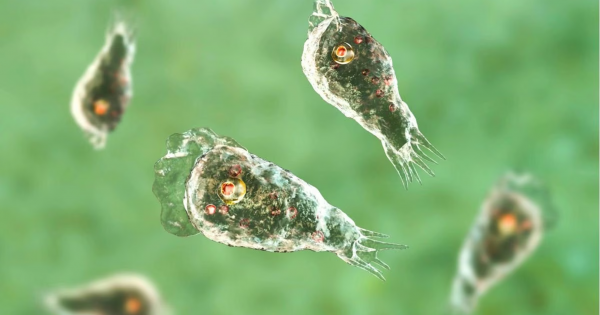
The death of a 10-year-old boy at a thermal complex in Catamarca from an infection caused by the amoeba Naegleria fowleri, known as the «brain-eating» amoeba, sparked concern and led to the temporary closure of the facility. The Malbrán Institute confirmed the diagnosis, according to La Derecha Diario, while health authorities investigate where exposure to the microorganism may have occurred.
What the amoeba is and how it enters the body
It is a parasite found mainly in warm freshwater environments, such as lakes and rivers, and can be fatal if it enters the body through the nasal passages. Crónica explains that entry usually occurs when people swim or dive in contaminated water. It also notes that a pool with inadequate chlorine or a tap with overheated water can provide a favorable setting for the bacteria to appear.
Once the amoeba enters through the nose via the olfactory nerve, it reaches the brain and causes primary amoebic meningoencephalitis, an infection that destroys brain tissue and triggers inflammation. The only route of infection is nasal; swallowing the water does not cause the effect, nor is it transmitted from person to person, according to the same source.
Symptoms can appear between the first and ninth day after exposure, according to Crónica. La Derecha Diario describes the condition as a rare infection that affects the central nervous system.
The case in Catamarca and the ongoing investigation
The boy died after contracting the infection at a thermal complex. La Derecha Diario reports that the Malbrán Institute confirmed the diagnosis and that health authorities are investigating where he may have been exposed to the microorganism. Crónica indicates that the facility was temporarily closed.
None of the sources consulted specifies the exact date of death or the name of the thermal complex. Nor is it detailed whether the health investigation has already identified the exact point of exposure. Attribution of the confirmed diagnosis corresponds to La Derecha Diario, which cites Malbrán; Crónica does not mention that confirmation in the available material.
What is known and what is not about the scope of the outbreak
The sources agree that it is a rare infection and that the route of entry is nasal. They also agree on the severity of the condition. However, there is no data on the number of cases recorded in the country or on other possible infections linked to the same thermal complex.
Crónica warns that water from a pool with inadequate chlorine or from an overheated tap can favor the appearance of the bacteria, but does not establish a causal relationship with the Catamarca case. La Derecha Diario, meanwhile, limits itself to stating that authorities are investigating the place of exposure. It is not confirmed that the thermal complex was the source of the infection; it is only reported that it was temporarily closed and is under investigation.
Practical impact: who is affected and since when
The temporary closure of the thermal complex affects regular visitors and staff at the facility, as well as tourism activity in the area. The effect is immediate for those who had planned to visit the site. The health investigation conditions the reopening and any official recommendations that may be issued.
- Immediate effect: temporary closure of the thermal complex and suspension of activities at the facility.
- Conditional effect: reopening depends on the result of the health investigation into the origin of the exposure.
- Uncertain effect: it was not reported whether additional health measures will be adopted in other bodies of water in the area or whether alerts will be issued for bathers.
- Affected population: people who frequent warm freshwater, especially during hot weather, and workers at the complex.
What data should be followed
The key data to follow is the result of the health investigation into the exact place of exposure to the microorganism. It is also worth watching whether authorities confirm or expand information about the Malbrán diagnosis and whether preventive measures are adopted at other thermal complexes or bodies of water in the province. The evolution of the facility’s closure and official recommendations for bathers are the next verifiable points.
Value module: differences between sources
| Data | Crónica | La Derecha Diario |
|---|---|---|
| Confirmation of diagnosis | Does not mention it in the material | Attributes confirmation to the Malbrán Institute |
| Closure of the complex | Reports it | Does not mention it in the excerpt |
| Route of infection | Nasal, not by ingestion or person to person | Does not detail it |
| Symptoms and timelines | Between day 1 and 9 after exposure | Does not specify them |
| Investigation of place of exposure | Does not mention it | Indicates that authorities are investigating where he may have been exposed |
Methodological note: the table contrasts only the information contained in the available excerpts from each source. No calculations or unit conversions were performed. The differences do not imply necessary contradictions, but rather different levels of detail in the coverage.
Fuentes consultadas
- Crónica
- Argentina.gob.ar Fuente primaria
- La Derecha Diario
El Sereno contrastó las fuentes enlazadas y añadió contexto, comparación o análisis documental. Las fuentes primarias están identificadas. La nota no se presenta como investigación de campo ni como entrevista propia, salvo indicación expresa.


Comentarios