
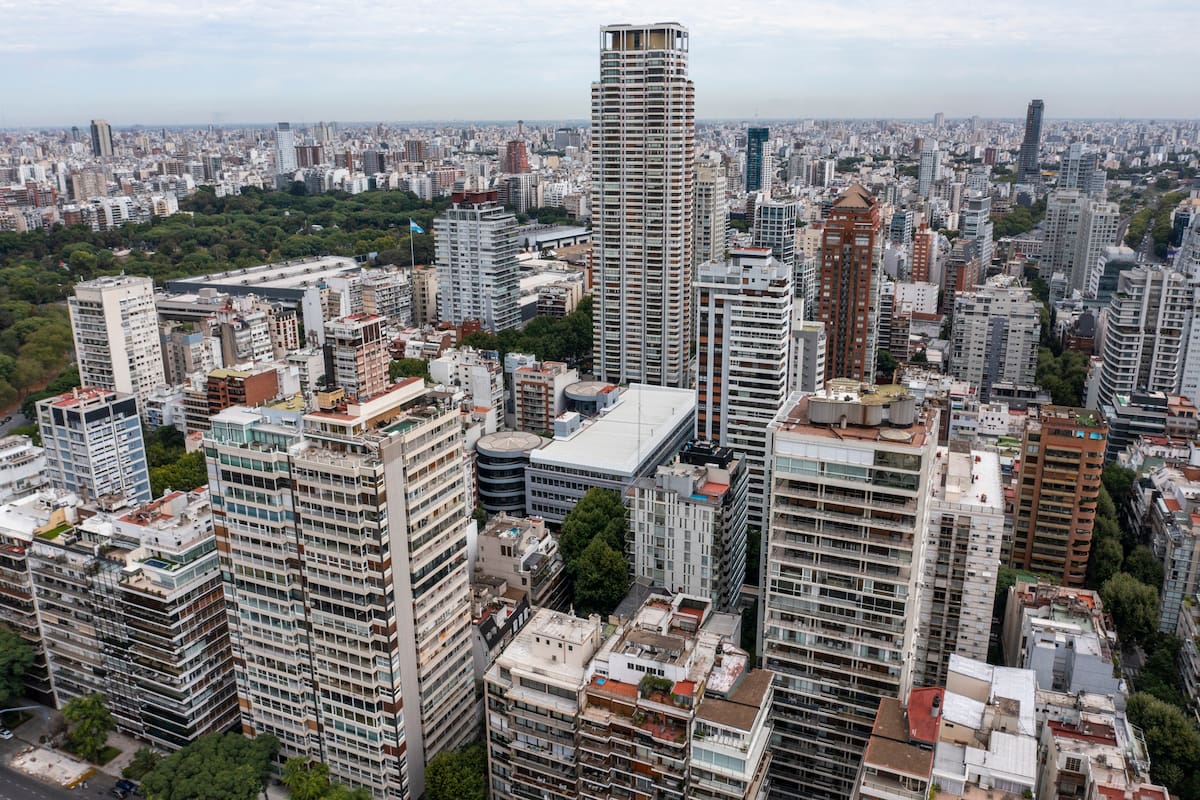
Buenos Aires, with its 3.1 million inhabitants in 203 km², is one of the densest cities in Latin America. However, the real estate market is experiencing a paradox: while in Madrid, with 3.5 million people, there are barely 16,000 properties for sale, in Buenos Aires the number exceeds 113,000. This is revealed by the May Radar Inmobiliario report, which marks 12 consecutive months of year-on-year stock growth.
“The current stock in the city is above what the market needs,” says Gabriel Brodsky, CEO of Grupo Predial. But not all specialists agree that there is an excess of supply. Maximiliano D’Aria, commercial director of the homonymous real estate agency, points elsewhere: “Today the problem lies in demand affected by lack of credit, little legal certainty, and little stability, rather than an oversupply.”
The fact is, according to Diego Cazes, general manager of L.J. Ramos, “there is a lot of repeated product and not so much of what sells easily.” So, what actually sells? Brokers agree that two-room apartments lead in sales speed. “They represent the balance between affordability and functionality,” explains Gabriela Goldszer, director of Ocampo Propiedades. They are followed by three-room units, which gained ground with home office. According to Juan Manuel Vázquez Blanco, economist and general manager of Fabián Achával, these two typologies accounted for 59% of transactions in 2025 and the first quarter of 2026.
But there is an exception: studio apartments. Despite being small, “they take time to sell because there is quite an oversupply,” according to Cazes. At the other end, large units of 170 to 180 m² also suffer. “They are the ones that take the longest to sell because they are not for investment, but for family housing,” says Carola Fernández Berisso, manager of the residential sector at Achaval Cornejo.
Location is key. “Oversupply coexists with specific shortages in specific segments: three-room units well located in Palermo and Belgrano, new units with parking in middle-class neighborhoods,” details Vázquez Blanco. During 2025, Palermo concentrated 19.2% of transactions, followed by Belgrano with 17% and Recoleta with 13.3%. In the south, the lack of credit hits hard.
Specialists emphasize that price is the determining factor. “Today the market heavily penalizes properties that start overvalued,” warns Mateo García, residential director at Toribio Achával. “There is no oversupply in the right product: what is well located, well designed, and well valued gets absorbed,” summarizes Goldszer.
In summary, if you are looking to buy, avoid studios and very large apartments. Go for a two- or three-room unit in neighborhoods like Palermo, Belgrano, or Núñez, and make sure the price is realistic. Oversupply does not forgive.

Para mí 113 mil propiedades y los precios siguen siendo una estafa. Esto huele a especuladores forrados en guita mientras los laburantes no pueden alquilar ni un cuchitril. Yo creo que hay que expropiar ya toda la vivienda ociosa, estos chantas venden depto falopa a precios de usura. ¡Basta de negociar con la necesidad!
Para mí esto es una estafa kirchnerista: 113 mil propiedades y los zurdos de mierda no bajan impuestos. Comprá en Recoleta o Palermo si querés ganar plata, sino perdés todo. El mercado libre es la solución, no estos vagos.