
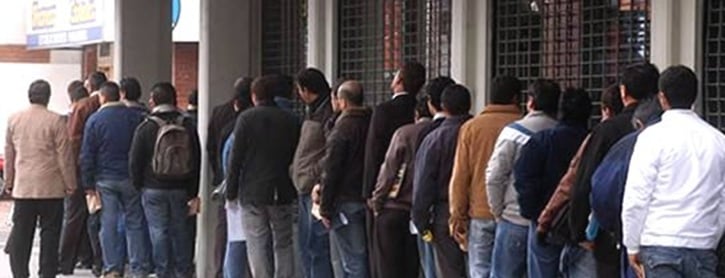
The dream of stable employment is fading for young Argentines. According to a devastating report by the Éforo Foundation, the combination of labor reforms, technological advancement, and deindustrialization is creating a time bomb: youth informality has soared to 68%, well above the Latin American average, while unemployment in that segment already doubles and triples the overall rates.
Data from INDEC for the first quarter of 2026 is stark: 44.2% of the economically active population works off the books, the highest level in history. That means millions of people without pension contributions, health insurance, year-end bonus, paid vacations, or severance pay. But the tragedy hits the youngest hardest: the International Labour Organization (ILO) revealed that six out of ten Argentines aged 15 to 24 are in informality, a rate of 68% that far exceeds the 54% in Latin America.
Unemployment also strikes mercilessly. While the overall rate is 7.8% (over 1.1 million people), among those aged 14 to 29 it jumps to 16%, nearly triple. Young women fare even worse: 16.8% unemployment, compared to 16.2% for men. And worse still, many have been looking for work for over a year without success.
The vice president of the Éforo Foundation, Carla Pitiot, does not mince words: “Young people face the highest levels of inequality and precarity when entering the labor market.” And she points directly to the labor reform pushed by the government and approved in early 2026. The numbers would seem to back her up: between December 2023 and June 2026, 314,000 formal salaried jobs disappeared. In the last year alone, the loss was 119,000 registered jobs, and in March 2026, 7,600 positions were eliminated in private companies.
Informality grew 1.2 percentage points in just three months, and the Foundation estimates it could increase by up to four points over the year. That not only makes workers more precarious but also undermines the pension system. According to calculations, each extra percentage point of informality represents a loss of $975 million in contributions, and if it rises four points, the state would lose $4 billion in revenue. ANSES and PAMI, which depend on those contributions, would suffer.
Éforo’s research with young people aged 18 to 25 paints a bleak future: most no longer believe it is possible to access a formal, stable job. They envision a horizon of multiple odd jobs, ventures, freelance work, or income from diverse sources. Fewer and fewer consider a university degree a guarantee of stability; they prioritize quick income over a long, uncertain academic path. However, they value experience and call for policies that link education with work.
Pitiot insists the challenge is to design public policies that adapt the labor market without sacrificing rights. But in the meantime, the reality is brutal: young Argentines are being left out of the system, condemned to precarity and uncertainty. The question is: how long can a country that lets its new generations fall be sustained?
Fuentes consultadas
- Periódico Tribuna
- INDEC Fuente primaria
El Sereno contrastó las fuentes enlazadas y añadió contexto, comparación o análisis documental. Las fuentes primarias están identificadas. La nota no se presenta como investigación de campo ni como entrevista propia, salvo indicación expresa.



Comentarios