
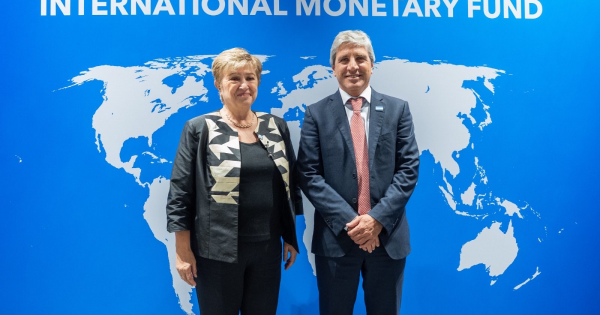
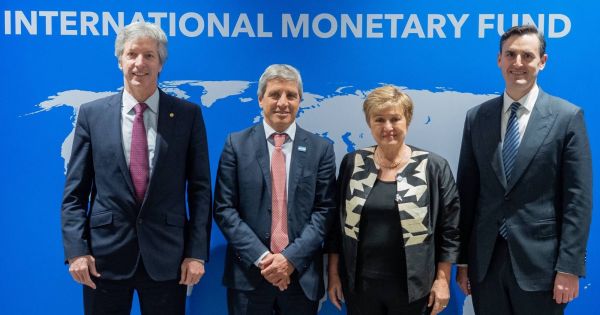
IMF Managing Director Kristalina Georgieva said during a panel in Thailand that Argentina will pay off its entire debt to the organization early, with the original maturity scheduled for 2034. The official compared Argentina’s case to Greece’s and argued that both countries «learned their lesson and put their house in order.» Economy Minister Luis Caputo, present on the same panel, responded: «You’ll be surprised, yes. That is already happening. It’s a big challenge for Argentina.»
The statements came in the context of the third review of the economic program agreed between Argentina and the IMF. According to the news report, the government aims to sustain the fiscal surplus and strengthen international reserves. The Central Bank would have accumulated more than US$15 billion in foreign currency purchases during 2026, with 732 million added in October, according to that source.
What the official projected payments document says
The primary source is a TSV-format download published by the IMF, updated as of June 30, 2026, detailing Argentina’s projected payments to the organization in Special Drawing Rights (SDRs). The document includes maturities for basic charges, level- and time-based surcharges, net SDR charges, and Extended Fund Facility (EFF) repurchases.
For 2026, the total annual amount recorded is SDR 2,082,529,842. For 2027, the projected sum is SDR 5,650,460,371. In 2028, the total reaches SDR 7,004,829,747. In 2029, projected payments amount to SDR 7,792,755,072. The document continues with records extending through 2030 and beyond, although the material provided does not allow establishing the total accumulated amount through 2034.
The spreadsheet does not contain a projection of early cancellation or an estimated date for full payment. Nor does it include an SDR exchange rate against the dollar or the Argentine peso. For that reason, this outlet does not convert the amounts into other currencies: the official document expresses them exclusively in SDRs and no reference exchange rate is available in the material.
Contrast between the political statement and the official spreadsheet
The news report attributes to Georgieva confidence that Argentina will pay before 2034. That statement comes from a secondary source, as it is a journalistic coverage of a public panel. The IMF spreadsheet, by contrast, is a primary source: it records projected payments with certain dates and amounts in SDRs, but does not mention any early cancellation.
Both sources agree that Argentina has debt maturities with the IMF. The key difference is that the news report informs about a political expectation expressed on a panel, while the official document describes scheduled financial obligations. Neither source on its own confirms that early cancellation will occur or that it is already underway.
The news report also mentions fiscal data attributed to the Fundación Mediterránea: reductions in discretionary spending of 37% in 2024, 12% in 2025, and a projected 6% drop in 2026 to reach a primary surplus of 1.3% of GDP. According to those figures, the IMF would have agreed to a primary surplus of 1.4% of GDP. These data do not appear in the official payments spreadsheet and cannot be verified with the available primary source.
What each document establishes and what it does not
| Document | What it establishes | What it does not establish | Open questions |
|---|---|---|---|
| News report (secondary source) | Statements by Georgieva and Caputo on a panel in Thailand; context of the third review of the program; BCRA reserve data and fiscal estimates from the Fundación Mediterránea. | Does not reproduce the official payments document or detail amounts in SDRs. Does not confirm that early cancellation has already occurred. | What is the exact text of the statements? What methodology did the Fundación Mediterránea use for its projections? |
| IMF, official TSV download as of 06/30/2026 (primary source) | Projected payments from Argentina to the IMF in SDRs, with dates and concepts, for 2026, 2027, 2028, 2029, and later years. | Does not mention early cancellation. Does not include an SDR exchange rate. Does not detail the total accumulated through 2034. | What is the total projected amount through 2034? How would an early payment be financed? What exchange rate would apply? |
Value module: comparison of annual totals in SDRs
The following table identifies the annual totals of projected payments appearing in the official IMF spreadsheet. No currency conversions are made because the document does not include an SDR exchange rate.
| Year | Projected total (SDR) | Document | Organization and date | Unit | Values used | Operation |
|---|---|---|---|---|---|---|
| 2026 | 2,082,529,842 | Projected Payments to the IMF as of June 30, 2026 | IMF, updated as of 06/30/2026 | SDR | Sum of basic charges, surcharges, net charges, and EFF repurchases for 2026 | Annual total reported in the document |
| 2027 | 5,650,460,371 | Projected Payments to the IMF as of June 30, 2026 | IMF, updated as of 06/30/2026 | SDR | Sum of basic charges, surcharges, net charges, and EFF repurchases for 2027 | Annual total reported in the document |
| 2028 | 7,004,829,747 | Projected Payments to the IMF as of June 30, 2026 | IMF, updated as of 06/30/2026 | SDR | Sum of basic charges, surcharges, net charges, and EFF repurchases for 2028 | Annual total reported in the document |
| 2029 | 7,792,755,072 | Projected Payments to the IMF as of June 30, 2026 | IMF, updated as of 06/30/2026 | SDR | Sum of basic charges, surcharges, net charges, and EFF repurchases for 2029 | Annual total reported in the document |
The difference between the 2026 total and the 2029 total is SDR 5,710,225,230. Taking the 2026 total as a base, the nominal increase relative to 2029 is approximately 274.2%. This operation results from dividing the difference by the 2026 total and multiplying by 100. It is clarified that this is an arithmetic comparison between annual totals from the same document, not a growth projection or an estimate of payment capacity.
What data or decision should be monitored
The key data point to monitor is the evolution of the third review of the program between Argentina and the IMF, because disbursements and the payment schedule depend on it. It is also worth following the publication of future updates to the official projected payments spreadsheet, to verify whether the SDR amounts change or whether any early cancellation modality is incorporated. At the same time, it will be relevant to observe whether the government formalizes any early payment operation and with what instruments, since neither the news report nor the official document provided details that mechanism.
Fuentes consultadas
- Crónica
- Fondo Monetario Internacional Fuente primaria
El Sereno contrastó las fuentes enlazadas y añadió contexto, comparación o análisis documental. Las fuentes primarias están identificadas. La nota no se presenta como investigación de campo ni como entrevista propia, salvo indicación expresa.

Comentarios