
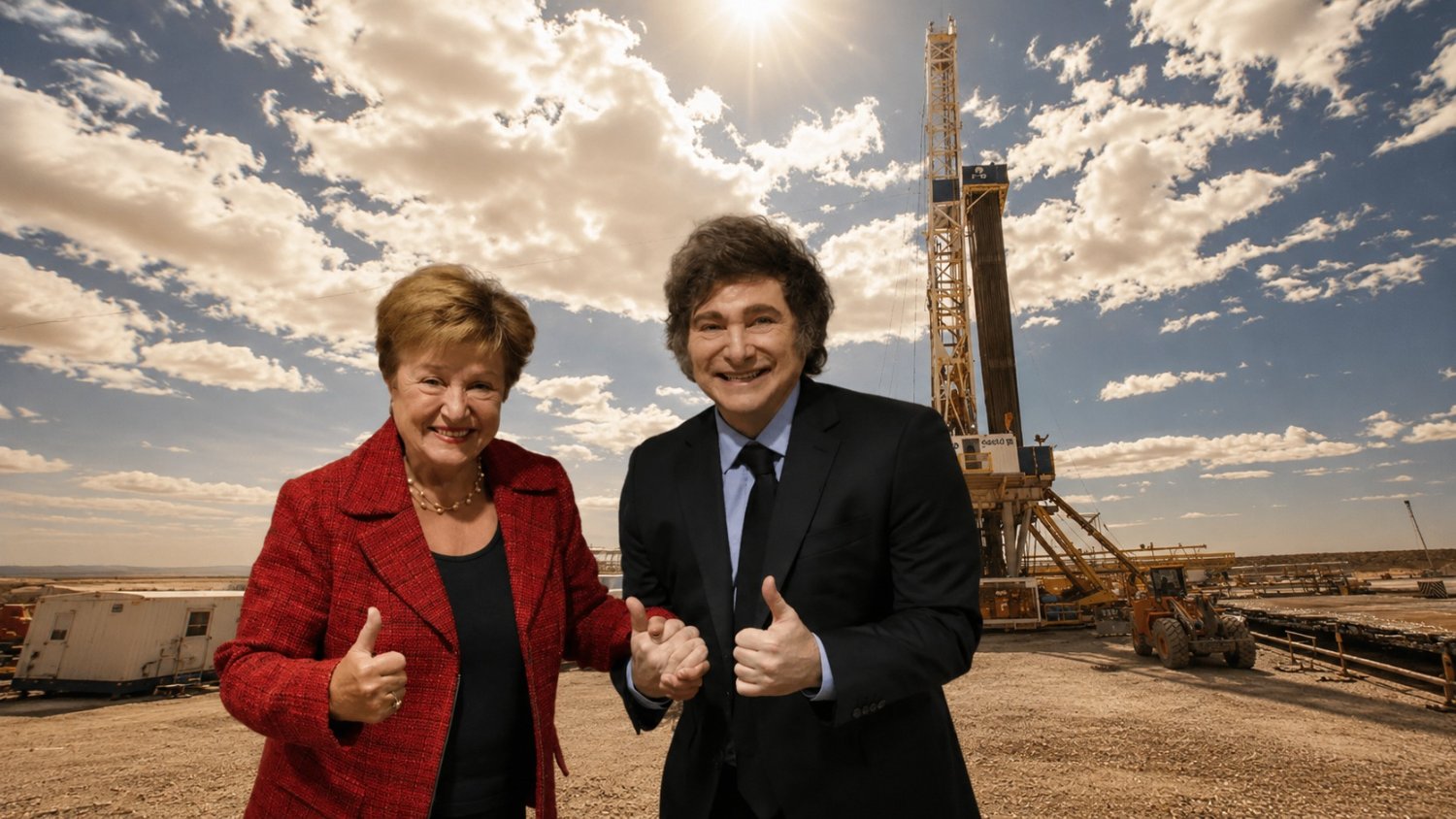
International Monetary Fund (IMF) Managing Director Kristalina Georgieva arrives in Argentina next Monday with an agenda that leaves no doubt about the organization’s priorities: meetings with President Javier Milei and Economy Minister Luis Caputo to oversee the austerity plan, and a visit to Vaca Muerta, the heart of the extractivist model the government is pushing to generate the dollars needed to pay off debt.
The IMF does not hide its demands. In recent weeks, it has backed Milei’s economic program, supported the reform of the Central Bank’s charter, and celebrated Caputo’s financial plan. IMF spokesperson Julie Kozack said these reforms will strengthen market confidence and facilitate Argentina’s return to international financing. Meanwhile, austerity continues to fall on the most vulnerable sectors: pensions, salaries, and public universities are the main victims.
Caputo himself acknowledged that the room for further cuts in public spending is shrinking, but the commitment with the IMF is to achieve a primary surplus of 1.4% of GDP by year-end. Capital flight shows no signs of stopping: since the partial lifting of currency controls in April 2025, private dollar purchases have exceeded $37 billion, most of it going to millionaires who evade restrictions.
Debt maturities are overwhelming. In 2026, $4.2 billion will be paid to the IMF, and in 2027, $7.5 billion. The interest alone for those two years – $6.2 billion – is double what is needed to comply with the University Law and equals two full months of pensions and retirement benefits. While the economy stagnates, the government prioritizes payment of a fraudulent debt.
Exports are not enough to cover maturities, even with record figures. Therefore, a central goal of Georgieva’s visit is to promote the issuance of new dollar bonds to tap international markets. It is the same vicious cycle as during the Macri administration: turning to the IMF to pay private creditors, and now borrowing from big capital to pay the Fund itself.
The visit to Loma Campana, one of Vaca Muerta’s main developments, reflects the strategic role of the hydrocarbon sector. The government is betting that increased oil and gas exports will provide the foreign currency needed to sustain the financial scheme. To that end, it has pushed through extraordinary benefits for large companies, such as the Large Investment Incentive Regime (RIGI), which guarantees tax reductions, fiscal stability, and free availability of foreign currency for 30 years.
Among the beneficiaries are the main oil companies operating in Vaca Muerta, while new projects continue to be approved under this regime. The official discourse presents these measures as essential to attract investment, but in reality they imply a massive transfer of public resources to national and multinational economic groups, which will obtain extraordinary profits by exploiting the territory through fracking, a method with serious environmental consequences.
Argentina’s history shows that IMF programs do not solve structural problems but rather worsen them. Export dollars end up absorbed by debt payments, profit remittances, and capital flight. The result is an economy that deepens its dependence on extractivism and worsens living conditions for the majority.
Behind the official photos and speeches about stability, Georgieva’s visit reveals the true economic program: cuts for the majority and privileges for large business groups, with the country’s common assets placed at the service of paying a debt that subjects Argentina to the interests of imperialism.
Fuentes consultadas
- La Izquierda Diario
- Argentina.gob.ar Fuente primaria
- Argentina.gob.ar Fuente primaria
- Fondo Monetario Internacional Fuente primaria
El Sereno contrastó las fuentes enlazadas y añadió contexto, comparación o análisis documental. Las fuentes primarias están identificadas. La nota no se presenta como investigación de campo ni como entrevista propia, salvo indicación expresa.



Comentarios