

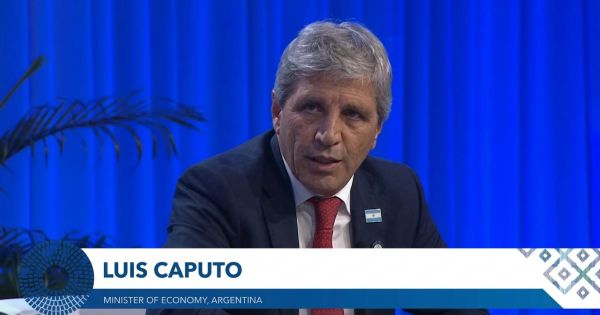
The Ministry of Economy announced changes to the Fiscal Innocence bill, aiming to expand the number of taxpayers who can access the regime and provide greater legal certainty. The initiative, presented by Minister Luis Caputo and the Legal and Technical Secretary of the Presidency, María Ibarzabal Murphy, modifies the law enacted in 2024 and seeks to respond to observations from tax experts.
Who can join and what benefits are maintained
According to the official statement, the bill eliminates the current requirements of annual income below one billion pesos and total assets up to ten billion pesos. Thus, all resident individuals and undivided estates in the country will be able to enter the regime, regardless of assets or income. The only caveat is that those considered «Large Taxpayers» by ARCA can join the simplified modality but will not enjoy the presumptions or liberating effects.
Minister Caputo stressed that the spirit of the law does not change: «The goal remains that those savings can be formalized in the banking system without any penalty.» According to official data, dollar deposits in the financial system amount to nearly $40 billion, but there is an amount more than four times that figure in savings outside the banking circuit.
When the tax authority can challenge the sworn declaration
One of the most relevant changes is the new threshold for ARCA to break the presumption of accuracy of the simplified sworn declaration. Today, if the challenge results in an increase of 15% or more over what was declared, the presumption automatically falls. The bill introduces a minimum floor: even if the 15% is exceeded, the presumption is maintained if the nominal difference claimed does not reach the equivalent of 5% of the evasion amount provided for in the Criminal Tax Law, which in concrete numbers is five million pesos.
Additionally, if ARCA detects a significant discrepancy, the taxpayer may file a corrective sworn declaration and pay the difference plus interest within up to 15 business days from notification of the official determination. If the challenge is rejected, the presumption of accuracy is fully restored, and ARCA must refund the contributions paid with interest within no more than 45 business days.
Practical impact on taxpayers and professionals
These changes aim to strengthen legal certainty, according to the official statement. However, a letter to the editor published in La Nación warns about the limits of the regime: the simplified sworn declaration grants a presumption of accuracy and liberating effects, but not immunity. Law 27,799 allows that protection to yield in the face of a significant discrepancy between what is declared and information from ARCA or third parties. The problem, according to the letter, is the origin of that discrepancy: a bank credit proves the entry of funds, but not its cause. It could be income, but also cancellation of a mortgage, repayment of a loan, or transfer between accounts.
The letter notes that tax bases record data, but not their cause, and that inconsistency generates requirements to explain legitimate operations. «The legal burden may be on the tax authority; the practical cost falls on taxpayers and professionals,» it states. Furthermore, if there are high formal fines, even without omitted tax, simplifying a form is not enough. «No reform should create a tax on error,» it concludes.
What immediate, conditional, and uncertain effects are expected
- Immediate: Taxpayers who currently could not join due to exceeding income or asset caps will be able to do so once the law is approved. Uncertainty about when the tax authority can challenge is also reduced by setting a minimum threshold of $5 million.
- Conditional: Benefits for «Large Taxpayers» are limited: they can use the simplified modality but will not enjoy presumptions or liberating effects. The possibility of rectifying within 15 business days depends on ARCA notifying the official determination.
- Still uncertain: The real impact on formalizing savings depends on the confidence the regime generates and the practical application of the new thresholds. The letter to the editor suggests that controversies could arise over the origin of bank credits, which could generate new requirements.
What data to follow
The bill still needs to be considered by Congress. It is advisable to follow the final wording of the law, especially the definition of «significant discrepancy» and the deadlines for rectification. It will also be key to observe how ARCA implements the new thresholds and whether taxpayers who join manage to avoid future contingencies. The evolution of dollar deposits and the number of adhesions to the regime will be indicators of the measure’s success.
Fuentes consultadas
- LA NACION
- Argentina.gob.ar Fuente primaria
El Sereno contrastó las fuentes enlazadas y añadió contexto, comparación o análisis documental. Las fuentes primarias están identificadas. La nota no se presenta como investigación de campo ni como entrevista propia, salvo indicación expresa.


Comentarios