
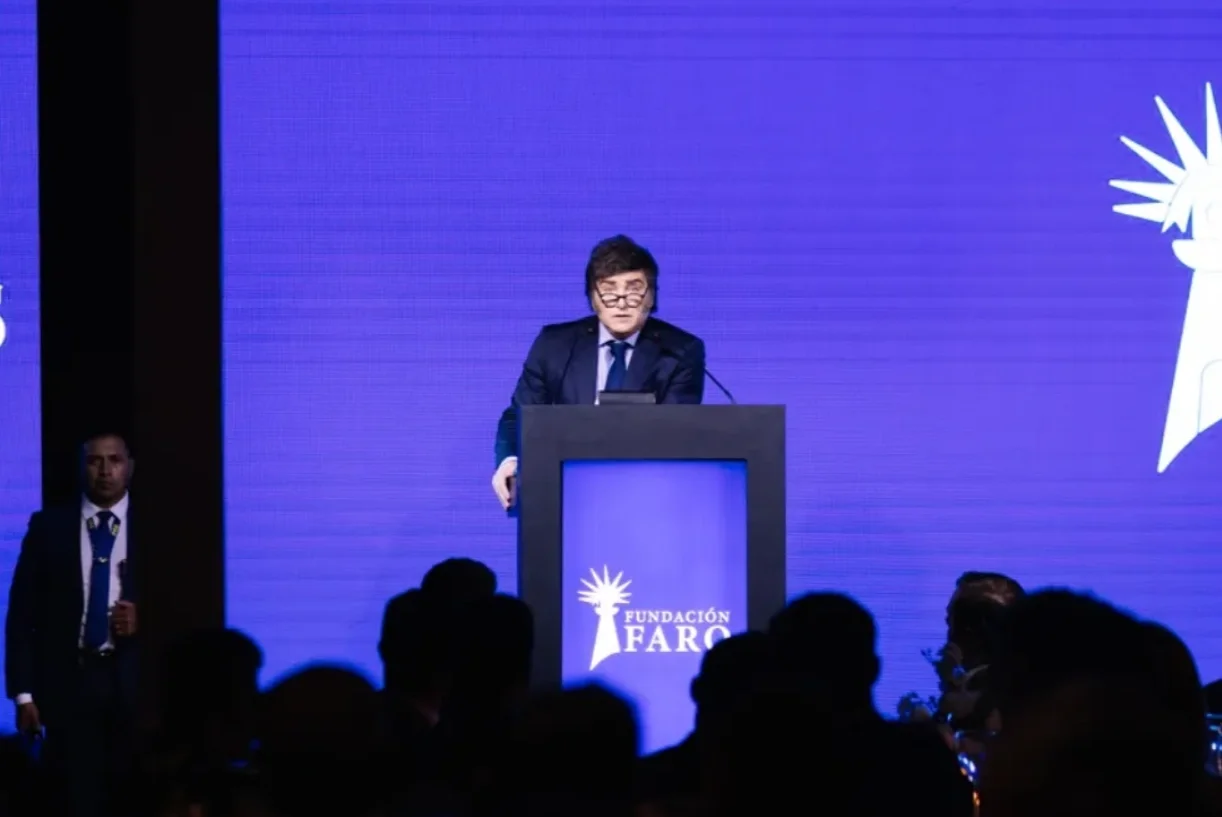
In a speech that went unnoticed by most, Javier Milei dropped an atomic bomb on the state. On Wednesday, at the Faro Foundation, the president did not just talk about fiscal deficit or inflation. He went much further: he proposed replacing traditional state functions with private insurance. An idea that, if realized, could retire the bureaucracy at a stroke.
The proposal, based on the work of economist David Friedman, questions the very reason for much of the state machinery. For decades, Argentines debated whether the state should be larger or smaller. Milei proposes something more radical: asking whether many of those functions should exist in the hands of the state in the first place.
The difference is abysmal. Privatizing is changing ownership. But the logic of insurance changes the incentive system. Bureaucracy reacts when damage has already occurred. Insurance, on the other hand, has a direct economic interest in preventing that damage from happening. Someone who insures a home invests in fire prevention. Someone who insures a car promotes responsible behavior. The incentive shifts from managing the problem to preventing it from arising.
That economic principle, barely outlined in the presidential speech, could have revolutionary consequences. For generations, Argentines were educated under the idea that every social need requires creating a public office, hiring employees, approving new taxes, and expanding administrative structures. That logic built an increasingly larger, more expensive state that, paradoxically, became less and less capable of fulfilling the functions it claimed to protect.
The tradition of the Austrian School has been pointing out this problem for decades. Ludwig von Mises showed that without prices generated by voluntary exchanges, it is impossible to allocate resources efficiently. Jesús Huerta de Soto expanded that reasoning by showing that all institutional coercion destroys the entrepreneurial ability to discover better solutions. The result is not just a more costly state. It is a society that loses innovation because decisions cease to arise from millions of individuals and become concentrated in a bureaucracy incapable of processing all dispersed information.
David Friedman takes that logic a step further. If private incentives work better for preventing risks than state administration, then many tasks traditionally monopolized by the state can be organized through voluntary contracts. Not because of an abstract moral superiority of the market, but because economic incentives produce better results.
Therein lies perhaps the most uncomfortable aspect for Argentine progressivism. For years, it built its power by promising state protection against any uncertainty. Every problem found the same answer: more regulation, more public agencies, more spending, and more taxes. However, experience shows that this path ended up generating the exact opposite of what it promised: more poverty, more insecurity, more bureaucracy, and less capacity to resolve conflicts.
The proposal that Milei put on the table completely reverses that logic. Instead of a state that monopolizes protection, a society emerges where incentives reward prevention, efficiency, and individual responsibility. The citizen ceases to be a passive beneficiary of public policies and becomes an actor who makes decisions and assumes the consequences of their choices.
That is why this discussion far transcends the economic situation. It is not just about lowering taxes or reducing ministries. It is about replacing a model based on the concentration of power with one where voluntary cooperation and incentives coordinate solutions that no state office can plan from above.
Perhaps that is why the idea went almost unnoticed amid the daily political noise. However, deep transformations often begin exactly like this. First, they appear as an intellectual hypothesis. Then they become the subject of debate. Finally, they end up modifying institutions that for decades seemed untouchable.
If fiscal balance was Milei’s first great battle, the insurance revolution could become the next chapter of a much more ambitious transformation: demonstrating that freedom not only produces more wealth. It can also offer better answers where the state built a monopoly of failures for decades.



Para mí esto es un golazo de Milei. Burocratas lacras a laburar de verdad, el Estado es una estafa. Viva la libertad carajo, que el mercado decida todo. Chau zurdos de mierda, esto huele a anarquía capitalista y me encanta.
Para mí este Milei está re loco, quiere reemplazar al Estado con seguros privados, o sea, que los empresarios se llenen de guita mientras el pueblo se pudre. Esto huele a neoliberalismo del orto, es el fin del estado de bienestar. Yo creo que es una cagada, viva la lucha de clases carajo. Firmado: El Bolchevique de Palermo.