
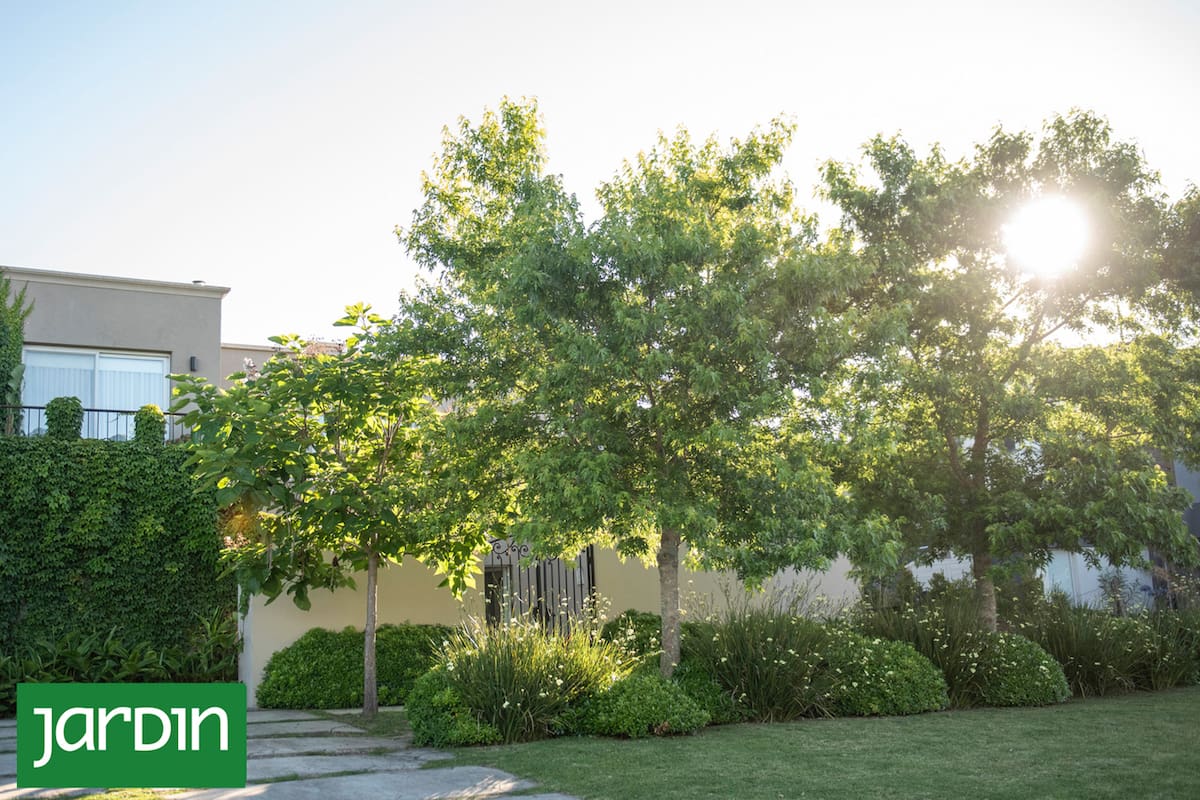
She imagined it years ago, built it with patience, and let it evolve. Amid flowers, shade, workshops, and an unexpected flower shop, Mechi Camargo’s garden in Ingeniero Maschwitz tells a story of perseverance and vision. This landscape designer cultivated her green space over years following a clear idea: that it be an extension of the house and also of her character.
Today it is an intimate space, built little by little and with little, where symmetry coexists with surprises and each season has something to show. You have to enter through the front, cross the patio, and go through the entire house before arriving. «I try to make the garden have attractions at different times of the year, so there is always a reason to go out and enjoy it,» says Mechi.
A landscape designer by profession and an observer by trade, she designed this space with classic lines, plenty of symmetry, and rhythm. The pool is in the center and that orders everything. «It is undoubtedly what determines the different spaces: the solarium, the fire pit, the play area for the kids, and a shaded area with trees.» That decision cost her arguments with her husband, who imagined the garden as a soccer field, but she stood firm.
The garden was put together little by little because the budget was tight. Mechi propagated her own plants, divided them, moved them. «A lot of work and effort,» she says. «The only thing I do spend on is good soil, which I believe is the key to success in the flower beds.» Over the years, the trees grew and the shade gained ground. Far from seeing it as a problem, Mechi accepts it as another stage in the garden’s life: she incorporates new species that tolerate shade, adjusts formative pruning.
«It evolves because the plants grow, but since everything is thought out, it increasingly takes the shape I imagined.» That phrase sums up her way of understanding landscaping: not as a still photo, but as something alive that develops. Being a landscape designer in her own garden has its paradoxes. Mechi acknowledges the technical advantage, but she also knows how to relax. «I always say that in the blacksmith’s house, the knife is made of wood. Here, we do what we can.»
She doesn’t feel the pressure of others’ gaze, and that — she says — is a privilege. What she does keep intact is the habit of observing: walking around, correcting, detecting a pest in time, making room for the plant that needs it. «These are small actions that make a big difference.» The newest addition to the garden is a greenhouse that arrived before she knew exactly what it would be used for. The spot was already planned; the use came later. Since she likes making bouquets, she started bringing flowers from the market, and almost without meaning to, she set up a flower shop at home. Next year she wants to use it for germination. She still needs to find the time.
She also gives workshops, rotating, once a week, at different students’ homes. Each class is a different garden and a new problem to solve. «Nice groups form and we share plants and experiences.» Teaching, like the garden, works best when it’s an exchange. Mechi says she doesn’t have a favorite spot. She enjoys each space according to the season, and above all, «I love looking at it!» And in that simple phrase is perhaps the key to everything: a garden that, after so much work, makes her want to stay.



para mi esto es lo q necesita la burguesia su propio paraiso mientras el resto se pudre q viva rodeada de flores mientras nos chorean en el subte me parece un cago de risa ojala le expropien el jardin y lo hagan huerta comunitaria firma el che de maschwitz
Para mí esto huele a cuento de chetos progres. Mientras esta mina se hace la hippie con sus flores, los paisajistas criollos se cagan de hambre por culpa de inmigrantes truchos que vienen a chorear laburo. ¡Basta de progres de mierda! Firmado: ElGauchoPensante.