

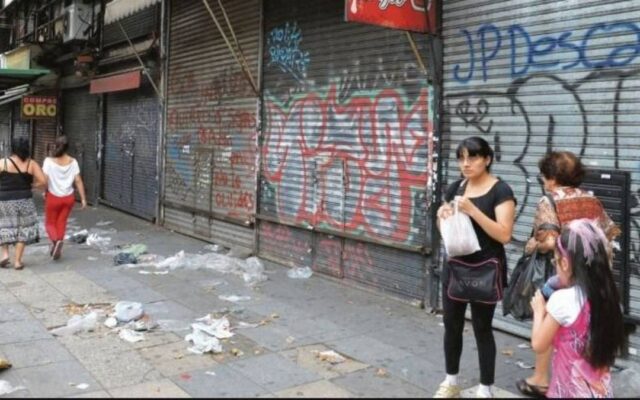
The economic crisis shows no respite, and the Argentine labor market is being reshaped with sheer precariousness. A new report from the Center for Worker Innovation (CETyD) shakes the board: so-called «refuge jobs» — informal odd jobs, subsistence self-employment, and low-productivity work — are multiplying as a desperate strategy in the face of a lack of registered employment. The phenomenon is no longer exclusive to the AMBA: it reaches all provinces and exposes the fragility of a model that fails to generate quality jobs.
According to the study, between early 2025 and the first quarter of 2026, formal private employment and registered independent workers together lost 242,000 positions. In parallel, the informal sector exploded: it added 274,000 unregistered salaried workers and 360,000 informal independent workers. The informality rate climbed to 44.2%, a number that hits directly at the table of those who still believe the problem is only in Buenos Aires.
The CETyD report is damning: the increase in employment does not respond to the creation of genuine jobs, but to a subsistence escape valve. Industry, once the country’s engine, continues to show signs of weakness. The Predictive Employment Indicator (IPE-CETyD) anticipates that the decline in registered employment could moderate in the coming months, but without reversing. And industry will remain the weakest link.
The hardest-hit provinces are Santa Cruz, Formosa, and Chaco. There, the total halt in construction — both public and private — wiped out opportunities. In Santa Cruz, the decline in hydrocarbon production in the Gulf of San Jorge Basin further aggravated the situation. Heads of household take refuge in odd jobs that are not even enough to cover basic needs. The same story repeats in Misiones, Catamarca, Corrientes, and Santiago del Estero.
On the flip side, Neuquén and Río Negro show the exception that proves the rule. Thanks to the Vaca Muerta boom, these provinces managed to sustain and even increase registered employment, with the largest drops in unemployment and precarious underemployment. But they are islands in a sea of uncertainty.
The deterioration of purchasing power is another key factor. During the first quarter, private sector wages grew below inflation, and disposable income shrank even further due to increases in fixed expenses such as housing, public services, transportation, and communications. Between January and March, disposable income fell twice as much as total wages (-5% vs. -2.5%). That explains why more and more members of the same household go out to look for odd jobs or increase their working hours to compensate for the loss of income.
The CETyD report leaves no doubt: registered employment remains weak, industry is not recovering, and unemployment finds its escape in low-quality occupations. «Refuge jobs» are the picture of an Argentina that is forcibly adapting to a labor market that no longer promises, only survives.

Para mí estos vagos de siempre viven del laburo ajeno y ahora la informalidad explota gracias al kirchnerismo que destruyó la economía. Me parece que menos plan social y más laburo honesto, carajo. Esto huele a zurdos de mierda festejando mientras el país se va al carajo. @Patriot Arg
Para mí este gobierno nefasto nos tiene reventados, laburando en negro mientras los empresarios se llenan los bolsillos. ¡Son una lacra! La culpa es toda del ajuste capitalista, quieren precarizar hasta los huesos. Abajo el FMI y los vendepatria, huelga general ya! ¡Viva la clase obrera!