
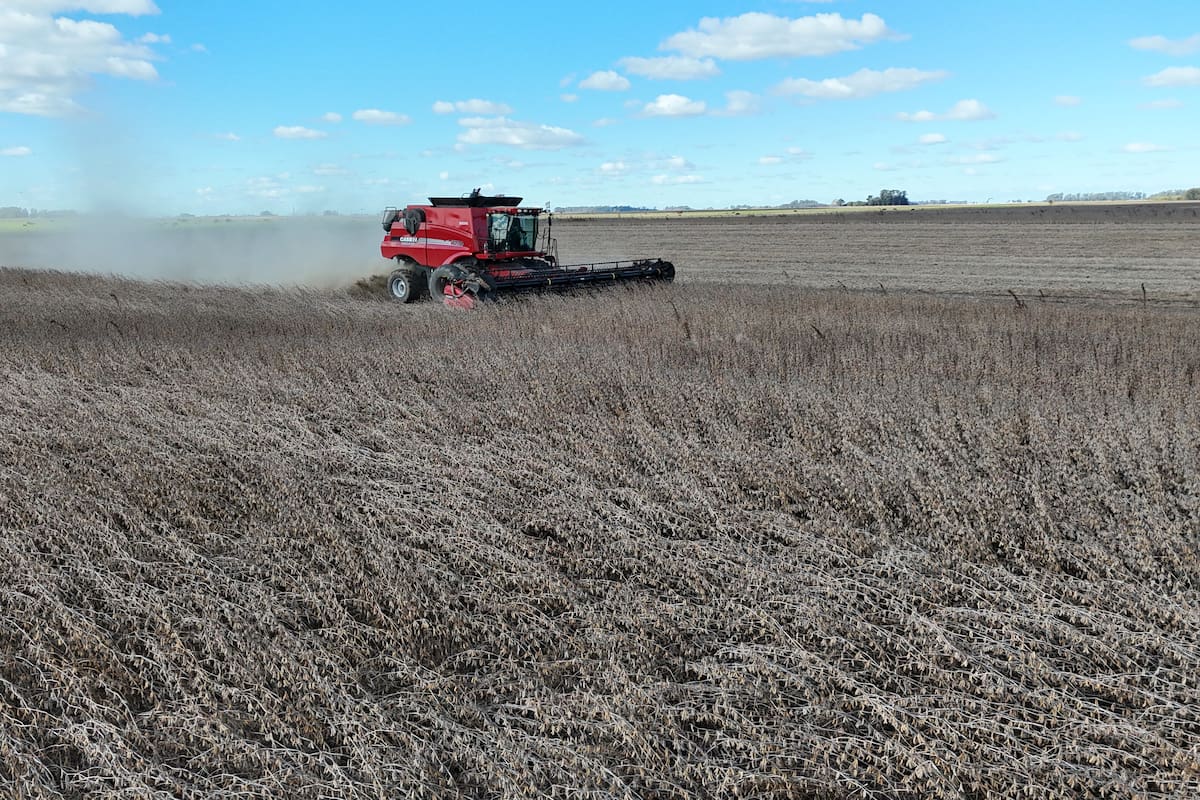
The policy of export taxes on agricultural products appears in two materials: an editorial from the newspaper La Nación and a press release from the Ministry of Economy about the visit of Minister Luis Caputo to the 2026 Palermo Rural Exposition. Both sources mention reductions in export taxes, but they differ in scope, data, and the timeline for total elimination.
Official measures and statements from the Ministry of Economy
The Ministry of Economy’s press release records that Caputo visited the 2026 Rural Exposition in Palermo, accompanied by Deputy Minister José Luis Daza, Secretaries Sergio Iraeta and Federico Furiase, BICE Director Felipe Núñez, BCRA President Santiago Bausili, and Director Martín Vauthier. They were received by the President of the Argentine Rural Society, Nicolás Pino, and Directors Eloisa Frederking, Mario Gramisu, and Carlos Odriozola.
In that context, Caputo stated: “we have lowered taxes and tariffs on capital goods, allowed the import of machinery even if used, and lowered export taxes.” He also said that “the countryside is a fundamental engine that valued these measures from the start by investing to produce and export more” and that “before 2031 our goal is to end the martyrdom of export taxes.” The press release does not detail percentages, timeline, or regulatory instruments.
The event included a presentation by Agrovisor, described as an intelligent monitor that analyzes the market to detect commercial opportunities in the agro-industrial sector. Caputo also participated in the awarding of the Grand Champion Male Hereford Prize to the San Marón Ranch of Chubut; Daza presented an award to Horacio and Martita Lavalle of Las Tranqueras Ranch, and Bausili to Gabriel Jaca of Txapela Ranch.
Data cited by the La Nación editorial
The editorial in La Nación maintains that since the Milei government took office, some export taxes were gradually lowered and others eliminated. It does not specify dates or amounts for each measure. It mentions that the Minister of Economy acknowledged that between January and August, agro-industrial exports grew 13% compared to the previous cycle, with revenues of 37.527 billion dollars.
The editorial also cites increases in foreign sales: sunflower, 869%; sawn wood, 25% compared to 2025/2026; and stemmed tobacco, 18%. It identifies buyers as India, China, and Vietnam, followed by Brazil, the United States, Chile, Peru, Saudi Arabia, and Malaysia. It mentions products such as oregano, roasted non-decaffeinated coffee, coriander and clover seeds, kiwi, jojoba oil, and tomato preparations.
Regarding the 2026/2027 campaign, the editorial attributes to a study by the Buenos Aires Grain Exchange the following projections: 37,020,000 hectares cultivated, a growth of 0.2% over 2025/2026; production with growth of 0.5%; total agricultural production of 157.9 million tons compared to 157.1 million in the previous campaign; sector exports with growth of 6.9% to 41.497 billion dollars; and Gross Agro-industrial Product of 54.297 billion dollars. The editorial does not reproduce the original document or its methodology.
The editorial also cites the President of the Grain Exchange, Ricardo Marra, who reportedly highlighted that agro-industrial competitiveness depends on a broader agenda, including infrastructure, logistics, financing, market access, tax and regulatory simplification, innovation, intellectual property, and predictability for investors. These statements do not appear in the official press release.
Coincidences, differences, and limits between the sources
Both sources agree that the Government applied reductions in export taxes and that Caputo visited the Rural Exposition. However, the editorial presents these visits as “unexpected visits to agricultural entities by political leaders” without naming Caputo in that passage, while the official press release describes them as a protocol activity with SRA authorities.
The editorial is an opinion source: it includes assessments such as “exemptions absolutely incompatible with the principle of equality” or “confiscatory and Kafkaesque tax policy,” which do not appear in the official press release. The Ministry of Economy’s press release is an official statement that records the visit and Caputo’s statements, but does not provide export data or production projections.
Neither source allows independent verification of the export growth figures or the Grain Exchange projections. The editorial cites a study by the Grain Exchange, but does not reproduce the original document or its methodology. The official press release does not mention that study. Economic data should be attributed to the source that mentions them, without assuming that the other confirms them.
Value module: relationship between projected production and exports
The editorial in La Nación provides elements for a simple arithmetic relationship, provided the limits are made explicit.
- Document: editorial “On export taxes: less is more,” by La Nación.
- Organization and date: the editorial does not state an explicit date in the provided text; it refers to the 2026/2027 campaign and to Caputo’s statements from “these days.”
- Unit: millions of tons and millions of dollars.
- Values used: total agricultural production 2026/2027: 157.9 million tons; production 2025/2026: 157.1 million tons; sector exports 2026/2027: 41.497 billion dollars.
- Operation: production difference = 157.9 – 157.1 = 0.8 million tons. Export/production ratio = 41.497 billion dollars / 157.9 million tons = approximately 262.8 dollars per ton. This last operation is an arithmetic inference from data in the editorial; it is not presented as an official calculation in the source. The denominator is the projected total agricultural production, not exportable production or that of a specific crop.
No currencies or units are converted because the material does not provide an exchange rate, conversion factor, or exact date to do so. The original units are retained.
What data or decision should be followed
The data to follow is the eventual presentation of an official schedule for the total elimination of export taxes, mentioned by Caputo with a horizon before 2031. So far, neither the editorial nor the official press release details instruments, intermediate deadlines, or sectors covered. It is also advisable to monitor the publication of the full report by the Buenos Aires Grain Exchange to verify the projections for hectares, production, and exports cited by La Nación, and to contrast them with official revenue and foreign trade data.
Fuentes consultadas
- LA NACION
- Argentina.gob.ar Fuente primaria
El Sereno contrastó las fuentes enlazadas y añadió contexto, comparación o análisis documental. Las fuentes primarias están identificadas. La nota no se presenta como investigación de campo ni como entrevista propia, salvo indicación expresa.



Comentarios