
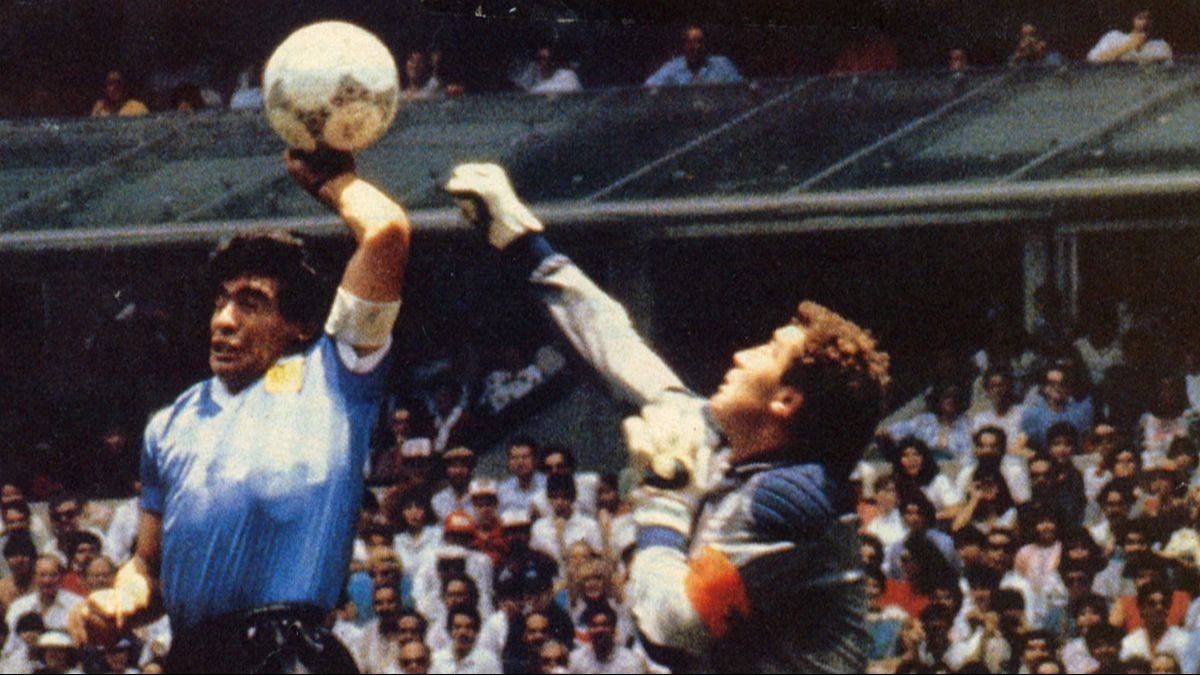
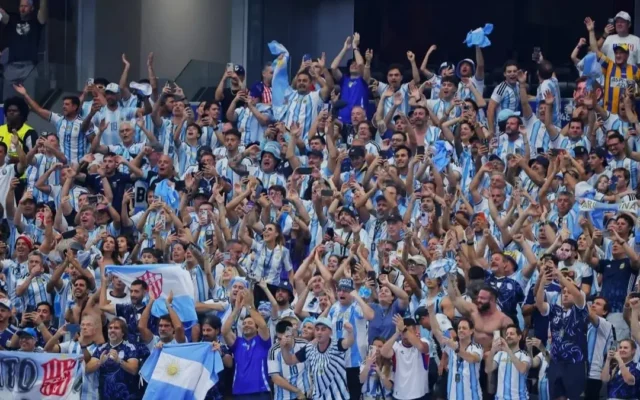
The final whistle of Portuguese referee João Pinheiro in the early hours of Sunday sparked popular celebrations in the streets and homes of Argentina. Messi’s team beat Sweden 3-1 in extra time and made it into the top four of the World Cup. For a few moments, perhaps a few hours, all attention was on the qualification, Julián Álvarez’s epic goal, the players’ embrace, Messi’s emotion, and the hope of reaching another final four years after Qatar. But the focus quickly shifted when realizing who the next opponent would be: England. That name alone, with its weight and meaning, changed the conversation from revolving solely around the national team’s performance, game strategy, or Lionel Scaloni’s possible changes, to something else. Before any technical or football analysis, an emotion difficult to explain had already emerged, sudden and unavoidable—a feeling both individual and collective, an almost instinctive reaction that millions of Argentines seemed to experience at the same time.
The attempt to dismantle it came with the first words and images: Maradona, the Falklands, the veterans, the banner with the poem «England, motherf***er,» the songs in the stands, the Goal of the Century, the Hand of God, the Darwin Cemetery in the Islands, the popular ingenuity that activates in moments like these. What we feel can be illustrated somehow on social media, with memes, tweets, and emotional content that, due to their power to strike a chord, are often highly effective in conveying messages and emotions. The debate moved to the media, then to the Argentine coach’s press conference, and echoed in everyday conversations: why is it impossible to experience an Argentina-England match as if it were just a football game?
The discussion is vast and says much more about Argentine society than about sports. Those who say «it’s just football» rightly recall that the players did not fight in the Falklands or were not born in 1982, that a semifinal is not a war rematch, that a game is not war, and that sports should not bear the burden of geopolitical conflicts. All that is true. However, that rational explanation quickly clashes with two things: a moving and mobilizing euphoria impossible to ignore; and the reality of a territory that remains occupied and a conflict in an ongoing diplomatic dispute. We could spend hours trying to downplay the matter, but the collective emotion appeared before the arguments.
French sociologist Pierre Bourdieu argued in his classic text Distinction that no game or sport is explained solely by its rules; they must also be understood in affective terms. To understand why a social practice like football mobilizes millions of people, money, investments, emotions, and life, he developed the concept of illusio, that is, the shared belief that what is at stake truly matters, is worth it. A concept that contrasts with contemporary notions of utility, profit, and benefit, typical of neoliberal economic doctrines. Illusio is not just about wanting to win a game, but about accepting that, for ninety minutes, a community deposits on that event a huge amount of expectations, affections, identities, and meanings. In that symbolic investment, sport becomes a social phenomenon and not mere entertainment. Seen from that perspective, tomorrow’s semifinal helps understand why not all tournaments, matches, or rivals occupy the same place in the collective imagination.
That this tension is not theoretical speculation but a social fact was demonstrated on Monday when the Federation of Falklands War Veterans «2 de Abril» deemed it necessary to intervene publicly through a statement addressed to society, the media, and political leaders. The text begins by acknowledging the emotion of seeing the national team among the top four in the world, but immediately introduces a reflection that transcends the sporting result: «Sport is not war.» From that premise, the veterans reject the idea of turning the match against England into a war rematch and argue that the claim for sovereignty over the Falkland Islands must be pursued through diplomatic channels, as established by the National Constitution. At the same time, later in the document, it vindicates the need for football to remain a space where the Falklands cause stays alive. In that sense, it asks fans to keep chanting «Malvinas Argentinas» in the stadiums, invites the match to serve to «Malvinize» and keep alive the memory of the 649 fallen, and recalls that history does not pause while a game lasts. The veterans’ position is particularly paradigmatic because it breaks a false dichotomy that dominates much of the conversation: it does not propose living the semifinal as a symbolic extension of the war, but neither does it accept the idea of a spectacle stripped of history. Between both extremes, the third position suggests separating sport from war, without separating it from collective memory.
Maurice Halbwachs argued that memory never belongs exclusively to individuals. We remember as members of a community that selects certain events or moments, makes them significant, relates them, and transmits them from generation to generation through stories, symbols, rituals, and commemorations. Collective memory functions as a permanent reconstruction of the past from the questions, concerns, and needs of the present. That is why some events remain alive and become part of identity, while others fade away. In that exercise lies one of the fundamental reasons why Argentina vs. England occupies a unique place in the national imagination.
On Wednesday at 4 p.m., a football match will begin at the Mercedes-Benz Stadium in Atlanta. That is indisputable. But it will also be the awakening of an event whose history began long before these players were born and will likely continue to generate debates long after the final whistle, whatever the result. When the ball moves, along with the Hand of God, the Goal of the Century, and the childhood of those who witnessed those wonders, there will also inevitably appear the memories of the Falklands, the claim for sovereignty, the names of the soldiers who died on the islands, those who died later, the sinking of the Belgrano, the conflictive relationship with a state never up to the task, the current situation of the veterans, and an unfinished discussion that continues to shape our identity. None of those points will be physically on the pitch, but they all form part of the meaning that millions of people attribute to the match.
Watch the 2026 World Cup in the best quality
These are the most sought-after TVs to watch the national team. All with 12 interest-free installments:
- Smart TV Kanji 32″ LED HD – From $120,000 in 12 interest-free installments (VAFTS9-89J3)
- Smart TV LG 43″ 4K UHD WebOS – From $450,000 in 12 interest-free installments (VAFTS9-WXW9)
- Smart TV Samsung 50″ 4K UHD – From $600,000 in 12 interest-free installments (VAFTS9-VVE0)
Approximate prices. 12 interest-free installments subject to each seller. Look for the codes on Mercado Libre.


para mi es una forrada comparar un partido con la guerra los mismos milicos q mandaron a los pibes a morir ahora salen a poner limites dejense de joder malvinas es argentina carajo vamos a ganarles pero no nos olvidemos de los q nos cagaron la vida
para mi ya basta de llorar con malvinas loco vamos argentina a romperles el orto a los ingleses como en el 86 con el diego los veteranos que se callen esto es futbol y sentimiento nacional a cagar a los piratas vamoooos carajo