
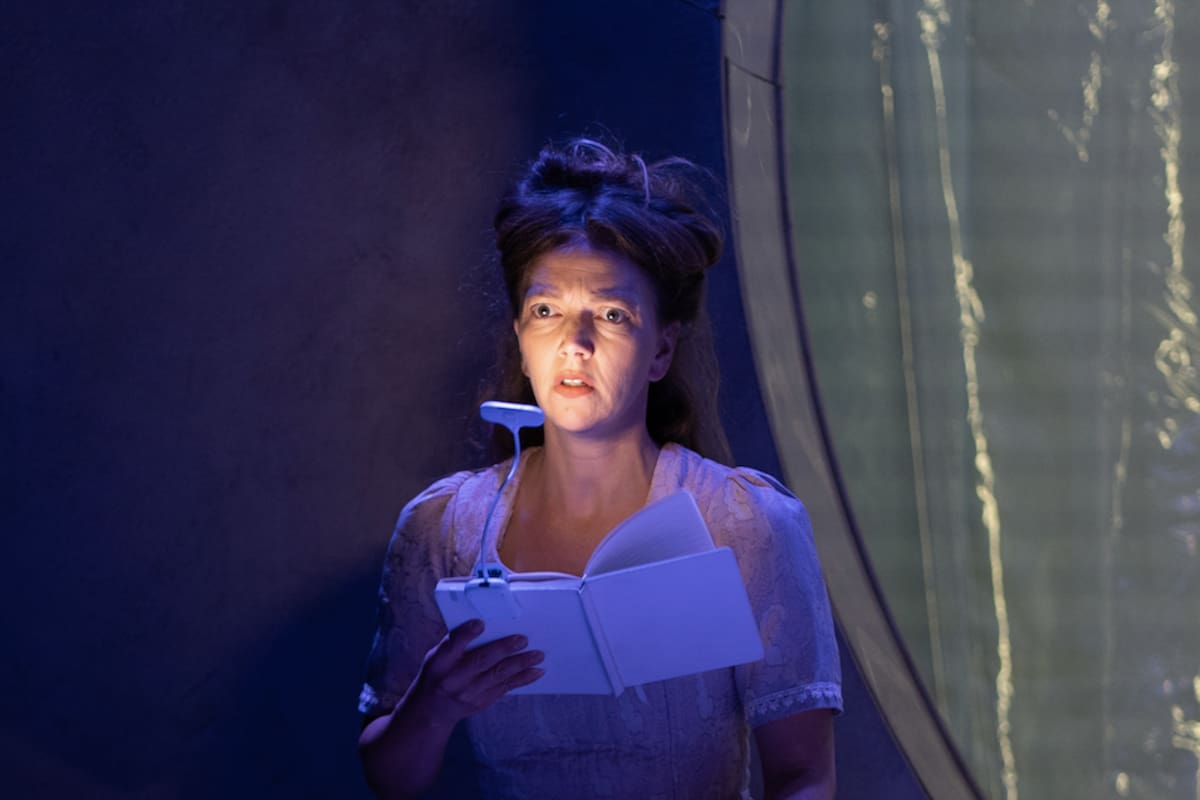
They say languages are learned in grammar and conquered at parties. Jenny knows this better than anyone. That night, at one in the morning, in the middle of a gathering that mixed dance, theater, and plenty of mate, a friend began speaking to her in rapid Spanish, porteño, full of lunfardo, and something clicked. After six months of gestures, creative silences, and searching for physical shortcuts for what words denied her, the British actress understood every syllable. «I’m listening to you, I understand you,» she told her friend with a mix of astonishment and laughter. That moment was much more than a linguistic leap: it was the confirmation that Buenos Aires had chosen her as much as she had chosen Buenos Aires.
Jennifer Moule was born in Pemberley, in southeast England, near Tunbridge Wells, though she grew up in a tiny village with a pub, a church, a cemetery, and many cows. Before she had the vocabulary to name it, she knew she was oriented toward the stage. She dressed up as a flight attendant, a secretary, any character that allowed her to turn the family living room into a theater of operations. Her mother, enthusiastic and musical, played cassettes of Annie Lennox, Cher, Elton John, and her father took her to see musicals where Gene Kelly danced in the rain and Fred Astaire turned every staircase into a stage. «I wanted to be Whitney Houston,» she recalls with a laugh, and in that statement there is no irony but a declaration of principles: from childhood she understood that art was the only territory where she could be all versions of herself at once.
That certainty accompanied her to university, where she studied literature with a specialization in theater, accumulating text, Shakespearean canon, and the most rigorous British tradition. But something in her asked for something else, a language that didn’t depend on the book or the canon. The signal came from the other side of the Atlantic, in the most casual way possible: an email from a friend who had traveled through Buenos Aires and wrote her four words that changed everything. «You have to come, this city is so you,» she said. That was it. One sentence, one seed.
«I’m very impulsive,» she admits, and in 2007, at 21, she bought the ticket. She arrived with basic Spanish learned at school, that peninsular variant of «estupendo» and «¿qué tal?», completely useless in a city where no one asks that but rather «cómo andás.» The first blow was listening: understanding the porteño rhythm, the speed, the lunfardo, the particular music of a language she apparently knew but in practice completely eluded her. She walked alone through streets that were not yet hers, navigated conversations with gestures, smiles, with her body doing what words couldn’t. There was fear too, that of a young woman in an unknown city, the stranger’s eye on the subway, the stares that didn’t exist in England. «If you’re a woman walking alone and you don’t understand the language, you get scared,» she says. But fear, like language, became domesticated.
What she found on the other side of that discomfort was something she didn’t expect. Feeling unable to enter conventional theater classes, she discovered the universe of physical theater, «clown, contemporary dance, contact, improvisation – she lists. The body took over when words failed. At the Centro Cultural Rojas, one workshop led to another, one person introduced me to another, and suddenly Buenos Aires was no longer a strange city but a network weaving around me. That first porteño chapter lasted a year and a half, and when it ended, I couldn’t leave completely.»
Then came Spain, Mexico, France, Liverpool, an itinerant life that looked south. «I always thought about Buenos Aires, missing this madness of all the projects, the little theaters, the outings,» she recounts. In 2016 she returned to stay, summoned by the same force that had attracted her the first time. «If I were a surfer or a mountaineer, I would need the river or the mountain. I need theater – she says. And here the scene is unbeatable.» The city welcomed her with a generosity that still surprises her: «people improvise, create, premiere with a fluidity that in England exists maybe during the Edinburgh Festival month and here it’s the natural state of things. It’s all year round, it’s incredible. My friends are doing a play, directing, recording an album, launching a fair in someone’s kitchen. People never abandon art, at any moment.» In that wheel of connections, shared rehearsals, and crossed projects, she built a network that today, ten years later, is the cast of her first feature film.
Acting in a second language is, in Jenny’s words, «more stressful than anything.» In a text-heavy play like «Secretos de un vínculo,» a production about motherhood that she co-starred in until a few weeks ago, that tension becomes concrete: «in English you have the texture of the word, the nuances, you can improvise if you get lost. Here you feel more exposed, that if you leave the text you have no safety net.» However, that discomfort also pushed her toward what she likes most: «movement scenes, physical moments, instances where theater dispenses with grammar. I like working more and more without so much text. A blank canvas, improvisation, pure performance.»
That play was her first experience involving adapting a non-fiction book for the stage. Alongside a cast of actresses, they built something like a family around writer and doctor Adriana Grande, whose philosophy of parenting runs through every scene. «Several times I cried in rehearsals because of the things that came out,» she acknowledges. «Adriana always has a very bright response. The play alternates humor with tenderness and culminates in images of visual strength hard to forget: a mother with a spiked bustier that embodies the convex bond, overprotection taken to the aesthetic limit.»
That process confirms something Jenny repeats whenever she can: «independent Buenos Aires theater has a particularity that distinguishes it from any other circuit. In theater you always learn something, you always grow.»
Motherhood came to confirm what Jenny suspected: art and parenting speak the same language. «With a child you understand that the play, even if it’s very important to you, occupies its real place in the world. That relieves,» she explains. But more than relativizing the weight of theater, Rubén, her son, gave her back something adults lose without realizing: the ability to see the world as if for the first time. «Children are mini clowns – she defines. They see a puddle, leaves on the street, and everything is an event. Adults are jaded zombies, tired of everything. They wake up eager, jump, can be a toad, a rabbit, any animal. That’s beautiful to observe.»
That re-enchanted gaze transferred to her stage practice. In an installation for babies where she handles a puppet for forty-five minutes, she found one of the purest forms of presence she knows. «Theater forces you to be present. If your mind wanders, you forget the lines, you lose the thread. For someone like me, who gets distracted easily, that’s an anchor,» she acknowledges.
Watch the 2026 World Cup in the best quality
These are the most sought-after TVs to watch the National Team. All with 12 interest-free installments:
- Smart TV Kanji 32″ LED HD – From $120,000 in 12 interest-free installments (VAFTS9-89J3)
- Smart TV LG 43″ 4K UHD WebOS – From $450,000 in 12 interest-free installments (VAFTS9-WXW9)
- Smart TV Samsung 50″ 4K UHD – From $600,000 in 12 interest-free installments (VAFTS9-VVE0)
Approximate prices. 12 interest-free installments subject to each seller. Search for the codes on Mercado Libre.



che pero para mi esta inglesa viene a robar laburo a los argentinos sin hablar español encima teatro independiente q es todo zurdaje q se vuelva a su pemberley y deje de ocupar espacio la cultura argentina la hacemos nosotros no extranjeritos un asco pos data la peli no la veo ni en pedo
Para mí esto es un asco, Jenny Moule la cheta europea que viene a colonizar el teatro porteño sin hablar español, mientras los actores criollos se parten el lomo por dos mangos. Me parece una falta de respeto que le festejen la ignorancia, esto huele a privilegio de clase, basta de aplaudir aventureros.