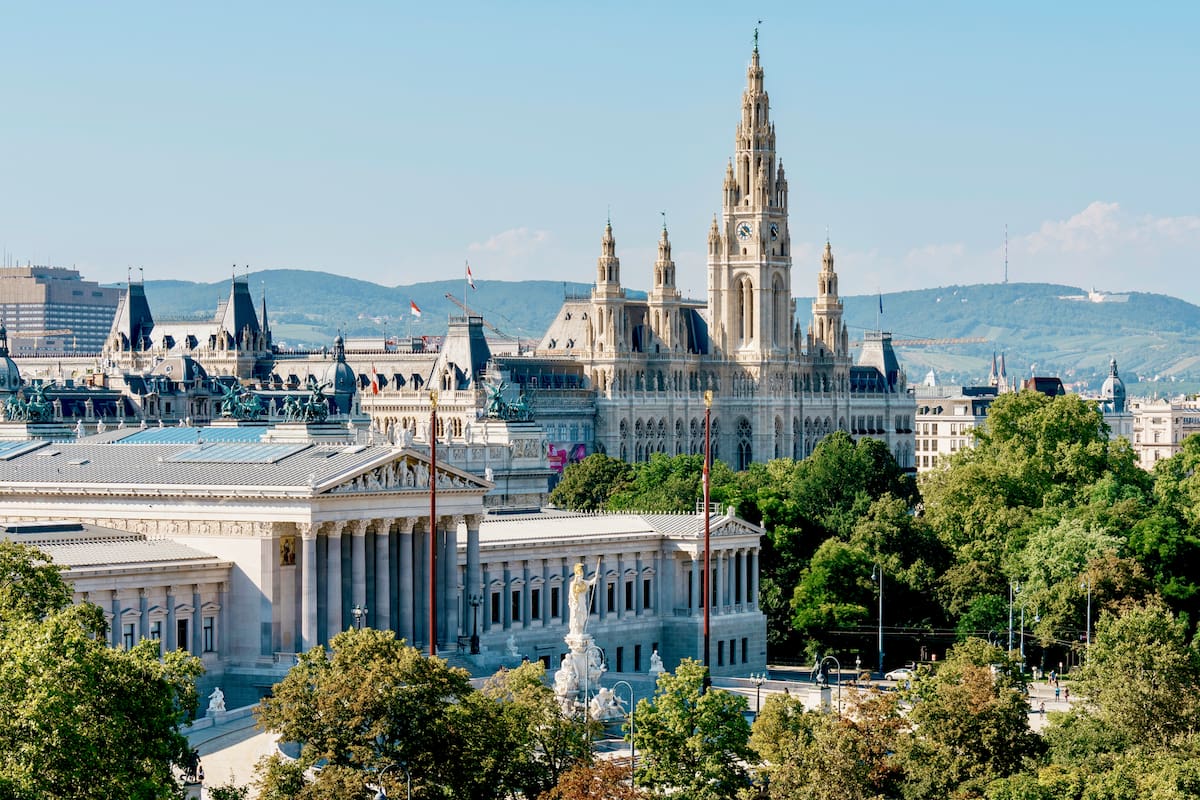
Countdown. After the 3-0 victory against Algeria, the Argentine national team prepares for Austria, its next rival. The match will be played this Monday in Dallas. Beyond sports, this small country located in the heart of Europe was for centuries one of the greatest powers in history. Its capital, Vienna, is considered one of the cities with the best quality of life in the world.
Below are five facts to get to know the next World Cup rival.
The territory of present-day Austria belonged for hundreds of years to the Austro-Hungarian Empire under the Habsburg monarchy. It was one of the most powerful empires in history and encompassed more than a dozen present-day countries. It was also at the center of one of the events that changed the world: the assassination of the empire’s heir, Archduke Franz Ferdinand in 1914 in Sarajevo (present-day Bosnia and Herzegovina), an episode that triggered World War I.
«Modern Austria emerged from a multilingual and multi-confessional empire that connected central, eastern, and southeastern Europe. Issues of diversity and coexistence are not new phenomena but have deep historical roots,» said Carina Siegl, historian at the University of Vienna and researcher at the Austrian Institute of Historical Research. Meanwhile, Andrés Reggiani, PhD in History and professor at Torcuato Di Tella University, considered that the memory of that empire «is associated with the preservation of cultural heritage that has ramifications and tourism benefits,» rather than a desire by Austrians to return to the empire.
Austrians have always maintained a closeness with Germans, due to their language, culture, and history. Years later, in 1938, when Nazi dictator Adolf Hitler was in power, Austria was forcibly annexed by its neighbor, which was expanding across the continent. World War II, which had begun in 1939 after the German invasion of Poland, ended with the defeat of the Nazis in 1945 at the hands of the Allies, who liberated countries like France and Norway from the Third Reich. After its liberation, Austria was seen more as a victim than as a participant in the humanitarian crimes against Jews and minorities.
Thus, the country later managed to develop a much stronger national identity than before, more separate from the Germans. «Austria is a relatively young state; Austrian national identity developed gradually throughout the 20th century,» added Siegl. However, she warned, the country «has not yet confronted its fascist past as Germany has.»
Today, nine million people live in its territory, speaking the German language with an Austrian dialect. Austria remains a bridge between Western and Eastern Europe with a strong economy and diplomacy. According to Siegl, Austrian identity often revolves around gastronomy, traditions, music, winter sports, coffee houses, and landscapes, although imperial nostalgia remains strong.
Austria holds a prominent place in the history of European culture. Two of the most influential composers of classical music were born on its soil: Wolfgang Amadeus Mozart, born in Salzburg in 1756; and Franz Schubert, born in Vienna in 1797. Their works continue to be performed in theaters and concert halls around the world and are part of Western cultural heritage. It is no coincidence that Vienna is considered one of the great cultural capitals of Europe. For centuries, it was a center of intellectual and artistic production that attracted musicians, writers, scientists, and thinkers from across the continent. Music occupies a central place in national identity. The capital houses the famous Vienna State Opera, one of the most prestigious opera houses in the world and a symbol of musical tradition.
The imperial history also remains present. One of the country’s great symbols is Empress Sissi, turned into a myth by films, series, and novels. She was empress consort from 1854 until her assassination in 1898. Much of her life was spent at Schönbrunn Palace, the majestic summer residence of the Habsburgs, which today is one of the main tourist attractions. «For many Austrians, she is an icon and a cultural and tourist symbol associated with an idealized image of the Habsburg monarchy. Her image is heavily mediated by the 1950s films starring actress Romy Schneider, which presented a rather romantic and sugar-coated version of her life,» commented Reggiani.
The country is also closely linked to Sigmund Freud, known as the father of psychoanalysis. Although he was born in the present-day Czech Republic, then part of the Austro-Hungarian Empire, he moved to Vienna when he was only four years old and developed much of his work there. From the Austrian capital, he revolutionized the understanding of the human mind and laid the foundations for a discipline that would later have enormous influence on psychology.
After years of instability, territorial divisions, and a search for an identity separate from its neighbor Germany, Austria is characterized by its strong diplomacy and enjoys political solidity with a parliamentary system. «Vienna is one of the great diplomatic capitals of the world along with Geneva (Switzerland) and New York (United States). Austria has a diplomatic weight disproportionate to its size, as it is an important player in security and nuclear control issues,» analyzed historian Reggiani. According to him, it has an active role in the European Union and actively participates in European defense, although it does not belong to NATO, the military alliance of Europe and the United States.
Austria is also one of the countries where the nationalist right has grown the most, a current that at the beginning of the century was considered dangerous for democracy amid fears of neo-Nazism. Vienna later proved otherwise. The Freedom Party of Austria (FPÖ) was a pioneer of the European right and governed in coalition from the 2000s. The FPÖ, explained Reggiani, normally competes for first or second place nationally. «At that time, Europe treated Austria as a case of democratic alarm and politically isolated it from the European Union as a sanction,» he added. Over time, Vienna showed that it was normal to cooperate between conservatives and the far right without undermining the democratic regime. Today, a tripartite coalition of conservatives, social democrats, and liberals governs.
Austrian gastronomy also reflects the country’s complex history. Klaus-Juergen Hermanik, historian and professor at the University of Graz, argued that many of the foods considered typically Austrian are actually the result of centuries of cultural exchanges during the Habsburg monarchy. Even one of the country’s most emblematic dishes, the Wiener Schnitzel, the famous fried cutlet or «milanesa,» would have origins outside its borders: «It originated in northern Italy,» stated Hermanik.
Watch the 2026 World Cup in the best quality
These are the most sought-after TVs to watch the National Team. All with 12 interest-free installments:
- Smart TV Kanji 32″ LED HD – From $120,000 in 12 interest-free installments (VAFTS9-89J3)
- Smart TV LG 43″ 4K UHD WebOS – From $450,000 in 12 interest-free installments (VAFTS9-WXW9)
- Smart TV Samsung 50″ 4K UHD – From $600,000 in 12 interest-free installments (VAFTS9-VVE0)
Approximate prices. 12 interest-free installments subject to each seller. Search for the codes on Mercado Libre.
Para mí estos austriacos se creen la última coca del desierto por un milagrito de hace 50 años. 9 millones de personas, un barrio de Buenos Aires. Me parece que les vamos a pasar por encima, como siempre. Vamos Argentina, a demostrar quién manda. Messi es Dios y punto.
Para mí esto huele a choreo de la FIFA y los yankis, quieren afanarnos el mundial con Austria, ese país imperialista que nos masacró en el 78 con la dictadura. ¡Che, vayan a laburar! Argentina va a pasar con el poder del pueblo, no con vendidos al sistema. #FuerzaSelección