
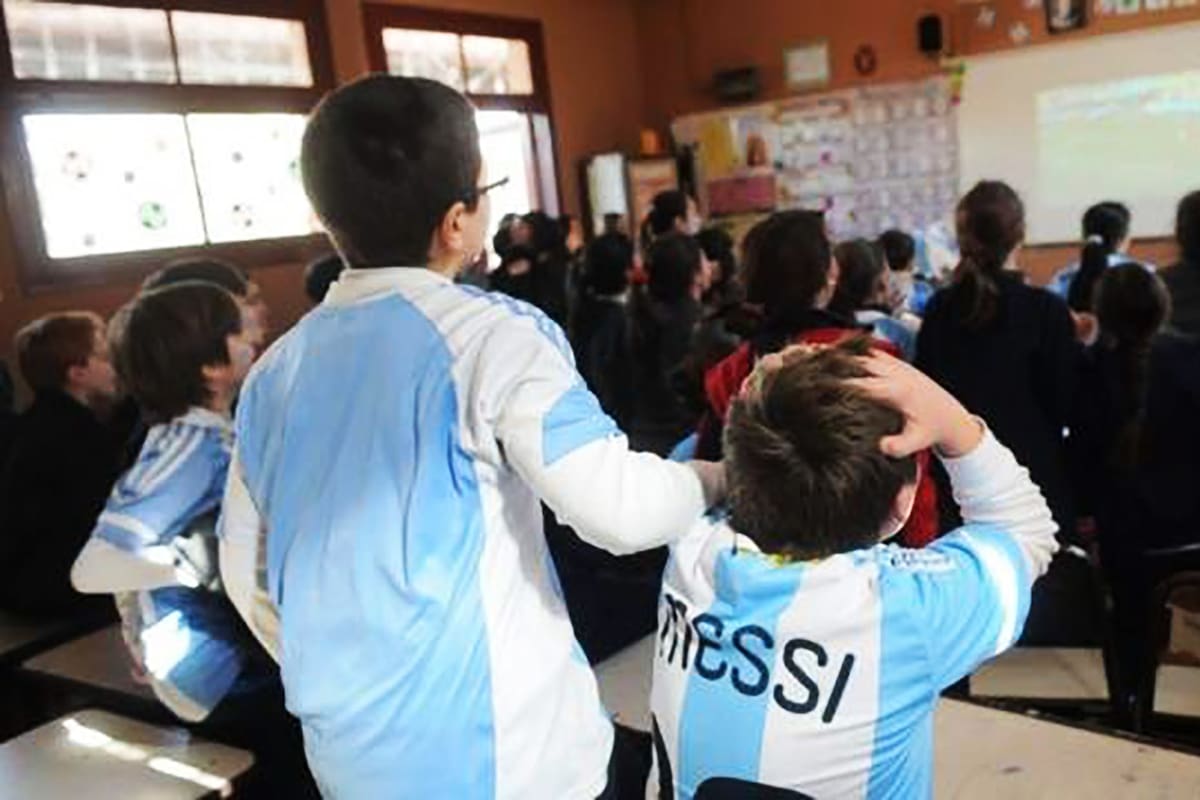
While millions of people follow every match of the 2026 World Cup, schools and families find in the tournament an opportunity for much more than cheering for Argentina. From mathematics and geography to emotional education and coexistence, specialists and teachers agree that the World Cup can become a powerful educational tool if used with balance and pedagogical sense.
Every four years, the World Cup changes routines, monopolizes conversations, and awakens passions that cross generations. Children are not immune to this phenomenon: they arrive at classrooms talking about results, trading stickers, following statistics, and reproducing debates they hear at home. Far from trying to ignore this interest, many schools choose to incorporate it into their educational proposals.
The question is no longer whether the World Cup should enter the school, but how to do it. And the answer seems to be turning that spontaneous enthusiasm into an opportunity to learn, reflect, and share meaningful experiences.
At Aletheia School, they understand that major social events are also part of school life. “The school cannot be thought of as isolated from the culture and events that mobilize society. We do not seek to stay on the sidelines of what generates questions, emotions, and conversations in families and children,” explains Laura Burzomi, director of Early Childhood and Primary Education.
From the students’ curiosity, projects arise that address very diverse content: geography of participating countries, languages, traditions, migrations, national symbols, statistics applied to sports, and even scientific aspects related to physical performance. Football thus becomes a gateway to multiple areas of knowledge.
Something similar happens at Nueva Escuela Argentina 2000 (NEA 2000), where the frenzy for stickers quickly found a place in the classrooms. “The stickers invaded the school’s play areas and we decided to capitalize on that genuine interest of the children,” says its director, Alejandra Salonia.
Mathematics appears naturally when students calculate how many stickers they need to complete the album, how many duplicates they have, or how many they need to trade. Activities related to flags, countries, and cultures from different parts of the world also emerge.
For Florencia Z., a third-grade teacher at a school in the northern area, the World Cup represents a unique opportunity to spark her students’ interest. “Children feel the World Cup a thousand percent. They are fans of football and Messi. That motivation adds a huge plus to daily activities,” she says.
With that idea, she designed a thematic booklet that covers all the subjects she teaches. In math, for example, problem situations revolve around ticket sales, match results, or Lionel Messi’s age at different points in his career. Teaching division is supported by distributing stickers among classmates, bringing abstract concepts to concrete situations.
They also work on bar graphs to analyze the number of participating countries per continent, compare statistical data, and draw conclusions from real information.
In social sciences and geography, students use maps to locate continents, oceans, participating countries, and World Cup venues. In language arts, they read texts about the history of the World Cups, work on demonyms, and produce descriptions of players using different types of adjectives.
“There is a huge number of possibilities around the World Cup. I found it very fun because my students love it,” the teacher summarizes.
The World Cup also offers an opportunity to work on aspects that go beyond academic content. In the emotional education workshop, Florencia proposes reflecting on the concept of an idol. The task goes beyond goals or titles: it seeks for children to identify what values the people they admire convey and why they consider them role models.
Educational psychologist and parenting specialist Brenda Tróccoli highlights that these events can become privileged spaces to strengthen family bonds. “The World Cup generally brings a lot of joy to families and an opportunity to share a theme that brings together all members regardless of age,” she notes.
However, she warns that it is important that the tournament does not completely displace regular routines. “The idea is to adapt family life to what happens with the World Cup, not the other way around,” she explains. Maintaining schedules, limits, and rest spaces remains essential for children.
She also highlights the sticker phenomenon as a way to recover in-person play and peer interaction. Although she warns about certain behaviors driven by adults, such as anxiety to complete albums quickly or the need to buy large quantities of packs at once.
Another possible learning experience relates to how adults experience the matches. Parenting specialist Maritchu Seitún often insists that children constantly observe their parents’ reactions to success and frustration. Therefore, she considers that the national team’s matches can become a valuable emotional learning experience.
“The national team wins or loses, and that does not put our identity at stake,” she states. From her perspective, children incorporate behavioral models when they see how adults react to a victory or a defeat.
If victory is lived with excessive euphoria or defeat as a tragedy, children tend to reproduce those same behaviors. Instead, accompanying emotions with serenity allows them to learn that losing is part of any competition and that personal worth does not depend solely on a result.
The same logic applies to children’s sports. When parents shout, pressure, or vent frustrations from the stands, they often end up taking away the children’s spotlight. “The desire to play and do well must be the child’s, not the adult’s,” the specialist concludes.
Watch the 2026 World Cup in the best quality
These are the most sought-after TVs to watch the National Team. All with 12 interest-free installments:
- Smart TV Kanji 32″ LED HD – From $120,000 in 12 interest-free installments (VAFTS9-89J3)
- Smart TV LG 43″ 4K UHD WebOS – From $450,000 in 12 interest-free installments (VAFTS9-WXW9)
- Smart TV Samsung 50″ 4K UHD – From $600,000 in 12 interest-free installments (VAFTS9-VVE0)
Approximate prices. 12 interest-free installments subject to each seller. Search for the codes on Mercado Libre.


Para mí esto es un lavado de cabeza con Messi para tapar la ideología de género que meten en las escuelas. Me parece una cagada usar el fútbol para enseñar matemática, así no aprenden nada. Esto huele a progresismo barato. ¡Viva la patria carajo!
Para mí esto es un verso de manual… usan a Messi para disfrazar la miseria del sistema mientras los pibes se mueren de hambre. Me parece un circo berreta, basta de estadísticas falopa y exijamos escuelas dignas. ¡El Che de la Boca te lo dice, dejate de joder!