
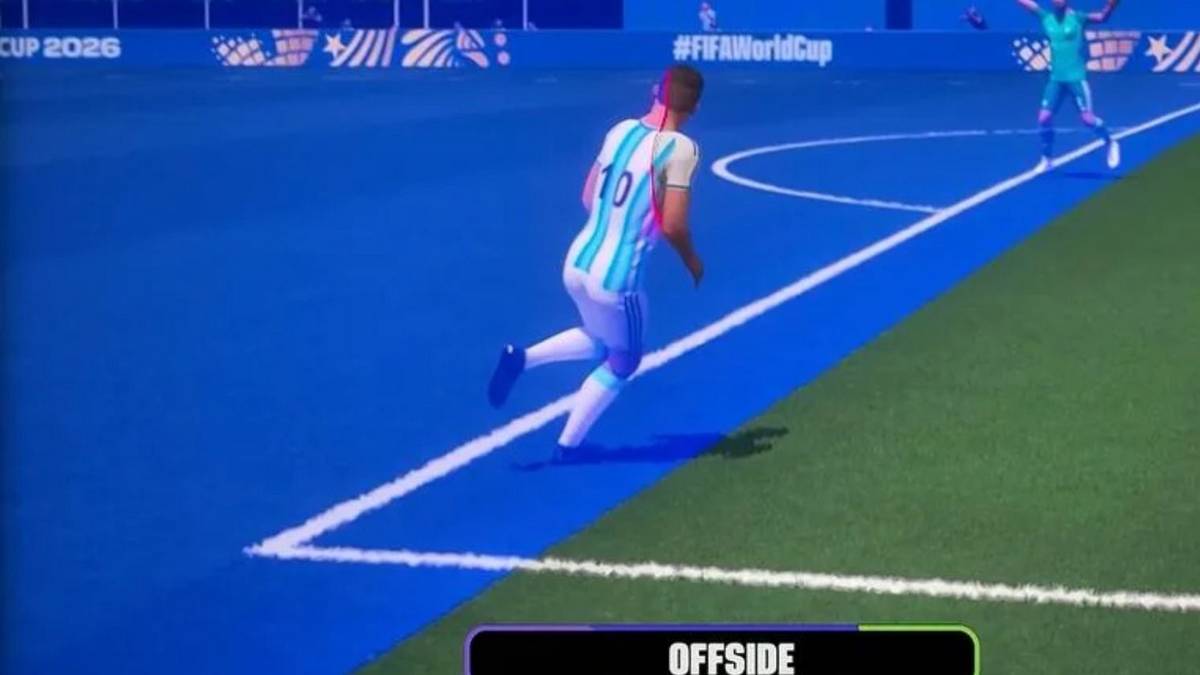
For fans and experts, perhaps the greatest charm of football is its unpredictability. However, science and technology are reducing that dose of «magic» thanks to devices and systems that not only measure with exasperating precision but also make decisions during the match based on millions of data points recorded in real time. In this sense, this World Cup is not only the first in aspects such as the number of participating teams (48) and having venues in three countries, but also for having become a showcase of technology applied to sports: optical tracking cameras, sensor-equipped balls, three-dimensional body scans, artificial intelligence, and new tools for referees and coaches are part of the arsenal designed to process millions of live data points and put them at the service of the technical staff of all teams.
In the weeks leading up to the start of the championship, Gianni Infantino, president of FIFA, presented these «gadgets» alongside Yuanqing Yang, CEO of Lenovo, at Lenovo Tech World 2026. It took place during the opening day of CES, held annually in Las Vegas, United States.
For the new systems to work, the 16 stadiums where more than a hundred matches are being played are equipped with optical tracking systems much more precise than anything known, and artificial intelligence will be applied to football analysis, player body scans, and cameras built into referees. All this information is centralized in a node located in Dallas, from where the information flow is coordinated.
Thus, the Trionda, the official ball of the tournament, is much more than leather and seams. Inside it carries a sensor, accelerometer, gyroscope, and a specialized chip to record whether the ball completely crossed the goal line. In combination with the stadium’s camera network, the sensor sends information 500 times per second to determine contacts and handball situations, or offside positions.
«These devices are used, for example, to detect exactly when the player touched the ball and to determine offside,» explains Argentine data specialist Manuel Durán, who heads the Data and Analytics Department of Racing de Santander, Spain. «Previously, we looked at the video frame by frame to see if the player was offside. Now, the ball automatically detects the moment the player touches it. This allows the decision to be much more objective.»
The sensors also alert the referee’s watch when the ball has completely crossed the goal line and it’s a goal. «This is something that in the past brought many discussions,» says Durán. «Now, it is known instantly: if it crosses 100%, the referee’s watch vibrates.»
The semi-automatic offside system, a tool known as SAOT, which was already used in Qatar 2022, adds other changes. Unlike the conventional VAR procedure, which depends on manual line drawing and human selection of frames from various television angles, the semi-automatic mechanism processes information autonomously and instantly.
In its 2026 version, artificial intelligence algorithms and an updated tracking system make it possible for the new detection margin to be 10 centimeters and the average time to resolve plays to be reduced to 25 seconds (vs. 70 seconds for traditional VAR).
Another of the most striking novelties is the scanning of all participating players. FIFA created digital models with «exact dimensions at a millimeter level» of each of the more than 1,200 players and can digitally recreate entire matches. In just one second, a set of high-speed cameras distributed around the stadium captures the physical dimensions of the players, and when a questionable play occurs, the system instantly processes the position of 29 key body points of the athletes. By combining these avatars with data from the smart chip suspended in the center of the official ball, artificial intelligence systems determine their exact position and VAR referees receive an automatic alert.
Finally, the Football AI Pro platform, based on generative artificial intelligence, combines AI agents capable of producing structured match data to offer tactical information, performance analysis, and strategic recommendations quickly, reliably, and in a structured manner. This platform was trained with hundreds of millions of historical and statistical data points collected by FIFA, and is available free and equitably to the technical staff of all 48 teams. Through a simple interface, an analyst from any federation can request automatic reports in text format, interactive graphics, or instantly edited video clips.
«Millions of football data points are analyzed,» highlights Durán. «They are measured live and offered to all teams. They are basically game statistics generated in real time, such as aerial duels, passes, interceptions, shots on goal, probabilities of shots on goal ending in goals. They have 700 million variables, and what the technical staff does is evaluate performance as the game progresses. They can determine, for example, whether players are positioned where they should be, or whether the other team is attacking more on the left side than the right… All that and more can be seen quickly on the field, with avatars and drawings on the screen that allow you to make decisions on the spot. Additionally, they are useful for post-match analysis.»
Among the announcements, it was also revealed that the referees of this World Cup wear micro-cameras that offer an unprecedented perspective of what happens on the field. But capturing those images without movement ruining them was a complex technical challenge. So real-time generative AI filters were implemented that process the video signal on the fly, remove blur, and stabilize the shot. Another debut is the 3D Goalkeeper View, a camera system capable of exactly recreating the view the goalkeeper had at the moment of a goal play, mainly for the referee to certify whether there was obstruction of vision by an opponent.
But as sensational as they may seem, not everyone is impressed by these innovations. An Argentine referee who preferred not to reveal his name opines: «The semi-automatic offside system is a more advanced version of what was being used in Europe: it alerts within 3 or 4 seconds whether it is offside or not, so they can ‘kill’ the play as soon as possible; that’s why, in fact, there are almost no errors from the assistants. Then, the referee’s little camera doesn’t add much, because it moves all the time; you’d have to be still as a statue for it to be useful. It might provide some information, but it’s more for people to see shots that have never been seen before.»
Watch the 2026 World Cup in the best quality
These are the most sought-after TVs to watch the National Team. All with 12 interest-free installments:
- Smart TV Kanji 32″ LED HD – From $120,000 in 12 interest-free installments (VAFTS9-89J3)
- Smart TV LG 43″ 4K UHD WebOS – From $450,000 in 12 interest-free installments (VAFTS9-WXW9)
- Smart TV Samsung 50″ 4K UHD – From $600,000 in 12 interest-free installments (VAFTS9-VVE0)
Approximate prices. 12 interest-free installments subject to each seller. Search for the codes on Mercado Libre.



Comentarios