
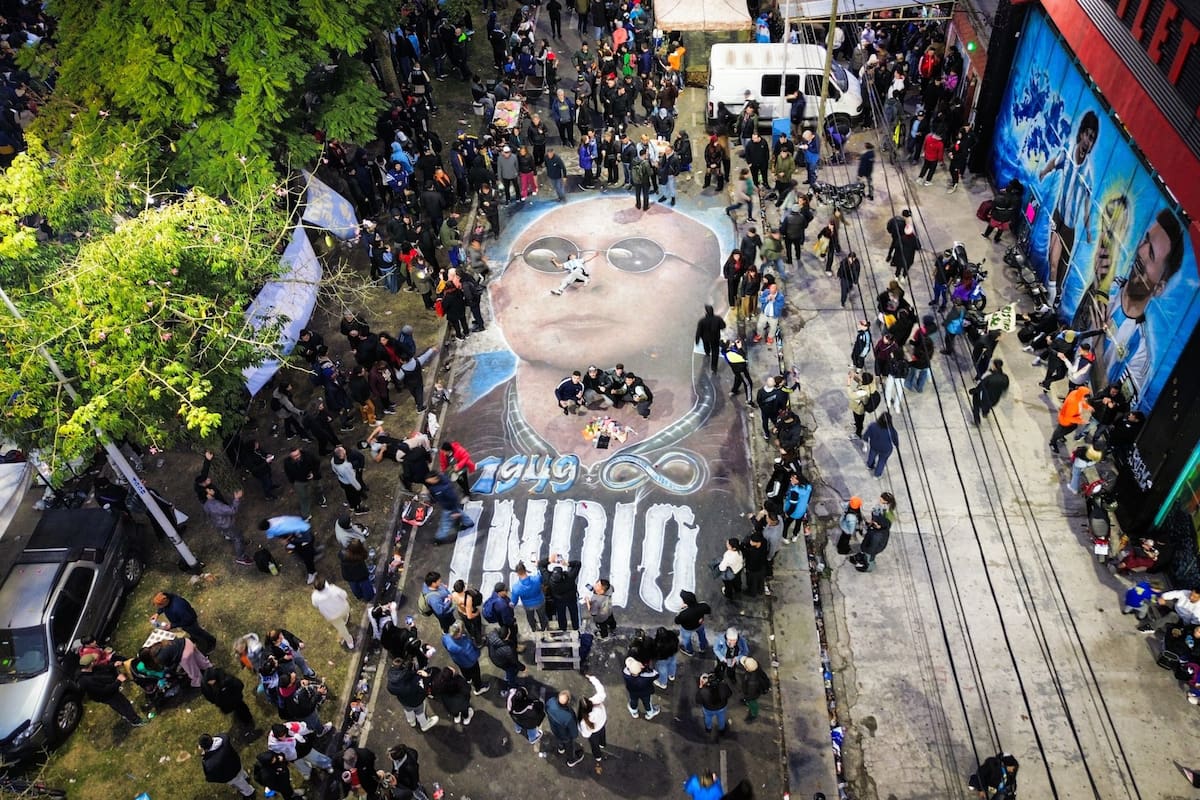
As that impressive, grief-stricken crowd attending the Ricotero funeral of Indio Solari moved forward, various political militants at different points in the column encouraged the singing of the Peronist march. They never achieved their goal. Sociologist and anthropologist Pablo Semán, a constant researcher of the most impoverished sectors and an eyewitness to the curious episode, calls this kind of operation «symbolic pickpocketing,» which consists of the improper appropriation of other people’s milestones and idols, a specialty of Justicialism of all times.
Semán connects that anecdote with certain hyper-politicized Kirchnerists and Milei supporters who only think, in vain, about how the World Cup can benefit them, when it has been historically proven that development and the final result do not affect the perception of governance in any way (at most, they calm spirits for three or four weeks), and also that the phenomenon is so strong and massive that it jumps any divide: the joy it produces is transversal, and Semán, who walks the asphalt and the mud, detects it everywhere, and in the end seems to tell the speculators on both sides: «I’m a huge fan of the Argentine national team, let me be happy.» Nor does he forget those «middle-class people who are mostly on social media and call Messi déclassé: as if they were construction workers!»
The episode of Indio Solari’s funeral, however, has a dimension that escapes simple «symbolic pickpocketing» and also the fact that certain ecumenical events avoid polarization. The truth is that in other times, those immense crowds, with those social characteristics, would probably have also sung the Peronist march. And they did not sing it, perhaps—it is a hypothesis—not only because it was not appropriate to the circumstances, but because of something that Semán himself describes as a great novelty of this era: in the most disadvantaged segments—where conditions are dramatic and today rejection of the current model predominates—even those who are against it do not think there is another alternative. He describes this widespread feeling as a «blind navigation»: those who reject do not know what they would like instead, and those who support do not know exactly where they are going, in a true sea of uncertainties. Some with complaints, others with applause, though always without euphoria, they seem to abandon themselves to a resigned phrase: «There is no other option.» At the lowest rungs of society, distrust of the «regulatory State» has not ceased, simply because it did not improve their lives and in some cases even proved harmful. This harsh diagnosis from the sociologist, who personally does believe in regulations, actually denounces the lack of a new idea. A fundamental idea that does not propose more of the past.
The matter initially seems to benefit Milei and challenge Peronist sensibilities, which were once based on a series of witty aphorisms and seductive slogans for different generations. The lures to enter the «national and popular movement» were: the benevolent power of the State, having the proletariat and unions on your side, representing the great majorities, cultivating a morality against every-man-for-himself, and practicing a healthy nationalism directly linked to Argentine identity. Those lures are no longer what they were. The present State, for example, ended up conspicuously absent, run by statists who paradoxically devastated its prestige, plundered it, and made it inefficient and distant. Kirchnerist policies tended to reduce the proletariat and replace it with informal employees, and new technologies turned them into entrepreneurs and autonomous workers, consequently much more individualistic; additionally, this vertical process may intensify, as global capitalism is replacing industry (the bastion of the worker as a historical subject) with the service sector, which generates a type of worker with a much less collective consciousness. The «backbone» referred to the fact that large union organizations contained all workers and guaranteed their mobilization; today’s union leaders are completely discredited, represent few, and lack the strength even to call a consistent general strike. Expressing and belonging to a majority was based on the belief—sometimes accurate—that «the Peronist people» were much more than half plus one, which gave them a certain infallibility; today it is known that more than sixty percent of society is critical of the Movement, as shown not only by certain systematic polls but also by the average of recent elections: Kirchnerism, concerned only with minorities, lost the majority, in one of the most resounding distraction operations in modern history. Then we recall the crucial commandment: «First the homeland, then the Movement, and finally the men,» a selfless concept that synthesized the detached and exemplary character that leaders should cultivate; today those leaders have proven to be exactly the opposite: Peronism, in the Argentine imagination, is now the party of inflation and venality, a poverty-mongering run by suspicious nouveaux riches. The fight against every-man-for-himself resulted in only them being saved. And the visible and scandalous case of Martín Insaurralde—heart of Buenos Aires Justicialism—and the fact that the great Kirchnerist campaign consists of releasing a female leader convicted by justice shows a moral discredit that is evident to all. Finally, nationalism appears, an atavistic, sentimental, once profitable and somewhat paranoid appeal that provided cohesion and allowed for an «anti-imperialist epic.» All those words seem a bit rusty (no serious person uses them without blushing), and right-wing populism has absorbed, with pride and to make matters worse, the word «patriots.» That a new libertarian law allows canceling all limits on the foreignization of land (Patagonia, Glaciers, Antarctica), thereby leaving freshwater masses unprotected—an obscene gift to the all-powerful owners of Artificial Intelligence—and does not immediately stir the «Peronist masses» as before, perhaps shows not only that the driver does not know how to drive but that the vehicle no longer works. Argentina has always had two souls, and it would be strange for one of them to disappear: it is more believable that at some point it will completely transform its software and give birth to a new fundamental idea, so that the call of the tribe takes effect and its potential audience sings the march again. In the immediate term, barring an accident or upheaval, that song won’t catch on.
Watch the 2026 World Cup in the best quality
These are the most sought-after TVs to watch the National Team. All with 12 interest-free installments:
- Smart TV Kanji 32″ LED HD – From $120,000 in 12 interest-free installments (VAFTS9-89J3)
- Smart TV LG 43″ 4K UHD WebOS – From $450,000 in 12 interest-free installments (VAFTS9-WXW9)
- Smart TV Samsung 50″ 4K UHD – From $600,000 in 12 interest-free installments (VAFTS9-VVE0)
Approximate prices. 12 interest-free installments subject to each seller. Look for the codes on Mercado Libre.

para mi esto es lo q pasa cuando se abrazan al ajuste el peronismo se volvio un chiste ni los pobres bancan mas su marcha le venden espejitos de colores mientras nos siguen cagando volve peron q estos vendepatria mataron el sueño justicialista ya no queda un mango ni pa la marcha viejos meados
Para mí esto huele a justicia divina, los zurditos se quedaron sin el cuento del Estado benefactor. Yo creo que chorearon todo y ahora ni los pobres les creen. Aguante la libertad carajo, que se vayan todos a laburar en vez de vivir del curro.