
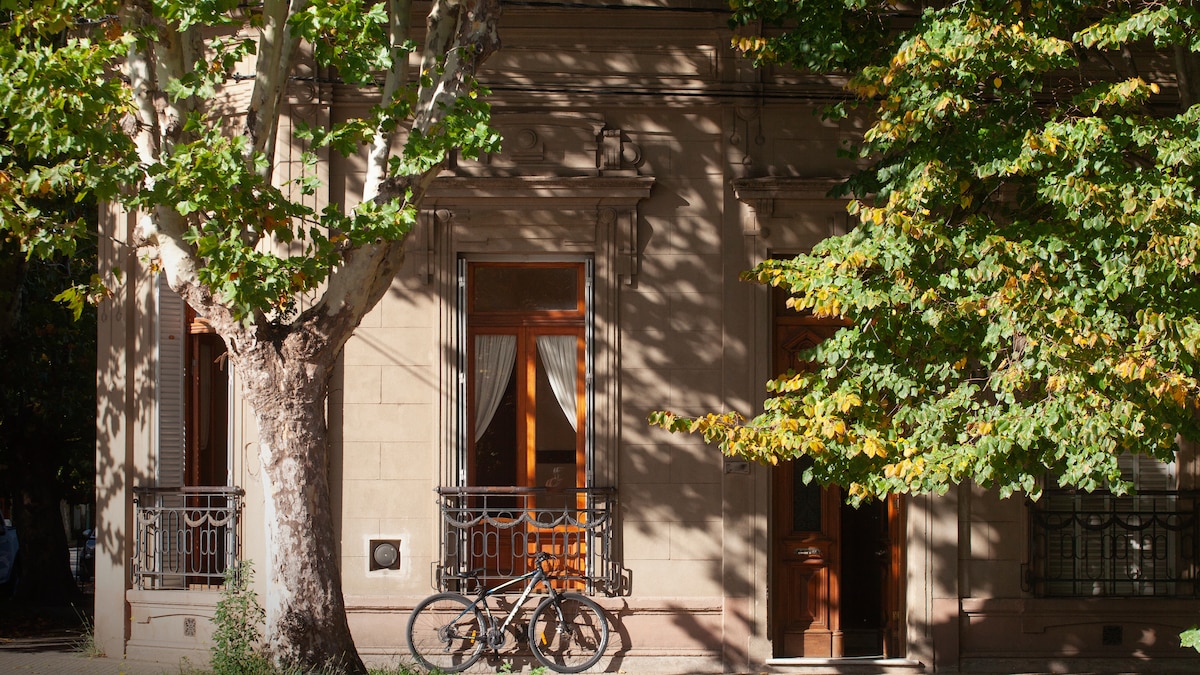
South of the province of Buenos Aires, a town of lineage and Basque surnames stands as a bastion of history and elegance. Coronel Suárez, named after the military man Manuel Isidoro Suárez, great-grandfather of the famous writer Jorge Luis Borges, is a destination that blends a frontier past with a vibrant present.
Entering via Hipólito Yrigoyen Boulevard, which later becomes Adolfo Alsina, reveals impeccably preserved French and Italianate-style houses. Among them, the former home of the Lusarreta family, built in 1926, now operates as La Casa Hotel Boutique, an accommodation that invites you to immerse yourself in the stately atmosphere of the place.
Iñaki Etcheverry, the city’s Tourism Director, explains that the town not only exports grains and cereals but also top-level polo players. The Coronel Suárez Polo Club is a local emblem, with triumphs that resonate on the national circuit.
The city’s history dates back to 1871, when it was Fortín San Martín. It was later called Sauce Corto and was a concession of 300,000 hectares to Colonel Ángel Plaza Montero. The district was created by law on July 10, 1882, under the government of Dardo Rocha. Eduardo Casey, who for years was erroneously considered the founder, accepted Plaza Montero’s lands and fulfilled the requirements of fencing, promoting livestock, and founding colonies. Thus arrived Welsh, Italians, Jews, and above all, Basques. He also promoted the arrival of Volga Germans from Olavarría, thanks to the Ferrocarril del Sud, whose passenger train operated until 2023.
Among the monuments are the Mástil Patrio by Antonio Bagué, financed by notable neighbors in 1935, and the neoclassical municipal building, which was originally Casey’s country house and was donated to the municipality in 1885. The Nuestra Señora del Carmen parish, from 1903, and the Sarmiento Popular Library, which in its beginnings was a Masonic temple of the Logia Abnegación, complete the architectural heritage.
Beyond the countryside and polo, Suárez has a paper mill and until recently a large sneaker factory. Silversmithing is another strong point: El Orfebre, run by brothers Fernando and Federico Pérez Dill, works with 925 silver and alpaca to create gaucho art and fine jewelry. “It would be very difficult to work with pure silver because it becomes very soft,” they clarify about the silver.
Alfajores Isidoro, by Alan Calles and Tomás Aguirre, derive from the original Don Eliseo, from Alan’s grandfather. They offer varieties such as hazelnut, mocha, and chocolate mousse. Penguin Coffee, by Iván Mulvihill, is a specialty coffee roastery that was born when Mulvihill was studying Economics in Buenos Aires and bought a roaster on AliExpress. He left his job in big data to return to his city and set up the business.
A few kilometers away, Cura Malal is home to Mercedes Resch, the driving force behind the progress of the hamlet of 100 inhabitants. In La Tranca, since 2009, she fosters artistic and spiritual gatherings every Friday. For nature lovers, Villa La Arcadia, 102 kilometers away, offers Cerro Ceferino (or Cerro del Amor), with views of Cerro Tres Picos, the highest in the province. There is also astrotourism, trails along the Sauce Grande River, and activities at the El Dique resort.


Para mí esto huele a otro curro de la progresía disfrazado de cultura. Vasquitos, polistas y Borges… mientras los argentinos de verdad laburamos como negros. Yo creo que romantizan oligarcas y vendepatria. Basta de zurdos, quiero una patria sin traidores.
che todo muy lindo con los apellidos vascos y los polistas pero para mi esto es pura facha mientras los oligarcas juegan al polo en el conurbano no llega ni el agua borges fascinado claro siempre mirando pal otro lado basta de romantizar la miseria los fortines eran de represion no de orgullo esto huele a clasismo puro