
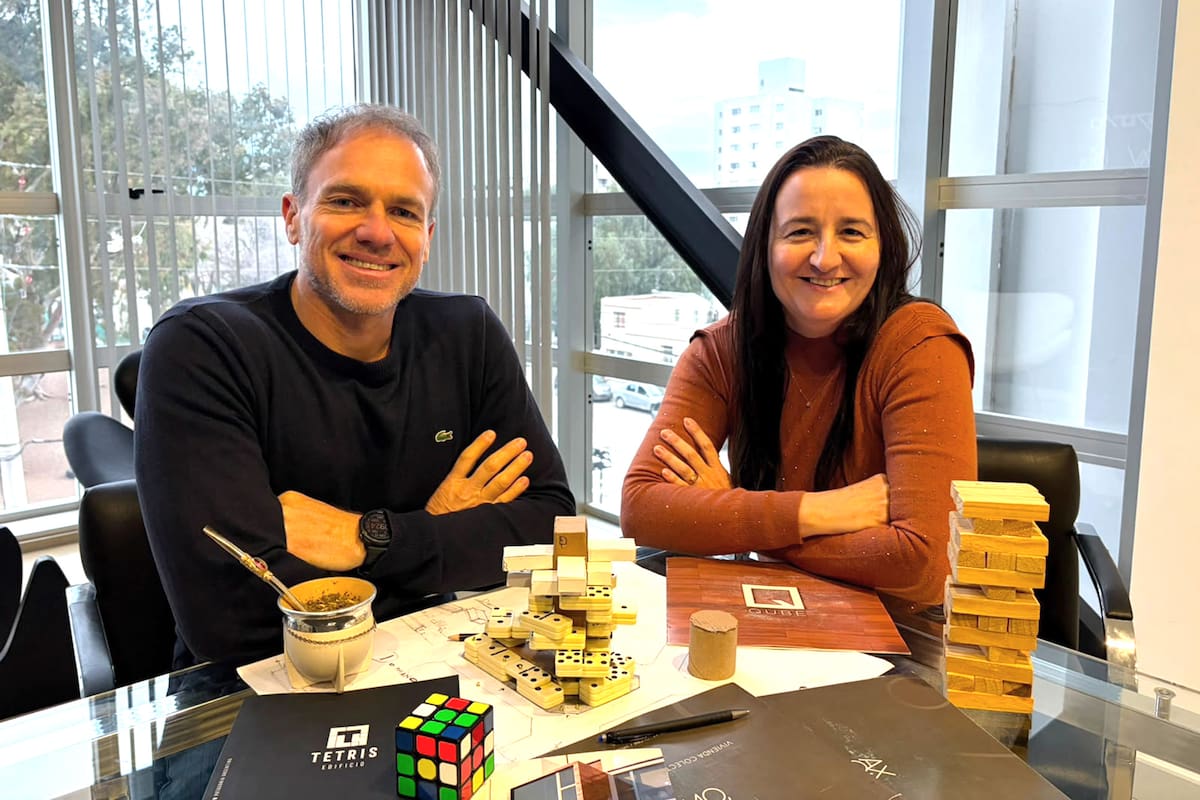
Whales, cliffs, and the sea are no longer the only attractions of Puerto Madryn. The city in Chubut, with 140,000 inhabitants, is experiencing an architectural revolution: buildings shaped like board games and video games are taking over the skyline. Behind this madness is the studio Oporto Diez Arquitectos, led by Mauricio Oporto and Josefina Diez.
“Playful architecture in Argentina and the rest of the world is still not very developed. Here in Madryn we have been doing it for years,” explains Oporto, who along with his partner decided to turn universal games like Rubik’s Cube, Jenga, Tetris, and dominoes into high-rise buildings. The result: works that defy gravity and become urban monuments.
Inspiration came from an unexpected place: a wall in his house covered with porphyry cobblestones, a volcanic stone that protruded. “It was the perfect shape. Since I saw it, everything flowed,” recalls Oporto. The first project was QUBE, an eight-story residential building inspired by the magic cube, just two blocks from the beach.
Then came Tetris, with pieces that interlock creating visual and functional situations. The building, also eight stories, is already an icon. But the one yet to come is Jenga, in the south of the city, with completion scheduled for November. There, six-meter modules seem to defy gravity, and the square meter is priced at US$2,600.
The saga will continue with Domino, an office building that will replicate domino tiles in its base. “It will be the one that most faithfully represents the game,” assures Oporto. But it’s not all visual impact: the priority is the user. “When you make a volume protrude three meters over nothing, you generate a 3×3.50 meter terrace. We stopped thinking about the traditional balcony,” he explains.
These shapes mean no two floors are the same. “Morphologically and functionally, it’s already a mess,” he says with a laugh. Materials are key: exposed brick, concrete, and white paint, which resist the salty air and Patagonian sun, while reinforcing the minimalist aesthetic.
For Oporto, playful architecture is a statement of principles. “By bringing games into constructive reality, we broke the prejudice that disruptive is not functional,” he notes. Interest has already crossed borders: the Tetris tower was intervened with mapping, acrobats, and live music, and the video went viral all the way to China, where it won an award for Best Artistic Intervention.
“Today an architecture student wrote to me asking for material on Jenga. Having me as a reference is great,” says Oporto emotionally. And he anticipates the saga won’t stop: “I feel like doing a puzzle.”


para mi estos edificios berretas son la degeneracion cultural q nos invade los zurditos aplauden cualquier mamarracho moderno y encima les premian en china por hacer tetris de cemento q pais de mierda antes las obras eran serias ahora todo es joda viva la patria y las formas cuadradas bien hechas no estos engendros
Para mí esto es un asco, mientras los ricos se divierten con edificios-juguete la clase obrera se pudre en conventillos sin agua caliente. ¡El premio en China debería ser para un hospital público, no para un capricho de fachistas! Esto huele a capitalismo decadente.