
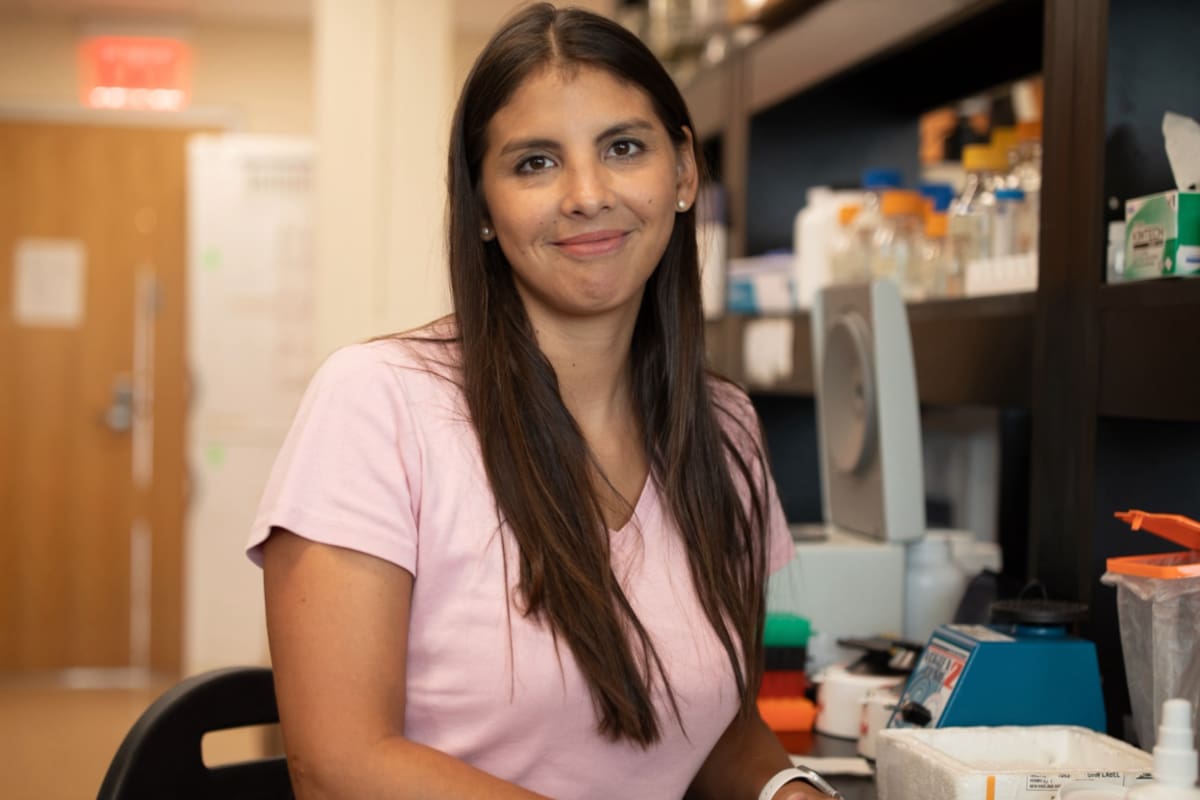
When she left Mercedes, Corrientes, to study Agronomy at the National University of the Northeast (UNNE), Sofía Cano Alfañar never imagined that years later she would be researching at some of the world’s most prestigious academic centers. Today, at 34, the native of Corrientes is pursuing a PhD in the Netherlands, after having worked and studied in the United States, Hungary, and Spain, on a journey that began among fields, rice paddies, and an early fascination with plants and nature.
Her story is far from linear. It includes moves, language challenges, international scholarships, years of work in plant genetics laboratories, and a constant search for training. But it also retains the imprint of that young woman who found a vocation in agriculture and who today works on projects seeking to transform plant waste into new protein sources for human consumption. She aims to revalorize tomato plant waste.
She was born and raised in Mercedes, a city deeply linked to agricultural production. Her family did not own fields, but maintained a close relationship with rural activity. «My father and uncles always had a connection to the sector, but as mechanics; they fixed machinery for the fields,» she recalls.
Her childhood passed between school, rural landscapes, and a permanent curiosity about nature. However, there was a moment that marked a decisive change in her life. «I went from sharing a classroom with 30 classmates to sharing one with only 17. That completely changed me because it empowered me and I discovered a responsible Sofía who enjoyed studying,» she says.
That change occurred when, during adolescence, she left public school to enter a private school. There she began to excel academically and discovered abilities that had remained hidden until then: «I was able to polish what I perhaps had hidden, but because I had never been stimulated.»
Toward the end of high school, she had already made a decision: she wanted to study a university degree related to agriculture. «I always wanted to work in the field because I really liked plants, exploring the rice paddies, and contact with nature. The biological part was what interested me,» she notes.
Confirmation came during a school experience at INTA Mercedes. «When I was in school, we did some internships at INTA and I loved it, and it confirmed that my career was Agronomy, I had no doubts,» she recounts. Thus she entered UNNE. The university years hold a special place in her memory. «Of all the experiences I have from all the places I have lived, university life was by far the best,» she affirms.
Beyond the academic content, she highlights the spirit of camaraderie she found in the program. «Agronomy is very fraternal. We all helped each other. We studied together, we were happy when we did well, we were sad when we did poorly, and we went back to studying,» she recalls.
She graduated in 2016. However, once she obtained her degree, a period of uncertainty began. She felt she did not fit into any branch, neither agrochemical sales nor production. It was then that she discovered her true interest lay in scientific research. «I realized I was very dedicated, very persistent, so I leaned more toward research,» she notes.
The path was not easy. While many researchers build their scientific profile from the early years of college, she had concentrated her efforts on advancing through subjects and graduating. «I found myself saying, ‘I am an agronomist engineer, yes, but that is not enough,'» she recalls.
She returned to INTA Mercedes and began looking for opportunities to start a scientific career. At the same time, an academic exchange she had done in Brazil during college opened a new perspective: «It opened my mind to wanting to study abroad.»
Through a classmate, she managed to contact an Argentine professor based in the United States who had also graduated from UNNE. The opportunity came in 2018, when she traveled to the University of Florida. Her goal was to start a master’s degree, but she quickly discovered she had to overcome a major obstacle: language. «My English level was not what was required to enter the university in a master’s program,» she says.
Far from giving up, she decided to take advantage of the experience to gain training and improve her language skills. She began working in a forage genetic improvement program, a topic familiar to her due to her previous connection with INTA Mercedes. Later she moved to a group specialized in molecular genetics and plant biotechnology. «It was enormous growth for me,» she summarizes about those years.
For three and a half years, she accumulated experience, strengthened her scientific profile, and finally managed to pass the English exams required for graduate studies. Then she began applying for international scholarships. «You apply to several, it’s like putting eggs in different baskets,» she explains.
The proposal she ultimately chose took her to Europe. Thus, between 2021 and 2023, she pursued an international master’s degree that combined studies in Hungary and Spain. The experience also included a work stint with Syngenta in genetic improvement programs. Later she decided to gain experience in the private sector and did an internship in the Netherlands. There she worked for a company specialized in horticultural seeds. «I wanted to have an experience in industry,» she explains.
The experience was transformative. The Netherlands captivated her both for its technological level and for the relevance of agriculture within the economy and research. After completing the master’s, she returned to the United States for a time, but she already knew the next step. «It was necessary to take the final step to finish training as a researcher and do the PhD,» she notes.
In November 2024, she began her PhD at Wageningen University & Research, considered a world reference in agricultural sciences. «Anyone who studies agronomy knows what this university is academically,» she affirms.
She currently belongs to a research group linked to bioeconomy and adding value to plant materials. Her work addresses one of the challenges facing production systems today: making use of agricultural waste that is normally discarded. «My project is to try to valorize tomato plant waste,» she explains.
The research seeks to extract compounds of economic interest from those plant remains. «In my case, it is extracting proteins from the leaves of the plant for human consumption as an alternative protein,» she details. The goal is to generate new productive opportunities from materials that currently have little commercial value.
For now, she does not plan to return immediately to Argentina. Her goal is to complete the PhD in the Department of Plant Breeding and then make the definitive leap to the seed and biotechnology industry in Europe. «I would like to finish the PhD and finally be able to take the step toward some company in the sector,» she notes.

Para mí es un choreo que manden guita a Holanda para hacer proteínas de tomate mientras acá la gente se muere de hambre. Esto huele a progres queriendo imponer su basura vegana. Viva la carne argentina y los productores locales, no esta mierda.
Para mí esta piba es la excepción que confirma la regla. Mientras ella investiga residuos de tomate, los dueños del campo se llenan de guita exportando soja transgénica que nos envenena a todos. El sistema capitalista es el que genera el hambre, no los residuos. Viva la ciencia socializada, abajo los agroexportadores sanguinarios. Firma: La Comandanta Juana