
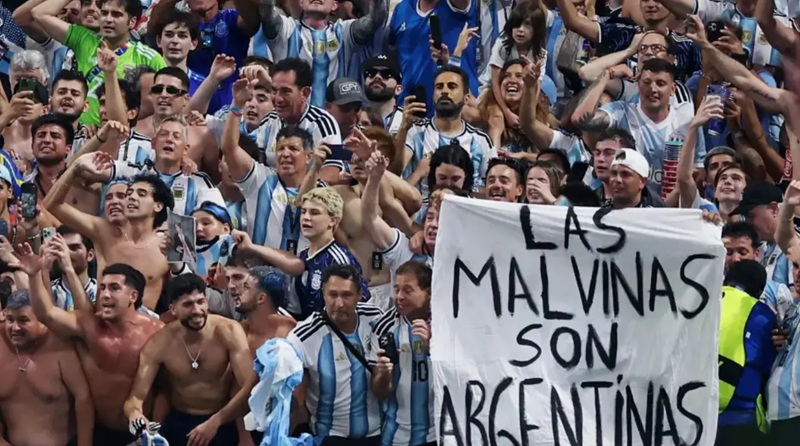
Argentina’s victory over England was not just another match. We knew it here, but also in Bangladesh, Palestine, Scotland, Ireland, and every corner of the world where colonialism left its mark. For ninety minutes, millions cheered for Argentina as if it were their own national team. The Atlanta stadium witnessed an unprecedented event: when the British anthem played, the crowd drowned it out with the chant «He who doesn’t jump is an Englishman,» accompanied by whistles and boos. It wasn’t just the Argentine fans; it was the world.
The images traveled the planet: streets full of light blue and white jerseys in Dhaka, packed bars in Montevideo, messages of support from Palestine, impromptu caravans in Latin American, European, and Asian cities. None of those people were playing in a final, but they felt the match also belonged to them. Because when Argentina faces England, football ceases to be just football.
For Argentines, England is not just a national team: it is the power that occupies the Malvinas Islands. But for many other peoples, England is also not a mere sports rival. It was the largest colonial empire in history and left a deep mark on Asia, Africa, the Middle East, and Europe. In Bangladesh, whose history is marked by British colonization in the Indian subcontinent, an Argentine victory over England is experienced as a symbolic revenge against an old dominator. In Ireland or Scotland, for different reasons, there are historical memories that explain sympathies difficult to understand if the analysis is limited to sports and the figure of Messi. That moment from 40 years ago with Maradona is revived: a classic against the English empire.
The match mobilized something that existed long before the game began. For a few hours, a community of feelings surfaced that overflowed any border. Social media showed entire cities filled with messages of support from countries that had nothing at stake in sports terms, but much in historical and political terms. Millions felt it was also their match. National defense against the various forms of domination that many countries still suffer. Each people projected a part of their own history onto that match.
On social media, the phrase began to repeat: «An Argentine is born wherever he wants.» It wasn’t about nationality, but identification. Being Argentine, for a moment, meant taking on a cause that transcended borders as one’s own. Not because national identities disappeared, but because a national cause could awaken the solidarity of other peoples. It means feeling that the defeat of colonialism, even on a football field, is also a small victory of one’s own. That feeling has a name: it is called fraternity among peoples. It has the aroma of internationalism, which understands that a people’s struggle for sovereignty can be embraced by many others. That Malvinas is not just an Argentine cause, just as Palestine is not just a Palestinian cause. Or as the defense of any people against oppression challenges those who know, from their own experience, what colonialism or dependence means.
Of course, a match does not recover the Malvinas, nor does it modify the balance of power between nations, nor does it end contemporary forms of imperialism. But it does reveal something that exists: a deeply anti-imperialist popular sensibility that rarely finds such massive and spontaneous expression. And there was another significant fact: the protagonists of the celebration were not governments or economic elites. In many places, workers imposed a de facto strike; the work routine was suspended for hours. Production gave way to embraces, honking horns, caravans, and flags. As happens on great popular days, the streets ceased for hours to belong to circulation and consumption and returned to those who inhabit and work them. It was the workers, the youth, and the popular neighborhoods who made public space their own and transformed a sports victory into a collective celebration.
That popular appropriation also marked a contrast with Javier Milei’s government. While the President publicly vindicates Margaret Thatcher and deepens a political alignment with the great Western powers, the streets expressed a different sensibility. The Malvinas cause does not belong to a government; it belongs to the Argentine people. And, for a few hours, it also belonged to thousands of people who, from other countries, felt it as their own. Perhaps that was the most interesting lesson of the match: not only that Argentina defeated England, but that, for ninety minutes, millions of people showed that solidarity among peoples is not an empty slogan. It exists. Sometimes it remains silent, but when a cause manages to condense it, it appears with extraordinary force.
Another feeling left by the great match of the National Team: the passion for unity, the strength to fight until the end brought victory. It managed to overturn everything from the most adverse predictions to the prohibitions that sought to prevent the stands from filling with the flags and symbols that the people made their own. And this goes directly against those who continually say that it cannot be done, that we must resign ourselves. Nothing could be further from the spirit of the Argentine team, which speaks of the spirit of the Argentine working people: passion, resilience, and fighting as they have fought throughout their entire life and history. The players also defied the limits imposed by FIFA by unfurling the Malvinas flag, and we will have to see if they are fined. This was also seen throughout the World Cup: the business owners acted like estate bosses, obeying directives from President Donald Trump or embracing the English crown. They made it clear, but they could not prevail.
In this sense, yesterday’s event was a symbolic triumph over imperialism. And it also left us a reminder: if millions of people can feel part of the same cause for a football match, imagine the strength of that unity if it were expressed to transform reality. What would that fraternity do for the defeat of the State of Israel and support for the Palestinian people? Or what would it do for the triumph of a nation like Argentina or Bolivia if it were freed from the plunder to which the puppet governments of imperialism subject them, or likewise for so many subjugated countries, to build truly free nations?



Para mí esto es una cachetada al imperio yankee, giles. Mientras ellos lloran, el mundo entero festeja como si Argentina hubiera ganado la guerra. De Bangladés a Palestina, todos saben que este triunfo huele a liberación nacional. ¡Viva la revolución, carajo! Extrema izquierda forever.
para mi es una verguenza q festejen con argentina somos un pais libre no un simbolo para zurdos de mierda viva la libertad carajo