
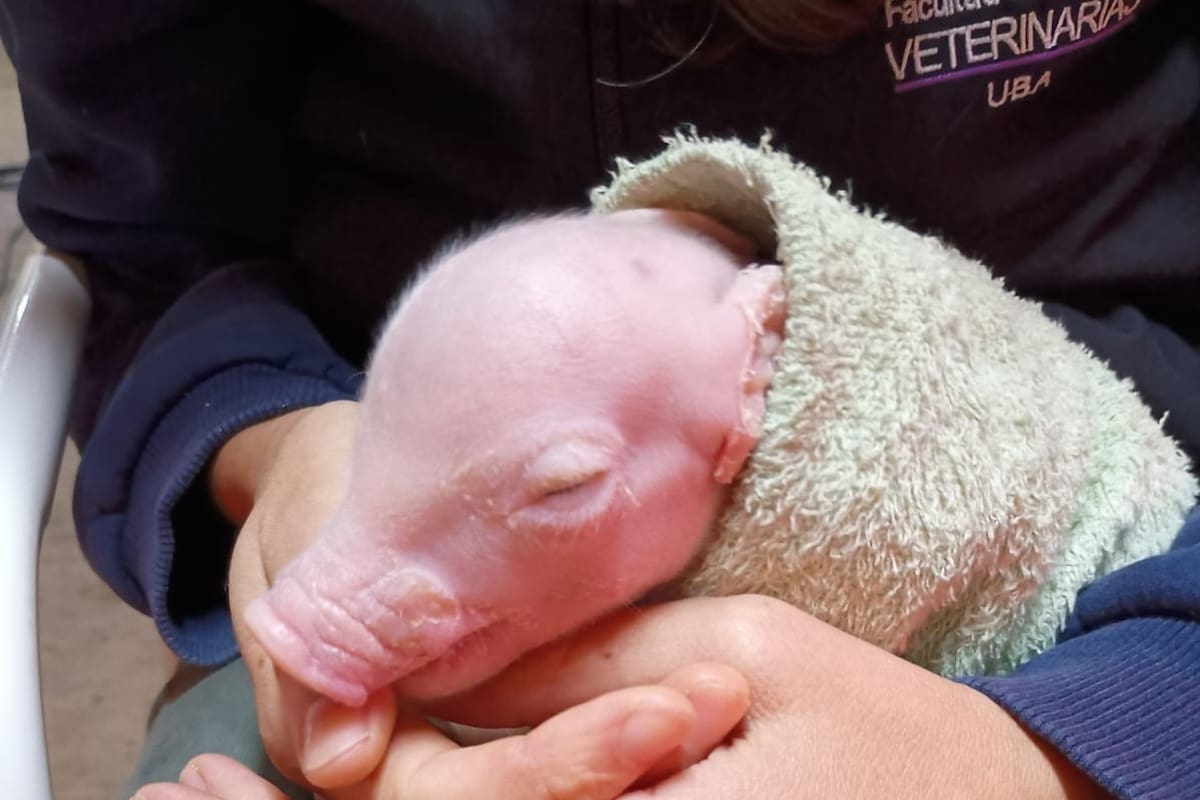
A team of scientists from the University of Buenos Aires (UBA) and the National University of San Martín (Unsam) achieved a milestone that puts Argentina on the map of world medicine: the birth of the first pig in Latin America with three inactivated genes, designed for future organ transplants to humans. The animal, which came into the world in April at the facilities of the UBA Faculty of Veterinary Sciences in the Buenos Aires neighborhood of Agronomía, is only the third development of its kind on the planet, after those achieved in the United States and China.
The creature, obtained through gene editing and cloning techniques, represents a giant step in the fight against immune rejection, the main obstacle to xenotransplants. The researchers deactivated three specific genes —GGTA1, CMAH, and B4GalNT2— that trigger the violent response of the human immune system against animal organs. In scientific jargon, this is known as «triple knockout.»
«We are responsible for maintaining the pregnancy and the birth, that is, we are the final link of the project, but also the beginning of the piglets’ rearing stage,» explained Marcelo Acerbo, a veterinarian specialized in porcine reproduction and professor at UBA. The team used a minimally invasive surgical technique to implant 120 genetically edited embryos into a recipient sow.
The project, which combines UBA’s expertise in animal reproduction with Unsam’s genetic vanguard, led by Adrián Mutto, does not stop here. Currently, there are already two pregnant sows with new clones in development, and the plan is to add seven additional genes to increase the compatibility of porcine organs with the human body. «This will include blocking growth hormones to mold and adapt the size of the porcine liver or heart, which in adult animals over 200 kilos exceeds the capacity of the human body,» Acerbo advanced.
The urgency behind this research is brutal: more than 7,000 people are waiting for an urgent transplant in Argentina, and so far in 2026 only about 900 transplants have been performed. Worldwide, only 10% of the demand for organs is met. The pig, due to its anatomical and physiological similarity to humans and its high reproductive capacity, is emerging as the ideal candidate to save lives.
But there is no need to rush: before any human trials, scientists must conduct preclinical studies to verify that porcine organs do not trigger rejection. «This is only the beginning of a process that will take several years,» those responsible clarified. Meanwhile, Argentina has already made history.



Para mí esto es un negocio de los ricos, como siempre. Mientras la gente se muere esperando órganos, la UBA hace experimentos con cerdos para trasplantes. Los liberales festejan porque ven plata, no salud pública. ¡Basta de hipocresía, queremos salud para todos, no ciencia ficción para pocos!
para mi la uba es una verga cria cerdos transgenicos mientras la gente se muere esperando organos esto huele a experimento zurdo jugar a ser dios firmado elverdulero74