
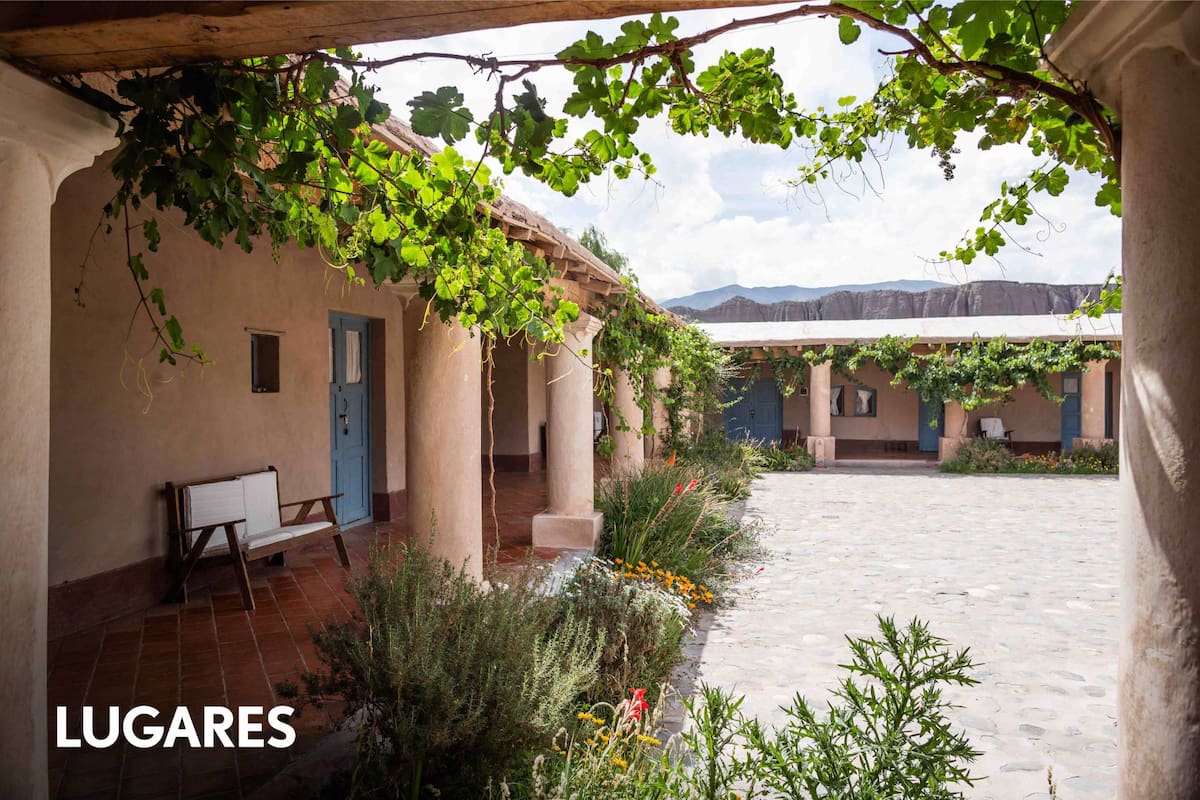
National Route 40 is still unpaved in this northern stretch, one of the most scenic with spectacular landscapes, but the range of services has grown notably in recent years. Below, a selection of historic properties that have been adapted to receive guests without losing their original essence.
Finca El Bordo de las Lanzas (Cachi)
Virginia and Magdalena Ruiz Moreno welcome guests to this estate that is a true treasure, ideal for a stop during the journey through the Calchaquí Valleys. 13 km from Cachi, the old stone and adobe house (1878) with cane, straw, and mud roofs opened to tourism over two decades ago. The seven rooms are decorated with warmth and northern spirit, and guests can have lunch and dinner here. They recently opened a tea house offering lunch and snacks, also for non-guests. Dishes are made with whatever the season brings from the organic garden. Afternoon arrives with fruit tarts, scones, and a variety of teas. They have a winery, a project that produces only 2,000 bottles a year and seeks to revive the tradition of homemade Salta wine: strong, intense, with color and tannins.
Cabañas del Valle (Cachi)
Located about 7 km from the town of Cachi, the ten cabins were designed among vineyards, and that is their great charm. Set on a ten-hectare plot, they opened in 2004 and were built with noble materials typical of the region: adobe, cane, and stone. There are houses for couples and others with two rooms to accommodate a family of six. The kitchen is equipped, and cleaning service is provided. From the pool, you can see the vastness of the Nevado de Cachi. There are walking trails and an open garden for those who get excited about daily harvest cooking, a practice possible from October to April when the weather allows.
Hotel de Campo La Merced del Alto (Cachi)
The house that now houses the country hotel was once a ranch headquarters, a hall as they are known in northern Argentina, built at the beginning of the 20th century. In the hands of the Ruiz de los Llanos family, it now offers nine rooms and a small spa. The beds in the rooms are strategically placed to admire the Nevado de Cachi as soon as you open your eyes. From there, you can see its highest peak, the Libertador San Martín. From March to May, the field turns red with ripe peppers: a unique attraction. Opposite are the vineyards. Their wines can be tasted in the on-site restaurant, open for dinner service.
Finca Tierra Colorada (Cachi)
The property has belonged to the Nanni family since 1905. In recent years, they renovated the old farmhouse (circa 1890) and opened its doors to tourism. Teresita Nanni, the youngest of the sisters, is in charge of welcoming travelers, always by prior reservation. Built of adobe, the house retains its original floors, doors, and ceilings. Elegant and sober, it is decorated in warm tones, and special attention to detail gives it character. There are five rooms: double, triple, quadruple, and a family loft for 5 people. The pool has a view of the hills, and beyond, you can glimpse the vineyards whose fruits are processed in the Tierra Colorada winery. There, Brea, a small restaurant, is open for lunch. Walking around, visiting the winery, or daring to go horseback riding to Los Médanos are the activities proposed here.
Posada y Casa Lavaque (Cafayate)
Here, two historic buildings converge: the mansion that once housed an educational institution and the home of Lebanese Pedro Lavaque, an immigrant, pioneer, and key figure in the region’s development. The entire complex occupies almost a city block, one block from Cafayate’s main square. It is a kind of multi-space integrated by the delicious cuisine of the La Despensa restaurant and the art and craft exhibits of the Casa Cultural Pedro Lavaque. As for the hotel offering, the old colonial residence with Italian influence (19th century) offers two accommodation options: Vieja Posada with 11 rooms and Casa Lavaque, a boutique space with only 5 rooms. The interiors were furnished with a native and modern design, very pleasant. Gardens with lush vines, patios, galleries, and a pool complete the complex, which is managed by Pedro’s great-grandson, Ramiro Trunsky, and his partner Paola Marcon.


para mi estos hoteles de lujo son la misma mierda de siempre los patrones explotando a los campesinos haciendose los culturosos yo creo q tendrian q estatizarlos y abrirlos al pueblo turistas basura q bancan estas injusticias
Para mí estos misterios históricos en Salta son puro verso de zurdos. Las fincas son de familias patriotas que nos dieron patria, no como estos progres que quieren tapar la verdad. Vamos a respetar la tradición carajo. Viva la derecha, viva Argentina.