
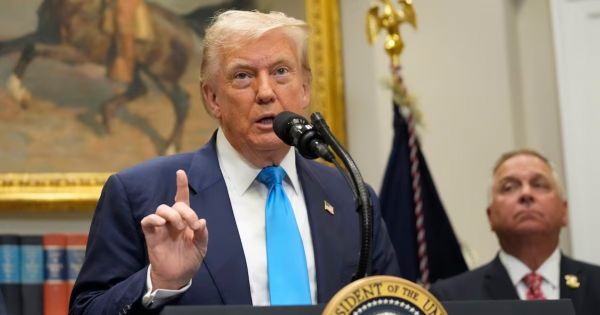
The United States confirmed that starting this Friday it will apply a 10% tariff on imports from Argentina and 59 other countries, in a new chapter of the trade war unleashed by President Donald Trump. The Office of the United States Trade Representative (USTR) reported that the measure replaces a previous duty imposed earlier this year and stems from investigations into alleged forced labor in the production of imported goods.
According to the official statement, the affected countries represent 99.4% of imports entering the U.S. market. Argentina was placed in the group of nations that will receive a 10% rate, along with Mexico, Canada, the United Kingdom, India, Indonesia, Ecuador, Guatemala, Honduras, and Malaysia, among others. The decision comes after the U.S. Supreme Court questioned the application of general tariffs, forcing Washington to adjust its trade strategy.
The USTR stated that «on June 2, 2026, it determined that the acts, policies, and practices of the investigated economies related to the lack of an effective prohibition on the importation of goods produced with forced labor are unreasonable.» In addition to the base 10% tariff, some products from countries such as Japan, South Korea, Taiwan, Switzerland, and European Union members will face rates between 10% and 12.5%, while other economies will receive the maximum level of 12.5%.
Most strikingly, Argentina had signed a reciprocal trade and investment treaty with the United States last February, an agreement aimed at deepening economic ties. However, that was not enough to keep it out of the new tariff scheme. From Washington, they indicated that the measure is part of Trump’s policy to «prioritize the interests of American workers» and reduce trade imbalances, using tariffs as a tool to boost domestic production.
The impact on Argentina could be significant, as the country mainly exports agro-industrial products and agricultural manufactures. The 10% tariff makes these products more expensive in the U.S. market, which could affect competitiveness against other suppliers. Additionally, the measure adds to local economic uncertainty, with inflation not easing and ongoing negotiations with the IMF.
The news generated mixed reactions. While some Argentine business sectors expressed concern, the national government has not yet made an official statement. The new tariff represents a hard blow to expectations of deepening bilateral trade, just when concrete steps had been taken with the February treaty.
In a global context of trade tensions, this measure by Trump reinforces his protectionist stance and leaves Argentina in a delicate position. It remains to be seen whether negotiation channels will open or whether the country will have to seek new markets to offset the impact.


che trump y los yankis de mierda nos rompen las pelotas otra vez con su arancel del 10% para mi esto es un castigo a los laburantes argentinos mientras ellos se llenan de guita que se metan sus aranceles en el orto viva la patria carajo
che trump la tiene re clara para mi argentina vende basura y encima se quejan el 10% es poco tendria que ser 100% kukas lloran? jodanse hermanos viva usa viva el libre mercado 🤘🇺🇸