
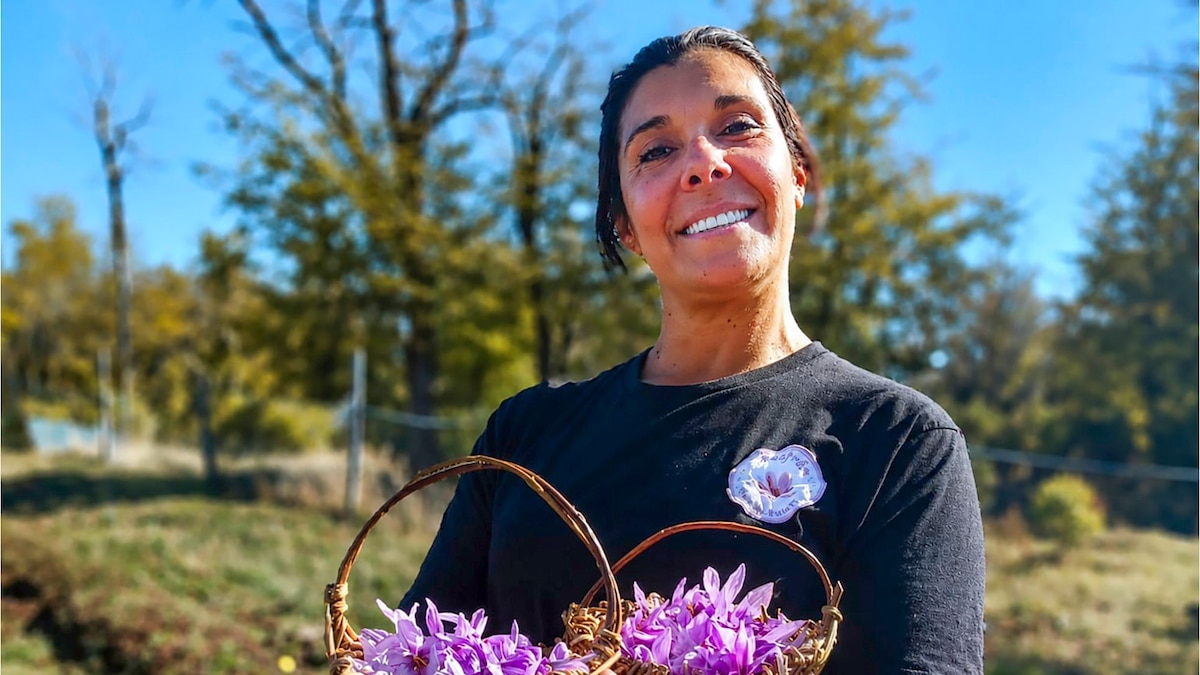
The story of Paola Ahumada is one of a return to her roots. Born in Chubut, she worked for twelve years at an oil multinational, but gastronomy ran through her veins. Her paternal grandfather, originally from Murcia, Spain, arrived in Comodoro Rivadavia to work on the YPF railway in the early 1900s and brought with him the knowledge of saffron cultivation. «Dad told me that our family used to grow saffron, and that’s why I say this crop found me,» Paola says from her field 25 kilometers from Trevelín, where she lives with her husband and children.
The path was not direct. Before dedicating herself to saffron, she studied Gastronomy, her true passion, which connects her to her Spanish, Arab, and Italian roots. Together with her husband, also from Chubut, they decided to leave the city and bet on the countryside. «We arrived here with my husband and our savings, to a field that I had inherited from my family,» she recalls. The area, at 690 meters above sea level, near La Zeta lagoon in Esquel, is harsh: «Temperatures can drop to -19°C and with 1.20 meters of snow,» she explains.
The first attempts were failures. «Everything failed…» she admits. She tried olive trees, but they didn’t work. She even thought about selling the land. It was then, during the development of her thesis, that she revisited the saffron dishes her father used to make. She traveled to Spain, contacted producers, and brought bulbs of the Negin and Sargol varieties. She started planting little by little and discovered that saffron adapted perfectly to the Patagonian climate. The bulb needs a cold winter to bloom well, with poor, well-drained soils. Its distinctive feature is the red stigmas, the authentic and coveted saffron.
Today, the «red gold» occupies a quarter of a hectare. «We use the whole flower,» Paola recounts. With the petals, she makes tea blends and cosmetics; with the pollen, protein croquettes for bees. Of the saffron, 80% goes to an export gin, 10% to health food stores across the country, and the other 10% stays at her establishment for the gastronomic sensory experience she offers. There, she fuses Arab, Spanish, and Italian cuisine. «Soon a book called ‘Cooking with Saffron’ will come out, with recipes from me and other chefs, to show the diversity and potential of the product,» she previews.
The gin, named Saffron Golden Gin, already has a Chubut origin seal and received a bronze medal at the Argentina Spirits Awards 2025, in the Contemporary Gin category, among 690 gins from around the world. More notable than the gin and tonic, craft cocktails find in this variety a perfect excuse to pair with its golden color, which it acquires through contact with saffron. Its aroma is fresh, with jasmine, pepper, cinnamon, and lemon. It is dry, with a slight spiciness and a long finish, oily and creamy texture, with a sweet touch. It pairs well with fresh fruits, soft cheeses, fish, shellfish, and sushi.
Paola does not stop. In the middle of the ñire field, she continues to bet: «We want to promote new saffron producers and set up a cooperative.» Her story is that of a woman who left the oil industry behind to recover a family tradition and turn it into a business that is already making waves in the gastronomic world.



para mi esta mina es la posta dejo el petroleo kuka por el oro rojo mientras los chevrones se afanan todo ella labura la tierra aguante el azafran del pueblo y la patagonia socialista carajo dejense de robar 🚩
y bueeeno otra heroina de mierda dejando el petroleo por el oro rojo mientras los zurdos lloran cambio climatico esta tipa labura y factura el azafran argentino es un orgaso pero los zurdos de mierda seguro lo boicotean viva la patria y el que no salta es un comunista 🚩🔥