
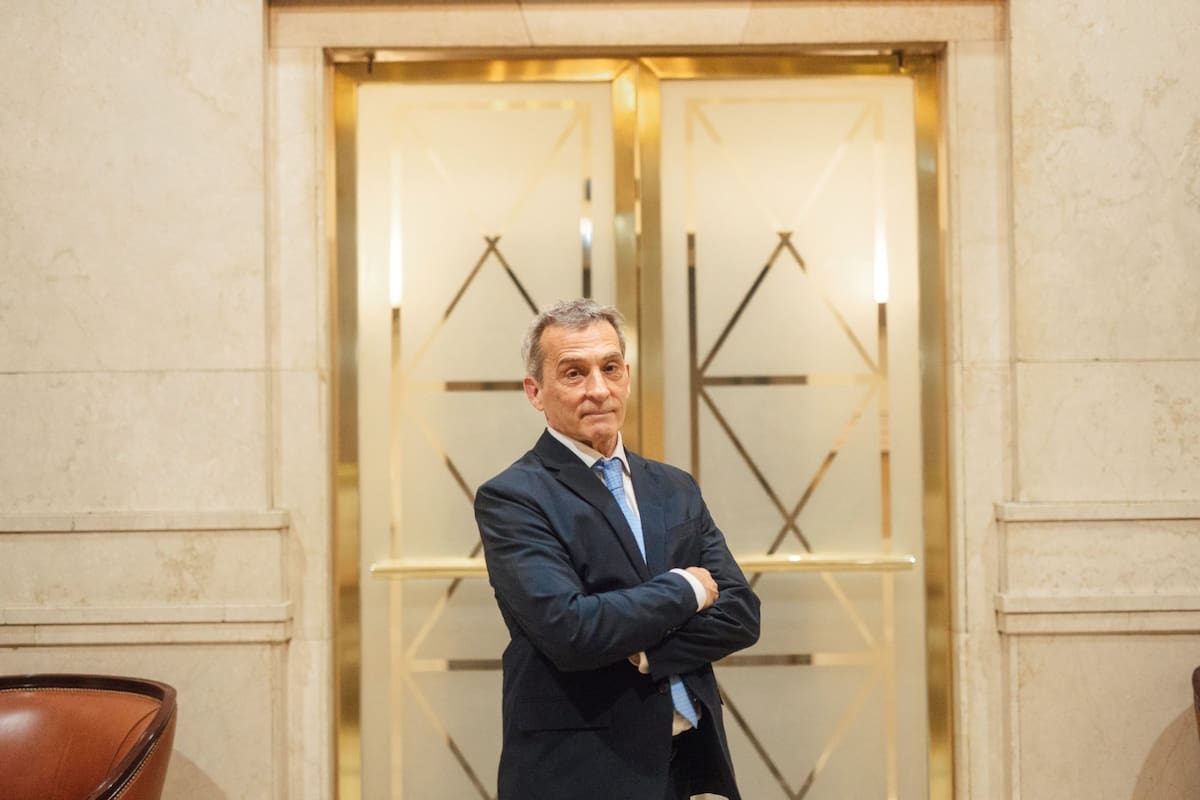
Citi’s chief economist for Argentina, Paraguay and Uruguay, Ricardo Dessy, argued that fiscal adjustment «raised the castle walls» and that the country withstood the jump in country risk better than expected, though he differed with the Government: he recommends buying more reserves and letting the exchange rate rise slightly to ease the burden on the sectors suffering most from the transition. He said this in an interview with LA NACION.
The news article is the only source that includes Dessy’s statements. It is not an official document or an academic study, but an edited interview. The Central Bank, by contrast, publishes on its website the regime and daily values of the exchange rate bands, a primary document that describes the current framework.
What the BCRA document says about the bands
According to the Central Bank’s official page, the exchange rate band system was launched on April 11, 2025 with a range of ARS/USD 1,000 to 1,400, within which the exchange rate fluctuates freely according to supply and demand. Until December 31, 2025, the BCRA adjusted those limits at a monthly rate of -1% and +1%. As of January 1, 2026, the floating band regime remains in effect and the monthly rate of slide for the ceiling and floor is determined based on the latest monthly inflation data reported by INDEC (T-2). The BCRA also offers a complete series in XLSX and separate series for the upper and lower limits.
That document does not mention reserve purchases, the country risk level, or statements by officials. Nor does it set an opinion on whether the exchange rate should rise or fall. It only establishes the band mechanism and its updating.
What LA NACION attributes to Dessy
The interview attributes several statements to Dessy. Among them: that country risk went from being close to breaking through 400 points to exceeding 650 in recent weeks; that what is striking is not the jump but how well the country withstood it; that fiscal adjustment made Argentina less vulnerable; that he recommends buying more reserves to build confidence and lower country risk faster; and that he would intervene less in the foreign exchange market. It also attributes to him the phrase «A higher exchange rate is not a solution to anything» and, at the same time, the idea that a higher exchange rate could bring relief to some sectors. The article notes that Dessy has differences with the Government, which prioritizes exchange rate stability and predictability.
The journalistic text does not provide the exact country risk figure at the time of the interview or the precise date when he spoke. Nor does it indicate whether the BCRA bought reserves or not during that period. These omissions are limitations of the source.
Contrast between the sources
The two sources do not contradict each other, but they operate on different levels. The BCRA describes an exchange rate regime with bands and an updating mechanism tied to inflation. LA NACION reports the opinion of an economist who proposes intervening less and buying more reserves. The coincidence is that both refer to the exchange rate and its administration. The difference is that the BCRA does not evaluate that proposal or confirm that the Government is considering it. The interview also does not cite an official document supporting Dessy’s recommendation.
There is no primary source in the material provided that sets the BCRA’s reserve level, the country risk value, or the effective exchange rate on the date of the interview. Therefore, it is not appropriate to calculate variations or convert currencies. Any comparison between the band range and the exchange rate mentioned in the article would require data that are not in the sources.
What each document establishes and what remains open
| Document | What it establishes | What it does not establish | Open questions |
|---|---|---|---|
| BCRA page on the exchange rate band regime | Start date (4/11/2025), initial range (ARS/USD 1,000 to 1,400), adjustment rate until 12/31/2025 (-1% and +1% monthly), effective from 1/1/2026 and updating based on INDEC monthly inflation (T-2) | Does not mention reserve purchases, country risk, economists’ opinions, or market exchange rate | What is the daily value of the bands on the date of the interview? Does the BCRA intervene outside the bands? How exactly is the T-2 lag applied? |
| LA NACION interview with Ricardo Dessy | Statements attributed to Dessy on country risk, fiscal adjustment, reserve purchases, exchange rate intervention, and differences with the Government | It is not an official document, does not set verifiable figures for reserves or country risk, does not indicate the exact date of the interview or the Government’s response | Is the Government considering buying more reserves? Which sectors would benefit from a higher exchange rate? How does the proposal relate to the current band regime? |
What data or decision should be followed
The next relevant data point is the monthly update of the exchange rate bands published by the BCRA, because the range within which the exchange rate can move without intervention depends on it. It is also worth following whether the BCRA changes its reserve purchase behavior, a point that the interview puts up for discussion but that is not documented in the material. The evolution of country risk and its relationship with the bands would require official series that were not provided.
Fuentes consultadas
- LA NACION
- Banco Central de la República Argentina Fuente primaria
El Sereno contrastó las fuentes enlazadas y añadió contexto, comparación o análisis documental. Las fuentes primarias están identificadas. La nota no se presenta como investigación de campo ni como entrevista propia, salvo indicación expresa.



Comentarios