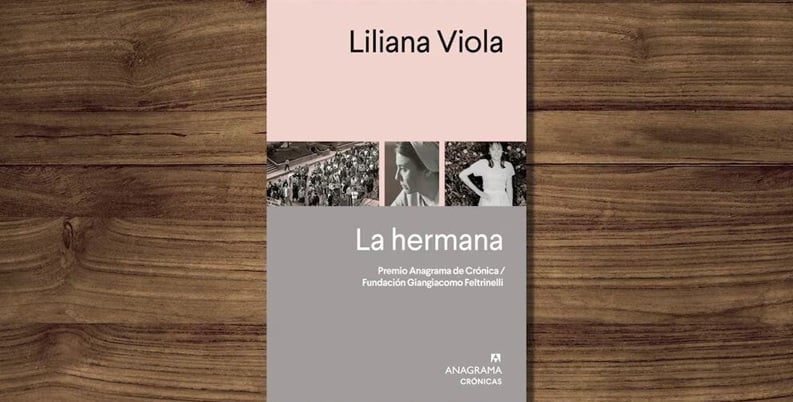
What happens when a nun stands up to power and doesn’t back down? That’s exactly what «La Hermana» explores, the chronicle by Liliana Viola that just won the Anagrama Prize for Chronicle / Giangiacomo Feltrinelli Foundation. And it’s not just another book: it’s a direct stab at the heart of Argentine impunity.
Viola, a journalist and writer known for her work in the SOY supplement and as the executor of Aurora Venturini’s estate, delved fully into the figure of Martha Pelloni, the nun who in the 1990s became a symbol of struggle when she stood up to demand justice for the femicide of María Soledad Morales, a student from Catamarca murdered by sons of the provincial power structure.
But the book doesn’t stay in the past. Viola reconstructs decades of complaints, from trafficking cases to children poisoned by agrochemicals, and shows how Pelloni became a kind of «signal nun»: a figure the media calls when a case explodes, but who is later left floating in the void of indifference.
In a conversation with Tribuna de Periodistas, Viola said the motivation for writing was «not being able to stand the degree of habituation» to verifiable crimes. «A half-closed eye toward crimes and highly unjust situations, with names and surnames, with demonstrable power circuits,» she said. And she added: «I refer to a certain naturalization of evil, a habituation that I could notice not only in society in general, but especially in myself.»
The author is not a classic chronicler who goes out on the street. «I don’t consider myself a chronicler, since I don’t leave my house much,» she confessed. But her method was different: she drew on archives, notes from other journalists, and a few meetings with Pelloni. «I built this plot from books, from notes that had already come out in different cases, many in provincial media,» she explained.
The book has already had an impact in Mexico and Spain, where Pelloni is read as a heroine. «They didn’t know her there, and now they read her as a heroine, of a magnitude much greater than we can recognize here in Argentina,» Viola noted. And she launched a phrase that stings: «I think this happens because we have her so close, so everyday, and also because of that ‘habituation’ I mentioned at the beginning.»
But it wasn’t all rosy. Viola admitted that she received «some veiled threats» and that «there are issues that, even though they happened almost 40 years ago, still have a very powerful network.» What network is she talking about? That’s what the book is about: how power conspires to cover up the truth, how the weak are left unprotected, and how a nun with habits and convictions became the nightmare of the powerful.
«La Hermana» is, ultimately, a cry in the midst of silence. A reminder that impunity is not an accident, but a system. And that as long as there is a Pelloni, someone will keep denouncing.

che este libro de la hermana pelloni me parece una genia total se la re banco contra los hijos de mil puta los ricos y la iglesia complice esto huele a que hay que quemar todo no da mas firma el loco de la rebelion
Para mí esta Pelloni es una vendida que encubre curas pedófilos mientras se hace la santa contra los políticos de bien. Me parece un asco que le den pantalla a esta zurda hipócrita. La dictadura al menos ponía orden, no este circo de impunidad para criminales y persecución a los patriotas. Vuelvan a casa, zurdos de mierda!