
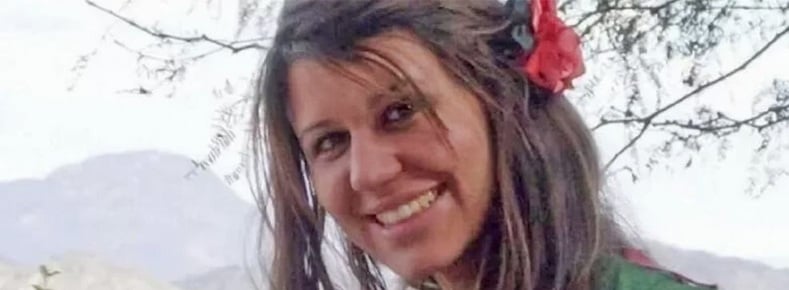
“While time flies, we swim in uncertainty. When the response is slow, a simple case becomes complex.” That is the reflection of an investigator who participated in the search for María Cash and still lives with anguish for not being able to provide certainty to the family of the designer who disappeared 15 years ago. Helplessness and frustration are the feelings that arise from that inability, despite all the work done since then.
The last certain trace of Cash is from July 8, 2011, around 4:00 p.m., on Route 9, at the height of Difunta Correa, a desolate and lonely place in northern Argentina. Exactly a decade ago. Her parents and siblings never gave up. Máximo Cash, María’s father, died in an accident on a road in La Pampa while searching for her. In his car, they found flyers with his daughter’s face.
Willingness abounds, but – despite efforts – the lack of training that still persists in the police and the judiciary leads to failure in such cases with simultaneous hypotheses. “Unfortunately, the mistake is to lean towards one. That tendency is induced by someone or by the desire to solve the case. If the same formulas continue to be applied, the result will be the same. Much has been done to change it, but there is still a long way to go,” they added. The feeling is shared by those searching for Guadalupe Lucero in San Luis.
The hypotheses surrounding Cash are several: from a psychiatric disorder that made her wander aimlessly and go into the bush, to human trafficking, abuse, and homicide. Also that she voluntarily evaded her life before July 8, 2011. The latter gives the family hope that she is still alive, even if she does not return.
Investigators must also navigate “distracting lines”: malicious people, pranksters, opportunists, or individuals who, influenced by images broadcast by the media, believe they see the missing person. Each of these must be ruled out.
The case of María Cash was never closed. In fact, it became a milestone in the search for missing persons in Argentina. An interdisciplinary panel, composed of the Federal System for the Search of Missing and Lost Persons (SIFEBU), headed by Leticia Risco; federal prosecutor Eduardo Villalba, federal forces, and an Ad Hoc investigator, has been meeting regularly since 2019, when a large-scale search operation attempted to find traces of the designer in an area near the grotto of Difunta Correa.
On this new anniversary, the meeting took place in Salta, with the participation of the family. Together they reviewed everything that was done to find María in a decade and highlighted how significant the case was for the State. “It made us see the shortcomings of the system. Since then, it has been strengthened, regardless of the government administration,” official sources indicated.
When the designer disappeared, the Ministry of National Security had been recently created (in December 2010). The case opened the eyes of investigators whose previous experience was linked to Marita Verón, related to human trafficking. “Until that moment, in 2011, the phenomenon was not understood, and with María – a disappearance that presented several hypotheses – the need for a national policy for the search for missing persons involving federal forces began to be addressed,” they detailed.
Following that line, in 2014 the Missing Persons Search Unit was created. That same year, Luciano Arruga was found through fingerprint comparison of people buried as NN. In 2015, the same team tackled the problem of coordination with the provinces: the Federal Communications System (SIFCOP) was developed, which allows real-time national communication of all missing persons among all police forces in the country.
The chronology of those fateful days shows a succession of erratic movements: on Monday, July 4, María arrived at the Retiro bus terminal with her father and left for Jujuy. She carried 700 pesos, a backpack, and a bag with clothes to sell. The next day, she did not arrive with the rest of the passengers at the San Salvador terminal; she got off in Rosario de la Frontera “because she didn’t like the atmosphere on the bus.” She backtracked 300 km to Santiago del Estero. On Wednesday, July 6, she hitchhiked and headed to Jujuy, from where she called a friend to pay for a ticket. She arrived at the provincial capital around 9 a.m. and went to a phone store, where she borrowed a cell phone to make a call. That same afternoon, at 5 p.m., she called her mother from a phone booth requesting an urgent money transfer and confirmed that she felt unwell and was very distressed. The communication continued with her father: “I’m going to Salta, I’ll see what’s up there. I can’t talk anymore.” The call ended.
On Thursday, July 7, the young woman’s backpack was picked up by an employee of the Aunor toll booth, but it was not checked until Sunday, July 10, when the search became public. Inside, they found clothing, her ID card, and small pictures of Saint Francis. The director of the San Bernardo Hospital, Jaime Castellani, stated that María Cash was at the facility’s emergency room on Thursday, where she asked to be seen but left unexpectedly.
On Friday, July 8, at 10:30 a.m., she communicated for the last time with her family via emails asking for friends’ numbers. In the morning, she sent an email to her brother requesting a relative’s phone number. She was at the Aunor toll booth between 1:30 p.m. and 2:30 p.m. In a security camera video, she is seen approaching a Chevrolet C10 pickup truck. It was the vehicle of Juan Causareno, a resident of Salta who said he took her to the border of Tucumán province. Then, at 4:30 p.m., she got back on a truck heading south. That vehicle took her 14 kilometers and dropped her off at the grotto of Difunta Correa. Thirty minutes later, she boarded the truck of Héctor Romero, who was heading south with merchandise. She got off 14 kilometers later, at a grotto in honor of Difunta Correa. On the same day, a doctor, Jesús Chiquisaq, claims to have treated her in his office in San Salvador de Jujuy.

15 años y nada, para mí la familia Cash espera justicia mientras los zurdos hablan de ‘trata’ para sacar rédito político. Esto huele a sistema corrupto e inútil, una vergüenza. Yo creo que la verdad está tapada, basta de hipocresía. Firma: El Federal
15 años y nada la justicia es una vergüenza para mi esto huele a que los milicos y las corporaciones tienen algo que ver María Cash desapareció y el Estado mira para otro lado la familia sufre y nosotros nos tenemos que bancar esta impunidad basta ya #JusticiaParaMaría