
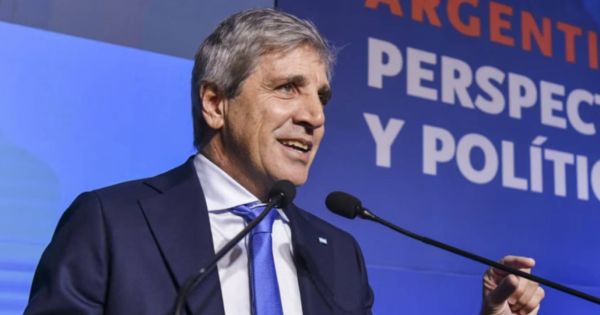
Economy Minister Luis Caputo is traveling to the United States to participate in the G20 summit in Asheville, North Carolina, where he will defend the direction of Javier Milei’s economic program. The ministerial meeting of finance ministers and central bank governors will take place over two days, according to La Derecha Diario. In this context, Caputo will be the main speaker in the session focused on global growth, according to Crónica.
The official delegation also includes Central Bank President Santiago Bausili; Secretary of Economic Policy José Luis Daza; and Vice President of the monetary authority Vladimir Werning, according to Crónica. From the economic area, they advanced the central theme of his presentation: «Caputo will speak about the measures implemented in Argentina to generate macroeconomic stability as a basis for sustained growth.»
Bilateral Meetings with Key Officials
During the event, the official will hold key meetings with U.S. Treasury Secretary Scott Bessent and IMF Managing Director Kristalina Georgieva, in a context marked by global tensions and international monitoring of Argentina’s financial targets, reported Crónica. The meeting with Bessent seeks to strengthen bilateral alignment, following the support provided by the U.S. administration and recent trade negotiations that allowed an extra quota for meat exports to that market.
On the other hand, the planned meeting with Georgieva will address compliance with the targets of the current program, which includes fiscal surplus, monetary issuance, and the level of international reserves. Although the multilateral organization’s team recognizes technical progress, it keeps under analysis socioeconomic variables such as the impact of tax collection and credit arrears on the population, according to Crónica. IMF spokesperson Julie Kozack, who accompanies the delegation at the summit, has emphasized in her public appearances the need to address social demands within the framework of the fiscal adjustment program.
Work Agenda and Global Issues
In addition to his intervention, the work agenda includes debates on sovereign debt, global imbalances, financial education, cryptocurrency regulation, and the modernization of the international financial system, according to Crónica. The summit will serve as a stage to reaffirm political ties with Donald Trump’s administration.
The Argentine economic team will participate for two days in meetings with finance ministers and central banks, according to La Derecha Diario. The information from Crónica and La Derecha Diario coincides on the date and location of the event, as well as Caputo’s participation and bilateral meetings with Bessent and Georgieva. However, La Derecha Diario does not mention the presence of Bausili, Daza, or Werning, nor the specific agenda topics such as cryptocurrencies or financial education. Crónica, for its part, does not detail the two-day duration mentioned by La Derecha Diario.
Timeline of Argentina’s Participation in the G20 and IMF Payments
Argentina’s participation in the G20 occurs in a context of negotiations with the IMF and a projected payment schedule that the organization published on its official website. The primary source is the IMF document titled «Argentina: Projected Payments to the IMF as of June 30, 2026,» which details the amounts in SDRs (Special Drawing Rights) that Argentina must face until 2030. This document is a primary source because it is the official communication from the multilateral organization.
- June 2026: The IMF updates Argentina’s projected payment schedule, with maturities beginning in August 2026.
- August 2026: First maturity of the year: basic charges, surcharges, and SDR charges, totaling 622,614,704 SDRs.
- September 2026: EFF repurchase maturity of 583,333,333 SDRs.
- December 2026: Last maturity of the year: repurchase of 250,000,000 SDRs, totaling 2,082,529,842 SDRs for 2026.
- 2027-2030: Projected annual payments amount to 5,650,460,371; 7,004,829,747; 7,792,755,072; and over 4,000 million SDRs respectively, according to the document’s detail.
Between each milestone, what changes is the amount and composition of payments: in 2026, maturities are lower than in subsequent years, and from 2027, EFF repurchases and surcharges are added. The IMF document does not specify whether these amounts are subject to changes due to future program reviews.
Value Module: Total Projected Payments 2026-2030
According to the IMF document updated as of June 30, 2026, Argentina’s projected payments to the organization for the period 2026-2030 total 25,530,575,032 SDRs. This calculation was made by adding the annual totals listed in the document for each year: 2026: 2,082,529,842; 2027: 5,650,460,371; 2028: 7,004,829,747; 2029: 7,792,755,072; and 2030: 4,000,000,000 (approximate, since the document cuts off in May 2030).
- Document: «Argentina: Projected Payments to the IMF as of June 30, 2026» (IMF).
- Organization and date: IMF, updated as of June 30, 2026.
- Unit: SDR (Special Drawing Rights).
- Values used: Annual totals from 2026 to 2030.
- Operation: Sum of annual totals: 2,082,529,842 + 5,650,460,371 + 7,004,829,747 + 7,792,755,072 + 4,000,000,000 = 25,530,575,032 SDRs.
No conversion to dollars or pesos is made because the IMF document does not provide the SDR exchange rate, and no official quotation is available in the material. Therefore, the original unit is preserved.
What to Follow
The data to follow is the outcome of Caputo’s meetings with Bessent and Georgieva, particularly if announcements arise about a new IMF disbursement or a modification of program targets. It is also relevant to monitor whether the IMF updates the payment schedule after these conversations, as any change in the timeline would affect the projections presented here. Attention should focus on official statements from the Ministry of Economy and the IMF following the summit.
Fuentes consultadas
- Crónica
- Fondo Monetario Internacional Fuente primaria
- La Derecha Diario
El Sereno contrastó las fuentes enlazadas y añadió contexto, comparación o análisis documental. Las fuentes primarias están identificadas. La nota no se presenta como investigación de campo ni como entrevista propia, salvo indicación expresa.


Comentarios