
In Peru, the political center has returned to the stage. It does not win elections or mobilize bases, but it appears when power needs to recompose itself. We are talking about a space occupied by academics, technocrats, journalists, former ministers, consultants, and NGOs that intervene in crises with a discourse of dialogue, institutionality, and moderation. Their function: to manage the regime’s crises and preserve the stability of the state and those who concentrate economic and political power.
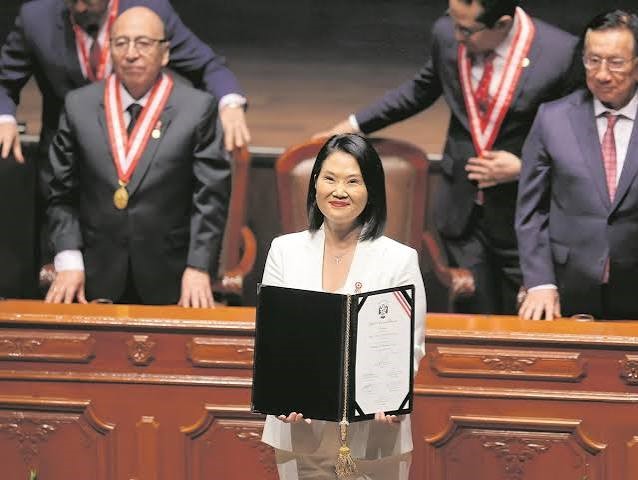
The arrival of Keiko Fujimori to the government activated this sector. One of its most visible expressions is Jorge Nieto Montesinos, a former presidential candidate, who proposed an agenda of «symbolic détente.» He proposes that the new government receive the families of the victims of state repression between December 2022 and January 2023, and that it promote political conditions to guarantee the stability of the next executive branch.
At first glance, listening to the families of those killed by the state and guaranteeing justice seems unquestionable. But the problem is that justice for the victims is incorporated into a political strategy that seeks to manage the crisis, not address its causes. Nieto’s «détente» does not question the power structures that made repression possible, nor does it center the political and criminal responsibilities of those who ordered and executed state violence. On the contrary, it seeks to build conditions to stabilize the return of Fujimorism without opening a deep debate on the responsibilities of the state.
Historically, the political center appears when social crises threaten to overflow the limits of the system. Its response is always the same: moderate the conflict, call for consensus, and rebuild trust in institutions that are not neutral but rather express power relations. That is why in recent months there has been a proliferation of forums on «recovery of democracy,» seminars on the «first hundred days of government,» and calls for «political responsibility.» The premise: the Peruvian crisis is primarily an institutional problem, not a consequence of deep social and economic inequalities.
But this view leaves out a fundamental issue: institutions are not neutral; they express power relations. The fragmented Congress, parties without social roots, labor precarity, territorial exclusion, and repression against those who question the established order are not simple defects of the system; they are mechanisms of a regime that sustains the domination of capital and keeps the popular majorities excluded.
The forum promoted by Flor Pablo Medina, congresswoman and former Minister of Education under Vizcarra, titled «How do we recover democratic institutionality?» is revealing. The question assumes that existing institutions contain the solution to the crisis. But those same institutions coexisted for decades with an economic model that deepened labor precarity, exclusion, and repression. The abstract defense of institutionality hides that the crisis arises not only from rules or procedures but from material conditions and power relations.
One must also observe the role of figures like Rosa María Palacios and other referents of Peruvian liberalism. Their interventions are presented as a defense of the rule of law and democracy, but they stop when the discussion reaches the economic structures that sustain the regime. Their criticism of authoritarianism does not usually extend to questioning the neoliberal model that produced exclusion, wealth concentration, and dependence on corporate power.
The reappearance of the political center is the response of sectors seeking to order the scenario opened by the return of Fujimorism, reduce social conflict, and ensure that power can govern without obstacles. But history shows that great social transformations were not born from agreements among elites or from consensus in academic forums. They emerged when workers, students, women, and indigenous peoples collectively burst in to question an order that seemed immovable.
Faced with the new Fujimorist government, the opposition cannot limit itself to waiting for institutional renewal or trusting in agreements among political sectors that share the need to preserve the stability of the regime. Nor can it reduce itself to accompanying a political center that seeks to make Fujimorism governable under the argument of avoiding a greater crisis.
The alternative is to build an independent opposition, capable of organizing the demands of those who live the consequences of the model: precarious workers, communities abandoned by the state, excluded indigenous peoples, students and young people without expectations for the future.
In a scenario where the new government will seek to sustain itself through alliances between the traditional right and sectors of the political center, the construction of a consistent opposition will depend on the capacity of popular sectors to organize independently. Not to restore consensus among elites, but to dispute the country’s direction from below.

keiko es lo unico sensato q le queda al peru para mi estos zurdos de mierda la quieren hacer pasar por dictadora pero ella es la unica q puede ordenar el desastre la moderacion es gilada hay q limpiar el congreso de roñosos vamos con todo carajo
Para mí esto del ‘centro político’ es puro maquillaje para la dictadura fujimorista. La ‘distensión simbólica’ de Nieto me parece un chiste de mal gusto, no tocan el poder real. Keiko es la misma derecha represiva de siempre, ahora pintada de modernos. ¡No les creo ni una, loco!