
There are debates that arise spontaneously and others that are manufactured. In recent hours, on the occasion of the semifinal between Argentina and England, one of those artificial debates that someone tries to install every so often has resurfaced: that this match constitutes «the classic» of Argentine football. It is not.
How could a rival with whom Argentina has played fewer than twenty official matches and friendlies throughout its entire history be a classic? Classics are not decreed from a television studio or a social network. They are built over decades of permanent confrontations, repeated competitions, sporting rivalries that both protagonists recognize as such. And in that sense, there is no doubt that Argentina’s football classic is Brazil. And for them, it is enough to ask Brazilians a simple question: What is your classic? The overwhelming majority answer will be: Argentina. Because that is how classics work. They are a mutual perception. The will or obsession of just one party is not enough to create them.
In fact, recent events completely dismantle the theory of the supposed «classic» with England. Just a few weeks ago, a significant portion of Argentines cheered for England to eliminate Mexico from the World Cup. It was no coincidence. It was a reflection of an uncomfortable reality for those who insist on the epic narrative: today, for many Argentines, the emotional bond with Mexico is far from what the rhetoric of «Latin American brotherhood» once promised. After countless snubs, insults, and episodes of hostility not only in sports, not a few preferred to see England advance rather than the Mexican national team.
However, those who maintain that England is Argentina’s true classic rival are not completely without foundation. What happens is that these foundations are not football-related. They are political. They are historical. They are cultural. And, for many, they are emotional.
The Falklands War left a deep wound whose dimension completely exceeds sports. Resentment, pain, and collective memory perfectly explain why a match against England generates an incomparable emotional charge.
But a political explanation does not automatically turn a sporting encounter into a football classic. And it is precisely there that a lesson emerges that transcends the pitch. Why dedicate a political column to discussing an apparently football-related issue?
Because something similar could happen in Argentine politics ahead of the 2027 elections. Javier Milei is probably one of the leaders with the greatest ability to inspire passionate support and equally intense rejection. His personality, his style, and his way of exercising power have built a leadership that also manufactures antagonists. And that is the risk.
That politics ceases to be organized around ideas and begins to be organized around a single mission: to defeat Milei.
At that moment, a completely artificial «classic» would be born. Not the classic between two historical projects of the country. But the classic between the native and the «foreignizing.» Between the gaucho and the foreign. Between a supposed national essence and everything that can be presented as «from outside.» An emotional narrative much more powerful than any economic discussion. There are already leaders trying to occupy that place.
Miriam Bregman, an illiterate who still seeks to establish the dictatorship of the proletariat, is perhaps the most evident example. Her thinking continues to vindicate ideological postulates that the vast majority of Western democracies abandoned decades ago. However, her growth in public image seems to be explained much less by mass adherence to her ideas than by her ability to represent rejection of Milei.
Can anyone seriously argue that Bregman is Javier Milei’s political «classic»? Hardly. Not because of the strength of her proposal. But because it is resentment toward the President that installs her as a reference for certain sectors.
Naturally, the example is deliberately exaggerated. Not because Bregman lacks political representation, but because it is difficult to imagine her competitively vying for the country’s leadership. But the mere fact that she can today be mentioned in that conversation demonstrates to what extent Milei’s figure has the ability to bring together on the same side sectors that share practically nothing except their rejection of him.
From this column we have warned several times what the true tragedy for Argentina would be. That the desire to punish one person ends up also condemning the only ideas capable of lifting the country out of its decline. That rejection of a leader leads to the restoration of those who emptied the state through corruption, or of those who still vindicate authoritarian models incompatible with a free society. Or, worse yet, both at the same time.
Football often offers extraordinary metaphors for understanding politics. This time is no exception.
Just as the supposed «classic» with England can only be sustained from a historical, political, and emotional explanation — but not from a football reality — there is also the danger that in Argentine politics, hatred ends up replacing ideas. And when that happens, societies stop choosing the best path and start choosing the most effective vehicle to discharge their resentment.
History shows that those who turn hatred into the main criterion for their decisions almost never end well. Not in football. And much less in politics.
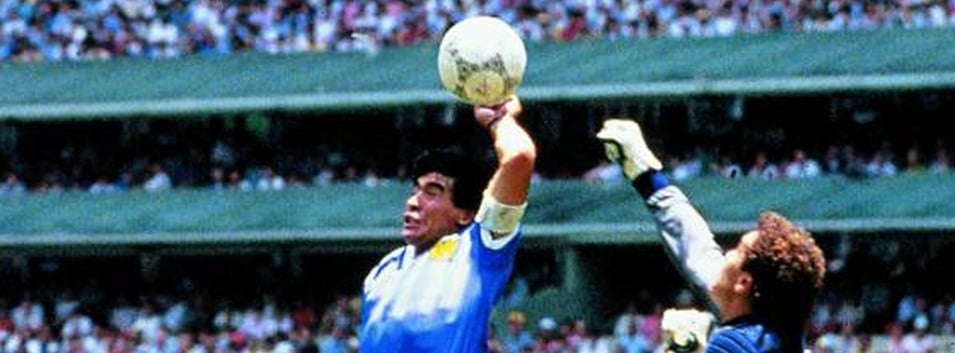
Argentina is a society that conspires against itself if it insists on having Maradona as a «national reference.» He was a footballer with extraordinary skills who knew how to exploit them to the fullest while he had physical and mental health, nothing more. That «philosopher of the potrero» or «the people’s player» does not clarify his dark attitudes toward many women nor regarding his support for dictators, autocrats, and mobsters. All kinds of transgressions were forgiven, including ethical and moral ones, and yet he is held up as an attitudinal stereotype of what it means to «be Argentine.» Being a big-mouthed bullshitter seems to be the «consensual» path for all those who continue to uphold him. From his addictions to his crimes against young people, including the Cuban minor Mesys Alvarez whom he brought from Cuba in a suitcase. Even the contradictions of supporting Menem and Cristina equally, including congratulating Cobos for his vote against the 125 law. Having scored one of the most beautiful goals ever seen in World Cups does not make him a respectable and exemplary person.



para mi el clasico es re invento como el odio a milei q nos quieren meter pero bldo malvinas y la dictadura no se olvidan los gor*s lloran x el campo nosotros vamos a recuperar la patria viva la izquierda milei y los ingleses son la misma mierda
para mi el clasico es una gilada inventada por politicos como el odio a milei ahora les duele q alguien piense distinto y quieren quemar todo inventate un enemigo para no pensar como siempre basta de resentimiento dejen gobernar argentina no es un partido de futbol