
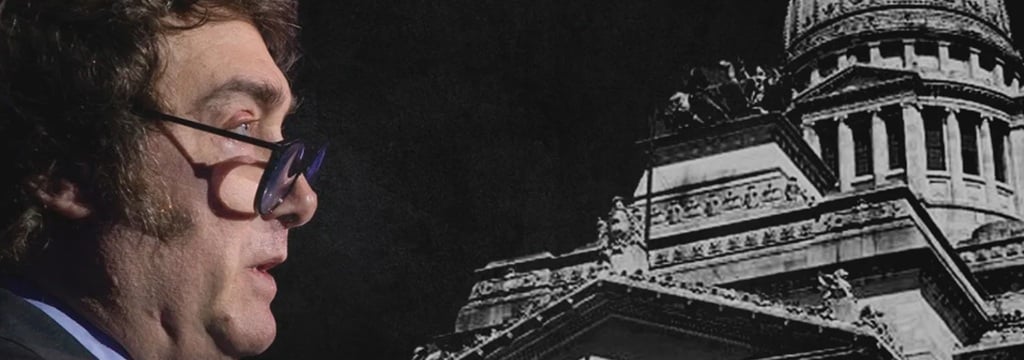
The Chamber of Deputies approved in an extended session two central projects for Javier Milei’s government: the reform of the Central Bank Charter and the Fiscal Innocence II bill. However, the opposition managed to place on the agenda debates that the government preferred to avoid, such as household over-indebtedness and the extension of the disability emergency.
A 15-and-a-half-hour session with mixed results
The session began after 11 in the morning and extended into the early hours of the next day. According to the newspaper Tribuna, the government celebrated the approval of the Central Bank reform with 144 affirmative votes, and that of Fiscal Innocence II with 139. A treaty on patents was also approved with 147 votes in favor.
But the mood changed when the opposition presented motions to set aside to deal with projects on the table. Two of them, the household debt and disability emergency, got 133 votes in favor, exceeding the 129 needed to enable a special session. The next day, the opposition called a session for September 9 to address both issues.
Government celebrates but acknowledges challenges in the Senate
President Milei celebrated the approval of the Central Bank reform, although he admitted that the Senate still needs to consider it. In a social media message, he posted: «Now, let’s fight for it in the Senate.»
The Fiscal Innocence II bill, promoted by the Ministry of Economy, seeks to expand the capital amnesty regime. According to the official statement from the Ministry, Minister Luis Caputo announced changes to «strengthen legal certainty» for taxpayers. Among the modifications, income and asset caps are eliminated to access the regime, and a minimum threshold is established so that the presumption of accuracy is not automatically broken.
Opposition manages to impose agenda and set the legislative pace
The day highlighted the opposition’s ability to unite and force debates. According to Tribuna, the opposition celebrated having changed the prevailing climate since the October elections, achieving a common agenda for the first time this year.
The government tried to downplay the event, showing a photo of an opposition press conference during the session and warning about an alleged electoral coalition among Peronists, the left, and other sectors. However, the special session called for September 9 represents a concrete challenge for the government.
Key documents and open questions
To understand the scope of what happened, it is necessary to cross-reference available sources. The newspaper Tribuna offers a detailed account of the session, while the Ministry of Economy details the proposed changes to the Fiscal Innocence Law. On the other hand, La Izquierda Diario analyzes the government’s repressive and discursive context, though it does not focus on the legislative session.
| Document | What it establishes | What it does not establish | Open questions |
|---|---|---|---|
| Ministry of Economy statement (primary source) | The changes to the Fiscal Innocence bill: elimination of caps, threshold of 5 million pesos, and deadlines for corrections. | It does not detail the outcome of the vote in the Lower House or the parliamentary debate. | How will these changes impact revenue? What will happen with «Large Taxpayers»? |
| Tribuna article (secondary source) | Chronicle of the session: votes obtained, duration, incidents, and the call for a special session. | It does not provide the full text of the bills or the details of the Fiscal Innocence changes. | What will happen in the September 9 session? Will they maintain the votes? |
| La Izquierda Diario article (secondary source) | Analysis of the government’s discourse on «enemies» and repression in protests. | It does not mention the Lower House session or the approved bills. | How does the security discourse relate to the legislative agenda? |
Value module: comparison of votes
According to Tribuna data, the affirmative votes were as follows:
- Central Bank reform: 144 votes.
- Fiscal Innocence II: 139 votes.
- Patent Treaty: 147 votes.
- IVA reduction on cassava: 231 votes (unanimity).
The difference between the project with the most support (231) and the one with the least (139) is 92 votes. This difference reflects greater consensus on issues of lower political conflict.
What to follow
The key point to follow is the special session called for September 9, where the opposition will try to address household over-indebtedness and the disability emergency. It will also be crucial to see how the government tries to defuse that session, and whether it can maintain the votes obtained in Wednesday’s session.
Fuentes consultadas
- Periódico Tribuna
- Argentina.gob.ar Fuente primaria
- La Izquierda Diario
El Sereno contrastó las fuentes enlazadas y añadió contexto, comparación o análisis documental. Las fuentes primarias están identificadas. La nota no se presenta como investigación de campo ni como entrevista propia, salvo indicación expresa.


Comentarios